


Prediction market prices are easier to read once you stop treating them like abstract odds. In a simple yes/no market, a price near 0.63 means the market is roughly saying “63% chance” for that outcome. That does not make the outcome certain. It only tells you where buyers and sellers are willing to trade right now.
This guide explains probability pricing in plain English: how prices map to implied probability, why the displayed number can differ from the price you actually pay, how fees and spreads change the cost path, and how to run small position-size examples before you trade. If you need the mechanics first, start with How Prediction Markets Work.
What a 0.63 Price Means
Most binary prediction market contracts settle to either 1.00 or 0.00. If the outcome happens, the winning side is worth 1.00 per contract. If it does not happen, that side is worth 0.00.
That bounded payoff is why the price can be read as an implied probability. A YES contract at 0.63 implies about a 63% market probability for YES. A YES contract at 0.27 implies about a 27% market probability. The same idea works in cents: 63 cents maps to 63%.
- 0.25: the market implies about a 25% chance. If YES resolves correctly, the contract is worth 1.00; if not, it is worth 0.00.
- 0.50: the market implies about a 50% chance. If YES resolves correctly, the contract is worth 1.00; if not, it is worth 0.00.
- 0.75: the market implies about a 75% chance. If YES resolves correctly, the contract is worth 1.00; if not, it is worth 0.00.
Price Is Not a Guarantee
A 75% market can still resolve NO. A 20% market can still resolve YES. The price is a live consensus estimate, not a promise from the platform and not a personal recommendation. Markets can be wrong because new information arrives, liquidity is thin, rules are ambiguous, or participants overreact to a headline.
That distinction matters for beginners. A contract at 0.80 does not mean “safe.” It means you are paying 80 cents to receive 1.00 only if that side resolves correctly. Your downside on that contract is still the amount paid, plus any trading costs that apply.
Displayed Price, Bid, Ask, and Spread
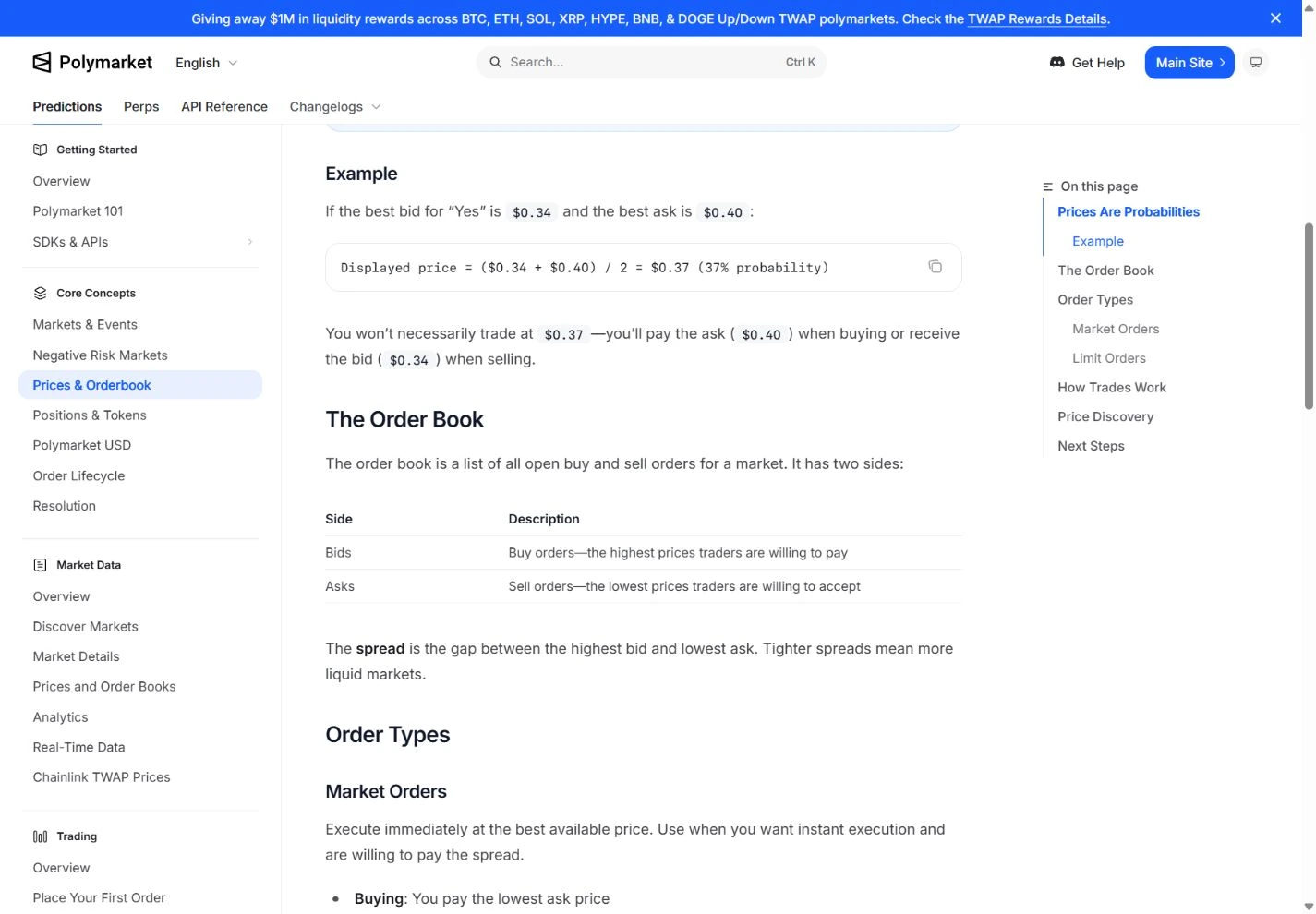
The number shown on a market page may be a midpoint or recent trade, but your real execution depends on the order book. Polymarket’s official documentation explains that prices are probabilities and that users trade through a central limit order book where the bid and ask can differ. Polymarket’s prices and orderbook guide is a useful official reference for this mechanic.
Use this simple version:
- Bid: the best current price someone is willing to pay.
- Ask: the best current price someone is willing to accept.
- Spread: the gap between bid and ask.
If the best YES bid is 0.62 and the best YES ask is 0.66, the midpoint is 0.64. But if you buy immediately, you may pay 0.66. If you sell immediately, you may receive 0.62. That spread is part of your real cost; the liquidity and spread guide shows how depth and execution friction change the price you can actually trade.
Fees Change the Break-Even Price
Spreads are not the only cost. Some platforms or market categories can also have trading fees, withdrawal costs, or other account-level costs. Polymarket’s current official fee documentation says fees are applied per market when enabled, and the fee can depend on price and category; always check the current market and platform terms before relying on an example. See Polymarket’s fees documentation for the official version of that platform-specific rule.
For learning purposes, keep the rule simple: if you pay 0.63, your break-even belief needs to be higher than 63% once spread, fees, and uncertainty are included. A small apparent edge can disappear after execution costs.
Expected Value in One Line
Expected value is the average result you would expect if the same kind of trade could be repeated many times. For a YES contract, a simplified pre-fee formula is:
Expected value per contract = your probability estimate x 1.00 – price paid.
If your estimate is 70% and the ask is 0.60, the simplified expected value is 0.70 x 1.00 – 0.60 = 0.10 per contract before costs. If your estimate is 55% and the ask is 0.60, the simplified expected value is -0.05 per contract before costs. The math is simple; the hard part is building a probability estimate you can defend.
Position-Size Examples: 10, 100, and 1,000 Dollars
The easiest beginner mistake is reading a price correctly and sizing the position badly. Here is a simple example using a YES price of 0.40 before fees.
- Spend 10 dollars at 0.40: about 25 YES contracts. Gross value is 25 dollars if YES resolves correctly; maximum loss is the 10 dollars spent before any extra costs.
- Spend 100 dollars at 0.40: about 250 YES contracts. Gross value is 250 dollars if YES resolves correctly; maximum loss is the 100 dollars spent before any extra costs.
- Spend 1,000 dollars at 0.40: about 2,500 YES contracts. Gross value is 2,500 dollars if YES resolves correctly; maximum loss is the 1,000 dollars spent before any extra costs.
The payout path scales quickly. So does the loss path. Use the YES/NO Contract Calculator to test price, cost, payout, and maximum loss before treating a market price as a trade idea.
Typical Beginner Mistakes
- Reading the midpoint as your execution price. The ask is what matters if you buy immediately.
- Ignoring the NO side. In a binary market, the opposite side often tells you whether the displayed YES price is realistic.
- Calling a high price safe. High probability still leaves real downside.
- Skipping rules and resolution. A good price can be a bad trade if the market question resolves differently than you expect. Read Market Resolution Explained before trading ambiguous questions.
- Confusing confidence with edge. You need a reason the market price is wrong, not just a strong opinion.
Where Probability Pricing Fits in the Learning Path
Probability pricing sits between basic mechanics and deeper analysis. Once you can translate 0.63 into 63%, the next step is asking whether that 63% is too high, too low, or about right. That is where Prediction Market Analysis becomes useful.
Source and Update Notes
This page uses official platform documentation for the order-book and fee mechanics it names. Examples are educational and simplified; they do not include every possible fee, liquidity, tax, jurisdiction, or account constraint. Last reviewed: 2026-07-04.
FAQ
Does 63 cents always mean exactly 63%?
No. It is a useful implied-probability reading, but the exact trading price depends on the bid, ask, spread, market depth, and fees.
Is a 90% market safe?
No. It may be more likely than a 20% market, but it can still resolve the other way. The amount you pay can still be lost.
Should beginners use probability pricing to pick trades?
Use it first to understand what the market is saying. A trade decision needs a separate source-backed reason why your probability estimate differs from the market.
For the broader sequence, return to the Guides hub.