


Short verdict: PredictIt is useful for eligible U.S. adults who specifically want political markets and understand its research-market structure. It is a poor fit for broad market coverage, large positions, low-friction withdrawals, or anyone who has not confirmed eligibility and current terms.
Last checked on 2026-07-26. This guide uses PredictIt official Terms and trading guidance, CFTC Letter 25-20, and a preserved public English screenshot. Start with our prediction markets beginner guide if contract pricing and settlement are new to you. No funded-account, KYC, deposit, withdrawal, or live-trade test is claimed.
PredictIt in One Screen
PredictIt is a focused political-market research venue, not a general prediction exchange or a shortcut around fees, rules, eligibility, and contract risk.
Who PredictIt Is For
- Eligible U.S. adults who want a politics-first market and are prepared to verify identity, account terms, and personal access.
- Readers who value a simple share model: prices from 1 to 99 cents, with the correct outcome redeeming at $1.
- Researchers and political-news followers who want to observe crowd prices or take limited positions.
- Beginners who will read each contract rule, use small educational examples, and include both profit and withdrawal fees in the decision.
Who PredictIt Is Not For
- Users who do not meet the current U.S. Person, age, identity, location, account, or other eligibility requirements.
- Traders who need broad sports, weather, entertainment, or crypto-event coverage rather than a political and limited economic-indicator focus.
- High-volume users who need large per-contract exposure or cannot tolerate profit, withdrawal, holding-period, and inactivity friction.
- Anyone who interprets CFTC staff no-action relief as a guarantee of legality for them, account access, market liquidity, settlement speed, or a winning outcome.
Fees and Withdrawal Friction
The official PredictIt Terms/FAQ capture checked on 2026-07-12 states a 10% fee on profits and a 5% withdrawal processing fee. It also records no account-opening or deposit fee, a minimum $10 account balance before trading, and a 30-day withdrawal holding period. Additional method-specific charges may apply. Our separate PredictIt fees and limits explainer keeps the detailed source record and more examples.
These charges affect different bases. The profit fee reduces a profitable position; the withdrawal fee then applies to the amount removed. A trader should therefore compare expected edge with both charges instead of reading a 60-cent purchase as a simple 40-cent net upside.
Worked Fee Example
Illustration only, based on the official fee capture checked 2026-07-12. It excludes taxes and any method-specific cost. Current Terms, fee rules, account screens, and market rules control.
Limits and Account Constraints
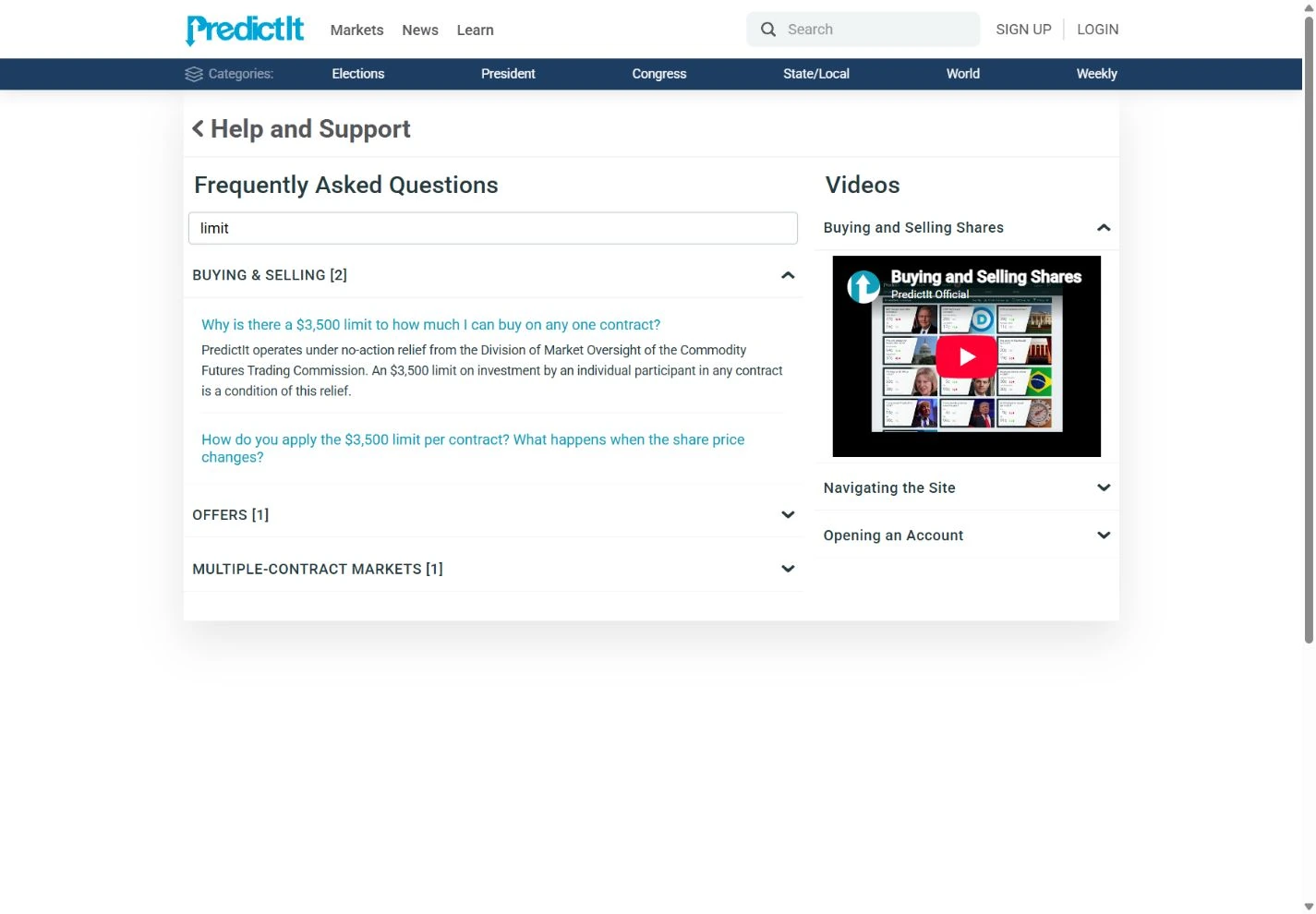
CFTC Letter 25-20 ties the single-participant investment limit in a particular contract to the FECA individual campaign-contribution limit. The letter states $3,500 as the amount current on 2025-07-14 and says the federal limit is adjusted for inflation every two years. Treat $3,500 as the amount documented at issuance, not an immutable platform promise; check the live Terms and the specific market page.
The amended letter removed the former 5,000-trader limit in a contract. PredictIt’s Terms capture also says withdrawal amount or frequency may be limited, additional identity or financial information may be requested, and a $2 monthly inactive-account fee may apply after 12 months without activity when a positive balance remains.
Political Market Focus
PredictIt’s narrowness is part of the product. Letter 25-20 permits political events and significant political questions—including elections, nominations, confirmations, official departures, court decisions outside criminal proceedings, legislation, executive actions, and certain international-agency actions—while excluding questions involving war, terrorism, or assassination. Earlier economic-indicator permission remains in place.
A public example is a multi-outcome question about which party will control the U.S. House after the 2026 midterms. Each displayed price changes as traders buy and sell; it is a market estimate, not an editorial forecast or certainty. Always read the market’s exact close and resolution wording.
How a PredictIt Contract Works
PredictIt’s public trading guide describes shares priced between 1 and 99 cents. A 60-cent Yes share costs $0.60. The trader may sell before close as the quoted price changes, or hold through settlement. If Yes is correct, the share redeems at $1; if it is wrong, the Yes share has no payout. A multiple-outcome market contains separate contracts for the listed possibilities.
Price is not enough. Before buying, identify the exact question, close condition, official resolution source, edge cases, and expected settlement timing. Our market-rules checklist shows what to inspect.
Beginner Concerns
- Price is not certainty: 70 cents expresses a market price, not a guaranteed 70% truth or payout.
- Fees can erase a small edge: model the profit fee and later withdrawal fee before deciding whether the trade is worthwhile.
- Limits do not cap every loss: a wrong contract can still settle with no payout for that side.
- Exit liquidity matters: a visible price does not guarantee that the desired quantity can be sold immediately at that price.
- Rules decide settlement: a correct political intuition can still lose if it does not match the written contract condition.
- Access is personal and time-sensitive: this guide cannot confirm that a specific reader may open or use an account.
What I Checked for This Guide
- PredictIt Terms/FAQ capture for fees, holding period, account minimum, inactivity, eligibility, and withdrawal caveats.
- PredictIt public trading guide for pricing, buying, selling, redemption, multiple-outcome contracts, and rule-reading flow.
- CFTC Letter 25-20 for the operating entity transfer, conditional no-action framework, trader-limit removal, contract cap, and allowed political scope.
- The July 2026 CFTC record describing PredictIt as a market operating under the amended staff no-action position.
- Preserved public screenshot evidence for visible market categories and cards; no logged-in account or money movement was tested.
Testing and Screenshot Status
Testing was limited to official-source review, public-page inspection, preserved public screenshot evidence, and rendered page QA. EventTradingHub did not complete PredictIt identity verification, fund an account, place or settle a trade, test support, deposit, withdraw, confirm a personal tax result, or determine a reader’s legal eligibility.
Visual proof
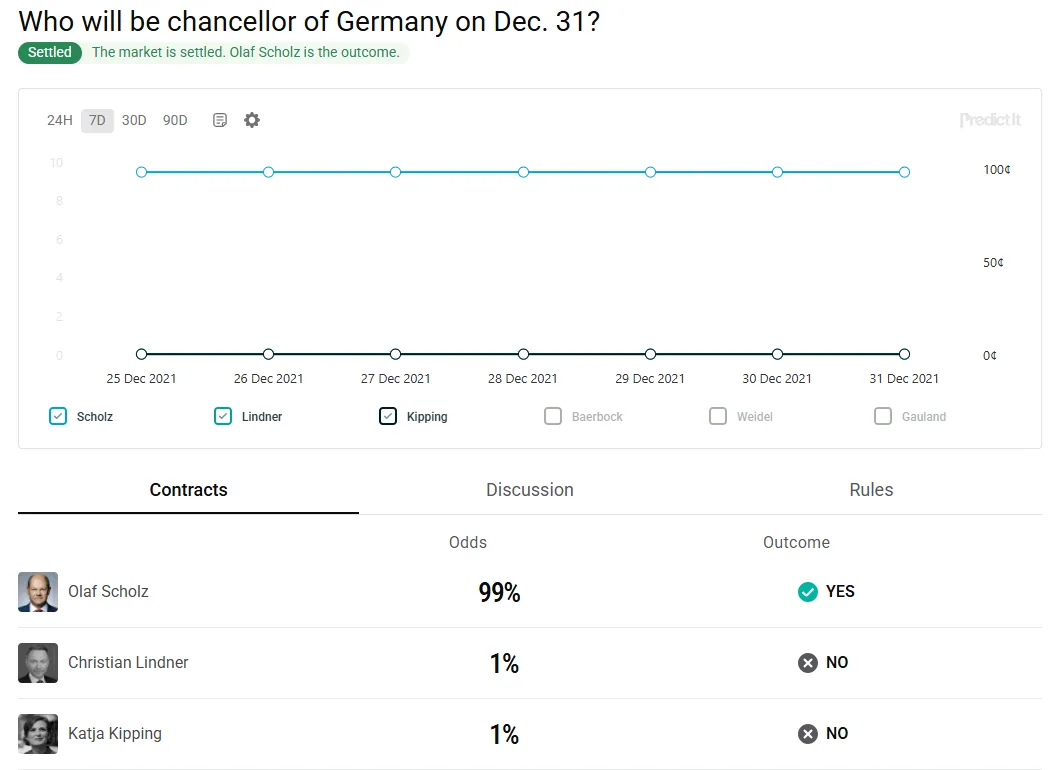
Visual Proof From This Review Pass
This image was captured for SEO plan item 4.5 to make the review/tool evidence more concrete without exposing private account data.
PredictIt vs Kalshi vs Polymarket
- PredictIt: strongest fit for a focused U.S. political-market experience under conditional CFTC staff no-action relief; the main tradeoffs are fees, limits, eligibility, and narrow scope.
- Kalshi: a CFTC-designated contract market with a broader event catalog and exchange-style fee/order-book considerations; see the Kalshi review.
- Polymarket: a separate crypto and product/jurisdiction context with wallet, dispute, and availability questions; see the Polymarket review.
This comparison is neutral editorial context, not a recommendation or paid placement. The right research path depends on eligibility, available markets, rules, fees, liquidity, funding, custody, resolution process, and risk tolerance.
Practical Worksheet
Original value worksheet
PredictIt fee and limit review worksheet
This block is a reader workflow for the exact PredictIt questions that often matter before a trade: how the market works, what costs apply, and whether a limit changes the practical setup.
Beginner mistakes
Beginner Mistakes to Avoid
PredictIt research has extra friction because platform scope, rules, and public materials can matter as much as the headline event.
- If official text is unavailable or unclear, keep the claim cautious rather than filling the gap.
- Do not compare PredictIt to broader platforms without separating scope, constraints, and current source status.
Disclosure
EventTradingHub has no approved affiliate, referral, sponsored, or paid-placement relationship on this page. PredictIt, Kalshi, Polymarket, and CFTC references are evidence or comparison context only. Editorial conclusions were not supplied or approved by a platform.
Event Trading Hub Review Methodology: this guide follows the review methodology for source quality, evidence limits, update cadence, platform comparisons, screenshots, and disclosure handling.
Risk Disclaimer
Prediction-market contracts involve financial risk and can settle with no payout for the losing side. You can lose money. This guide is educational research, not financial, investment, legal, tax, eligibility, or trading advice. Check current platform Terms, fees, limits, market rules, resolution criteria, account screens, availability, and applicable law before using real money.
Official Sources Checked
- PredictIt Terms and Conditions — fee, account, withdrawal, eligibility, and operating terms captured on 2026-07-12 and rechecked for this guide.
- PredictIt FAQ — fees — official fee explanation used in the 2026-07-12 source capture.
- PredictIt — How to Trade on PredictIt — public pricing, buying, selling, redemption, and market-rule workflow.
- CFTC Letter 25-20 — amended no-action conditions, entity transfer, trader-limit removal, FECA-linked investment limit, and political-contract scope.
- CFTC 2026 prediction-markets proposal — current regulator context that continues to describe PredictIt under the amended staff no-action position.
Update History
- 2026-07-26: rebuilt for SEO plan item 7.4 with a first-screen verdict, fit/not-fit, current official-source status, fees, limits, political focus, examples, beginner concerns, comparison, screenshot evidence, methodology, disclosure, and risk disclaimer.
- 2026-07-12: official Terms, FAQ, and CFTC evidence rechecked for the dedicated fees-and-limits explainer.
- 2026-07-04: added evidence/status blocks, update-log structure, original-value worksheet, visual proof, What I Checked coverage, and beginner-mistake guidance.
Frequently Asked Questions
Is PredictIt a CFTC-registered exchange?
Do not use that shortcut. PredictIt operates under conditional CFTC staff no-action relief, amended by Letter 25-20. That is different from describing PredictIt itself as a CFTC-designated contract market.
What are PredictIt’s main fees?
The official source capture checked on 2026-07-12 states a 10% fee on profits and a 5% withdrawal processing fee. Check the current Terms and account screen because fees and method-specific costs can change.
Is the PredictIt contract limit always $3,500?
No fixed forever claim is justified. CFTC Letter 25-20 states $3,500 at issuance and ties the limit to an FECA amount adjusted for inflation every two years. Verify the current official amount and market page.
Can anyone in the United States use PredictIt?
This guide cannot say that. The official Terms source capture limits access to eligible U.S. Persons aged 18 or older, while identity, account, location, platform-policy, and other restrictions can apply. Exact state and territory availability was not fully reverified.
What should a beginner check first?
Confirm personal eligibility, read the complete market rule and resolution source, inspect the price and available quantity, calculate both fee layers, check the current contract cap, and decide in advance whether the position will be held or sold.
Risk notice
Prediction markets involve risk
Prediction markets and event contracts involve financial risk. You can lose money, including the full amount committed to a contract.
Event Trading Hub is for education and research only. This is not financial, investment, legal, or tax advice. You are responsible for your own decisions and for checking platform rules, fees, availability, and local regulations before trading.