


Prediction market fees are hard to compare because platforms do not all charge the same kind of cost. One venue may charge a formula-based trading fee. Another may charge a fee only on profitable sales. Another may show the fee only in the live order ticket.
This guide compares the fee structures a beginner is most likely to encounter across Polymarket, Kalshi, and PredictIt, then shows how the same $10, $100, or $1,000 amount can lead to very different costs depending on whether the fee is tied to trade size, profit, withdrawal, or the market ticket.
Quick Answer
There is no single prediction-market fee model
Fee Comparison Table
The table below is intentionally conservative. It does not rank platforms or say one venue is cheaper in every case. It separates the main fee type, what to check before using it, and where the public source status is strongest.
| Platform | Trading Fee | Withdrawal Fee | Profit Fee | Limits | Last Checked | Source |
|---|---|---|---|---|---|---|
| Polymarket | Varies by category | Platform: $0 | No separate fee | By market | 2026-07-18 | Help docs |
| Kalshi | Formula | By method | No separate fee | By market | 2026-07-18 | Help docs |
| PredictIt | Profit-based | 5% processing | 10% profit | By account/market | 2026-07-18 | FAQ |
Fee details
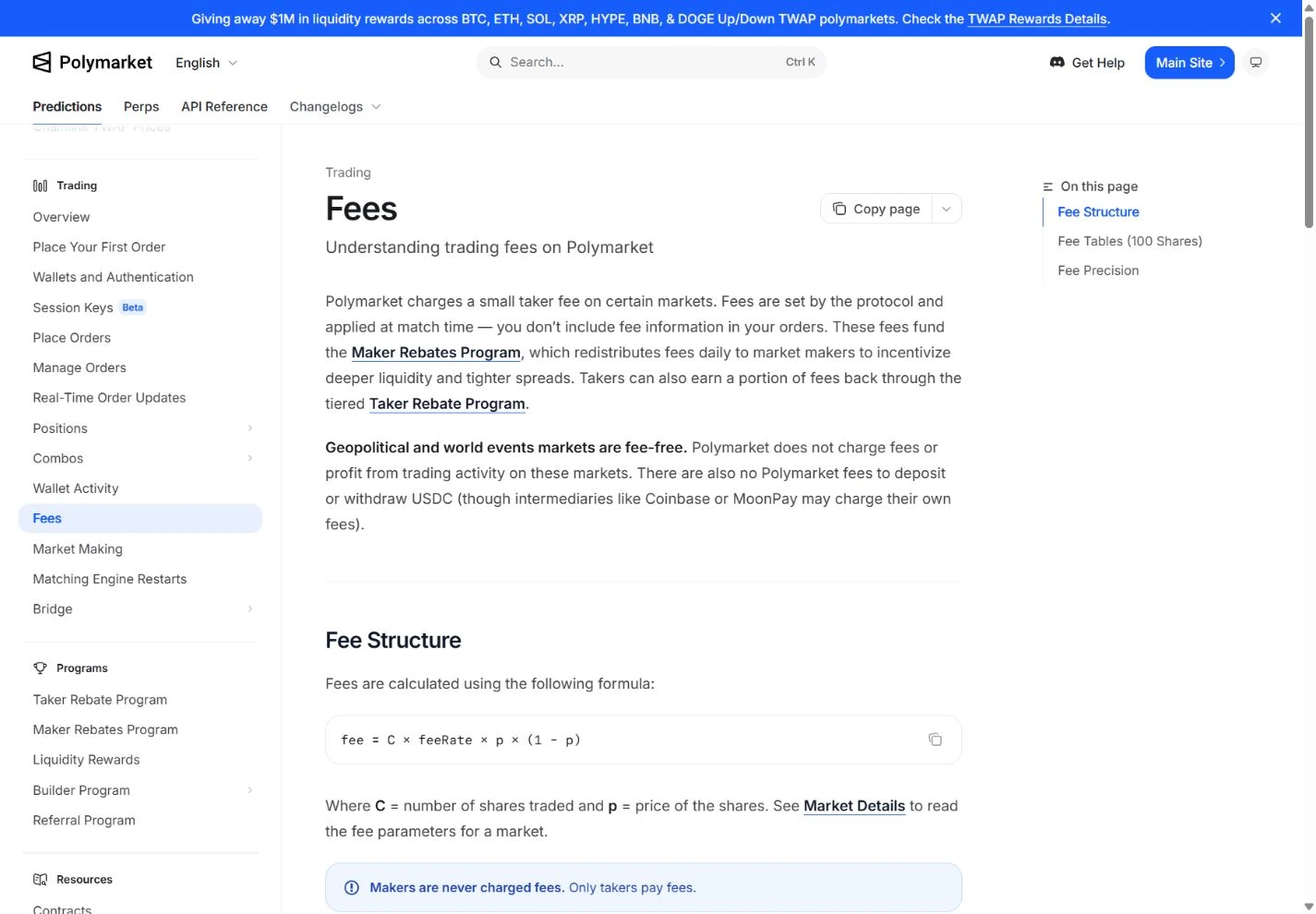
- Polymarket: official help lists category-dependent taker fees, including a 4%-7% fee-rate parameter for fee-bearing categories. The actual amount can vary by share price; makers are listed at 0, and geopolitical markets are listed as fee-free. Polymarket does not list its own USDC deposit or withdrawal fee, but exchanges or payment providers may charge separately.
- Kalshi: trading fees are formula-based and tied to expected contract earnings. Some markets can have different fees or maker-fee treatment, so the live order ticket and current official schedule should be checked before trading. Withdrawal cost depends on the selected method and payment rail.
- PredictIt: the retained official FAQ record documents a 10% fee on profit from profitable share sales and a 5% withdrawal processing fee. Payment-rail details, availability, and account limits should be rechecked against current platform terms before use.
Examples: $10, $100, and $1,000
These examples are not predictions and not advice. They are a worksheet for seeing how fee type changes the math. They ignore bid/ask spread, price movement, taxes, chargebacks, market-specific exceptions, and any unsupported current fee changes.
Example 1: Kalshi-style formula fee at a 50 cent price
For a simple midpoint illustration, use the standard source-note formula shape: 7% x contracts x price x (1 – price). At a 50 cent price, a $10 order is about 20 contracts, a $100 order is about 200 contracts, and a $1,000 order is about 2,000 contracts.
| Trade size | Approx contracts at 50 cents | Illustrative fee | Why it changes |
|---|---|---|---|
| $10 | 20 | About $0.35 | Fee scales with contracts and price probability. |
| $100 | 200 | About $3.50 | Ten times the notional means roughly ten times this simplified fee. |
| $1,000 | 2,000 | About $35.00 | A large trade can make the fee meaningful even before spread. |
Always treat the live ticket as the authority. The example is for understanding fee shape, not for replacing the platform’s displayed fee.
Example 2: PredictIt 10% profit fee and 5% withdrawal fee
PredictIt is easier to model because the common source-note fee is attached to profit and withdrawal rather than a market-category ticket. If a profitable sale creates $10, $100, or $1,000 of profit, a 10% profit fee would be:
| Profit or withdrawal amount | 10% profit fee | 5% withdrawal fee | Beginner takeaway |
|---|---|---|---|
| $10 | $1.00 | $0.50 | Small wins can still lose visible value to fees. |
| $100 | $10.00 | $5.00 | Profit fee and withdrawal fee are separate concepts. |
| $1,000 | $100.00 | $50.00 | The percentage looks simple, but the dollar cost becomes material. |
Example 3: Polymarket category-dependent fees
Polymarket is not safe to flatten into one universal percentage. The fee question is market-specific: is the category fee-free, is a taker fee enabled, and are there third-party or network costs around funding or withdrawal?
- $10 trade: a fee-free market may show no platform trading fee, but a small third-party funding cost can still matter relative to the position size.
- $100 trade: if a taker fee is enabled, check the ticket rather than applying a generic sitewide fee assumption.
- $1,000 trade: even a small percentage, spread, bridge cost, or network cost can become large enough to affect whether the trade still makes sense.
What Fees Do Not Include
A fee table can still understate the true cost of entering or exiting a prediction market. Before comparing platforms, separate these costs:
How To Use This Page
Use this page as a starting checklist, not as a substitute for official platform screens. For platform-level context, compare the source-backed records in the Prediction Market Platforms database. For a single YES/NO position, model stake, payout, and maximum loss with the YES/NO Contract Calculator.
Quick answers
Prediction Market Fees FAQ
Method
Source and Methodology Notes
Last updated: July 18, 2026. This page uses official-source records from EventTradingHub’s platform database work and the July 2026 review-source pass. The review methodology explains how platform facts and update dates are checked. Fees, funding, withdrawal rules, and market categories can change, so the official page and the live order ticket should win over any static explainer.
- Polymarket fee wording is based on official Polymarket trading fee help and is kept category-dependent instead of universal.
- Kalshi fee wording is based on official Kalshi fee help plus the official Kalshi deposits and withdrawals collection for money-movement caveats.
- PredictIt fee wording is based on the official PredictIt fee FAQ as recorded in source notes. Current funding rails are treated as partial rather than overclaimed.
This is educational content, not financial, legal, tax, or trading advice. It does not recommend a platform and does not contain affiliate, sponsored, or referral links.
For the broader learning sequence, return to the Guides hub.