


Short verdict: Polymarket is strongest as a crypto-native market-discovery venue for readers who already understand wallets, stablecoins, order books, and rule-based resolution. It is not my default beginner pick for someone who wants bank-style funding, a simple U.S. regulated-exchange story, or zero crypto friction.
Last checked on 2026-09-06. This review uses current official Polymarket documentation, a dated market-interface capture, the official changelog capture, and internal comparison notes. It does not claim a funded-account test, completed KYC, a live deposit, a live withdrawal, an executed trade, or personal legal eligibility.
Review Verdict: Polymarket in One Screen
| Review field | Current take |
|---|---|
| Overall verdict | Useful for crypto-comfortable users who want broad event-market coverage and can read market rules before trading. Weak fit for readers who want ordinary bank rails or a single simple U.S. availability answer. |
| Best for | Market observers comparing public-interest, sports, crypto, weather, culture, tech, politics, and other event categories where Polymarket access is available. |
| Not for | Anyone who cannot tolerate wallet/network mistakes, ambiguous resolution rules, regional restrictions, or dispute timing. |
| Biggest upside | Market breadth and active public order books make it useful for learning how event prices react to news. |
| Biggest risk | The product combines trading risk with crypto operational risk and UMA-resolution/dispute risk. |
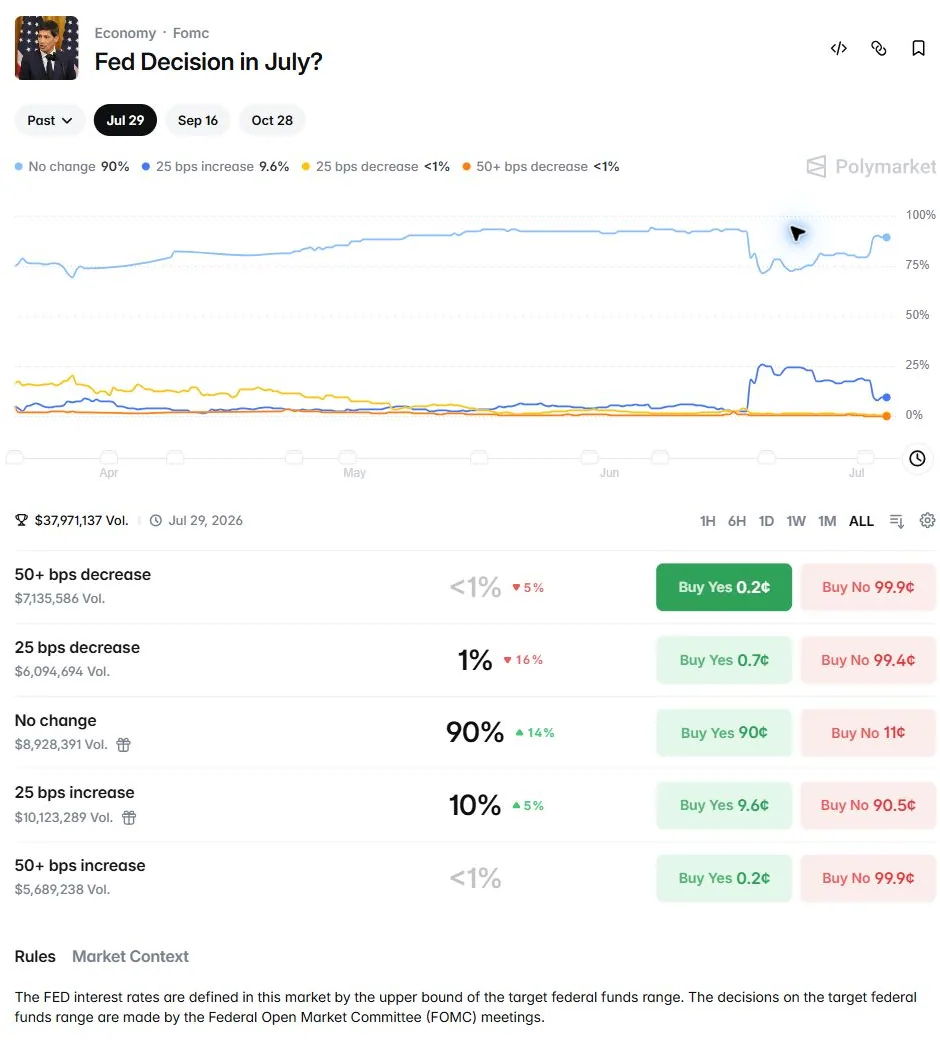
| Evidence status | Official-source refresh completed 2026-07-23; screenshot block was captured 2026-07-04 from a public English market-detail screen. |
| Disclosure | No affiliate, referral, sponsored, or paid placement link is used in this review. |
Who Polymarket Is For
- Readers who already understand that token, wallet, network, and deposit-address choices are part of the product experience.
- Users who want broad market variety and are willing to compare liquidity, spread, volume, market rules, and resolution source before acting.
- Researchers who use prediction markets as a way to watch news expectations move, not as a forecast guarantee.
- Crypto-comfortable users who can verify whether their physical location and local rules allow the activity.
Who Polymarket Is Not For
- Beginners who want only ACH-style funding, ordinary brokerage-like account language, or no wallet/network decisions.
- Users in restricted or uncertain locations, including readers who would need a VPN or proxy to access trading.
- Anyone looking for a universal no-fee claim; Polymarket’s official fee page now describes category-dependent taker fees.
- Anyone who does not want to read the written market rules, resolution source, end date, and edge-case wording before trading.
Fees and Funding Costs
- Trading fees: official Polymarket documentation says taker fees apply on certain markets, makers are not charged, and the parameters differ by category and market.
- Price effect: the documented formula makes the fee for a given category highest around a 50% price and lower toward the extremes.
- Funding friction: deposits and withdrawals can involve bridge, conversion, gas, supported-asset, minimum-amount, or third-party costs even when Polymarket does not add a platform fee.
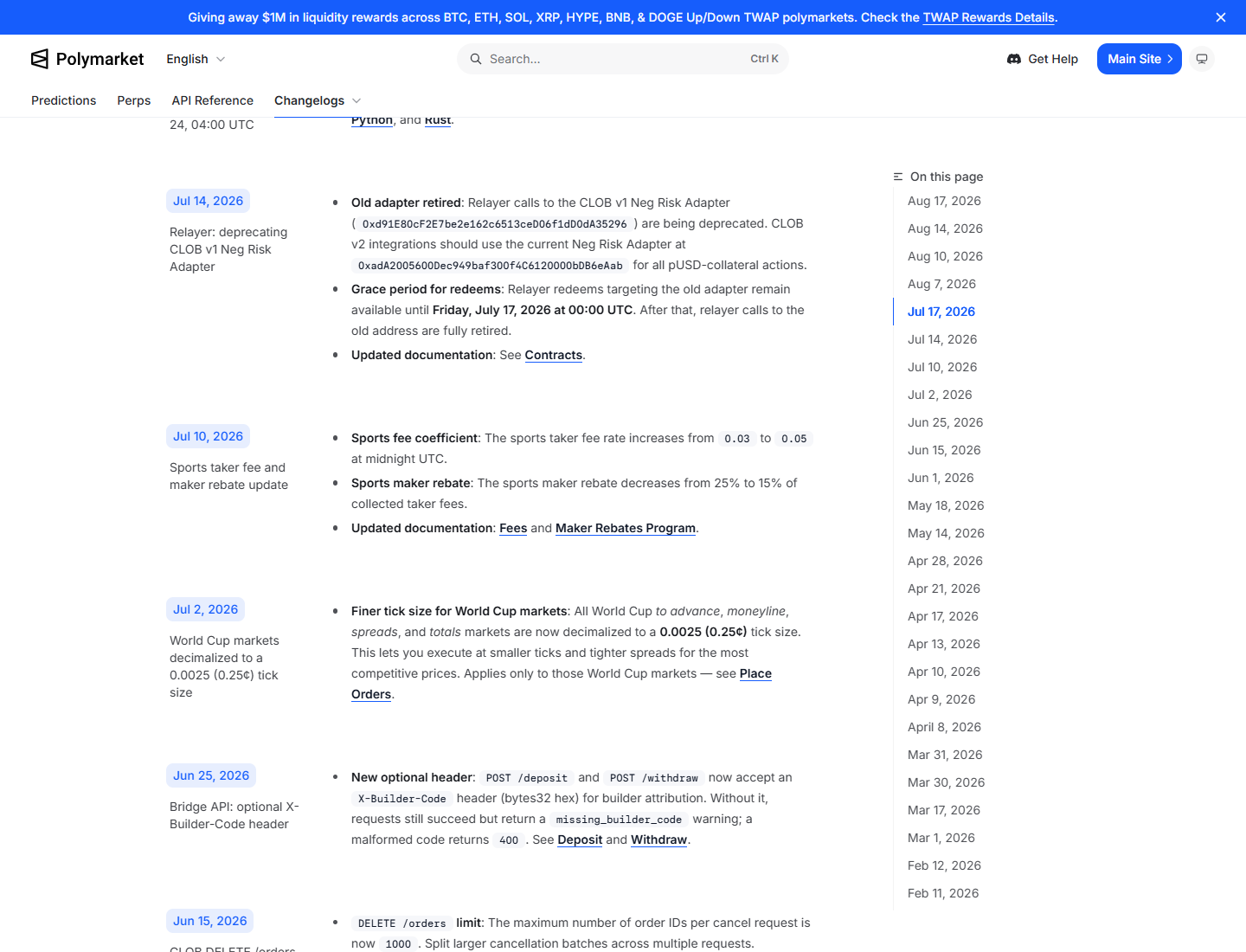
- Evidence limit: the dated changelog screenshot below records one sports fee/rebate change; it is not a universal or permanent fee table. Check the live market and official fee documentation before trading.
- Use the prediction-market fee comparison for cross-platform context. No funded transaction was performed for this review.
Liquidity And Market Variety
Polymarket’s practical advantage is breadth: many categories can appear on one marketplace, and active order books make event probabilities easy to inspect. The review question is whether a specific contract has enough depth, a reasonable bid/ask spread, and rules you understand. A busy market can still be a bad entry if the spread is wide or the event wording is fragile.
Polymarket’s price help explains that displayed prices are tied to order-book supply and demand, including bid/ask midpoint behavior. That means the price is a traded estimate, not a promise, and not an editorial endorsement. For mechanics, use the internal liquidity and spread guide.
Funding And Crypto Wallet Friction
- The official deposit flow requires choosing a deposit method, token, network, and profile-specific deposit address.
- Polymarket warns users to verify address and network details and to test small amounts before larger transfers.
- Deposits below stated network minimums can remain pending until cumulative amounts meet the required threshold.
- Withdrawals require a recipient address plus token, amount, and network selection.
- The review therefore treats Polymarket as materially more operationally complex than a simple bank-funded beginner product.
Resolution Process
- Polymarket documents UMA’s Optimistic Oracle as the resolution mechanism for markets.
- The market title is not enough. The rules define the resolution source, end date, and edge cases.
- A proposed result enters a challenge period. If it is not disputed, it can resolve after that challenge window.
- If disputed, the process can move through additional proposal, debate, and UMA voting steps before finalization.
- For a deeper walkthrough, read Polymarket disputes and UMA resolution explained.
Dispute Risks
The main dispute risk is timing and ambiguity. A market can look obvious to casual readers while the written rules, source choice, or edge case make the final outcome non-obvious. Polymarket’s help says finalized UMA outcomes are immutable, so a trader cannot assume the platform can simply reverse a disliked result.
Clarifications are another risk. Polymarket’s clarification help says rule clarifications can clear the order book and cancel resting orders. That is useful context for anyone leaving passive orders in markets where wording may need extra context.
Real Examples I Used For This Review
| Example | What it tests in this review |
|---|---|
| Trump 2024 U.S. presidential-election markets | Tests why whale concentration, intense public attention, liquidity, and late-cycle rule reading matter. This is used as a market-behavior example, not as a trading recommendation. |
| Iowa Selzer poll on 2024-11-02 | Tests whether a reader understands that one surprising data point can move market attention without proving the final outcome. |
| Bitcoin $100k milestone on 2024-12-05 | Tests the crypto-native side of the platform: category interest, fast repricing, and the need to separate event odds from token-transfer friction. |
| Super Bowl LIX, Eagles 40 Chiefs 22 on 2025-02-09 | Tests sports-market resolution clarity, post-event settlement expectations, and the difference between a clear final score and the written contract rules. |
Evidence: interface, rules, and fee changes
These screenshots document specific interface facts. They support the review; they are not a substitute for checking the live market, current fee page, full rules, and regional eligibility.
Compare Polymarket With Kalshi And PredictIt
Comparison note: this section is comparison context, not a paid placement, affiliate recommendation, or instruction to use a different platform. Kalshi and PredictIt appear here only as alternatives a reader may compare after reading the Polymarket-specific review above.
Kalshi is included as a U.S.-regulated comparison point; that does not make it automatically safer, cheaper, more liquid, or better for every user. Regulation does not remove fees, liquidity limits, eligibility limits, market-rule risk, or resolution risk.
- Kalshi: use it to compare Polymarket’s crypto-native user experience with a U.S.-regulated exchange model and clearer bank/debit/crypto funding categories. Caveat: This is not an endorsement; regulation does not remove market, liquidity, fee, eligibility, or resolution risk.
- PredictIt: use it to compare a narrower politics-focused venue with Polymarket’s broader all-category event marketplace. Caveat: the scope is narrower than a broad prediction-market venue.
- Platform database: use it for side-by-side checks on availability, funding, regulation, fees, screenshots, and source status. Caveat: treat every row as a starting point for current official-source verification.
- Availability tracker: use it for country/state access caveats before assuming a platform is usable from a location. Caveat: it is not legal advice and does not tell a specific user whether they personally may trade.
Beginner Risks and Mistakes
The beginner risk is the combined effect of price, spread, funding path, regional restrictions, written rules, and dispute timing. Use this compact stop-check before acting.
- Do not trade from the headline or screenshot; read the full live rules and named resolution source.
- Do not treat high volume as proof of a safe entry, reliable outcome, or tight spread.
- Verify wallet, network, supported asset, minimum amount, and withdrawal route before sending funds.
- Check current geographic restrictions directly; do not use a VPN or proxy to bypass them.
- Reduce exposure or skip the market when wording, source hierarchy, or dispute treatment is unclear.
Disclosure
EventTradingHub has no approved affiliate, referral, sponsored, or paid-placement relationship on this page. Official Polymarket links are source links only. See the site Disclosure page for the broader policy.
Review methodology: this page follows the Event Trading Hub Review Methodology for platform criteria, source checks, update cadence, fee/rule changes, and disclosure handling.
Official Sources Checked
- Polymarket fees — per-market/category fee logic and maker/taker treatment.
- Polymarket deposit documentation — supported bridge flow, assets, minimums, and loss warnings.
- Polymarket geographic restrictions — official location-checking and restriction status.
- Polymarket resolution documentation — sources, end dates, edge cases, proposal, challenge, and dispute flow.
Update History
- 2026-09-06 — article-template pilot: consolidated duplicated evidence/risk blocks, refreshed official source links, and added a second dated interface proof.
- 2026-07-24 — neutralized cross-platform comparison and fixed mobile comparison layout.
- 2026-07-23 — rebuilt the review with verdict, fit, costs, funding, resolution, disputes, examples, disclosure, and official sources.
Frequently Asked Questions
Is Polymarket best for beginners?
Not universally. It can be useful for crypto-comfortable users, but a first-time prediction-market reader should understand wallet setup, network selection, fees, liquidity, rules, and dispute risk before using real money.
Does Polymarket have fees?
Yes, on certain markets. The current official fee help describes category-dependent taker fees, maker rebates, fee-free geopolitical/world-event markets, and third-party/intermediary caveats.
Can I fund Polymarket like a normal bank account?
This review treats Polymarket as crypto/stablecoin based. The official deposit and withdrawal help uses token, network, and address flows, so users should not assume it behaves like a bank-only product.
What is the biggest Polymarket review risk to understand?
The biggest review risk is combining several risks into one simple brand impression. A user has to check market rules, source, spread, fee path, funding path, availability, and resolution/dispute mechanics separately.
Risk notice
Prediction markets involve risk
Prediction markets and event contracts involve financial risk. You can lose money, including the full amount committed to a contract.
Event Trading Hub is for education and research only. This is not financial, investment, legal, or tax advice. You are responsible for your own decisions and for checking platform rules, fees, availability, and local regulations before trading.