


Short verdict: Kalshi is a credible CFTC-regulated event-contract exchange with an inspectable order book and multiple funding rails. It is not automatically available or suitable for every user, and regulation does not remove contract-loss, fee, spread, rule, settlement, or operational risk.
Last checked on 2026-07-26. This review uses Kalshi help/legal pages, the current July 2026 fee schedule, a CFTC designation order, and a preserved public English screenshot. It does not claim a funded account test, completed KYC, live deposit, live withdrawal, live trade, personal legal eligibility, or tax advice.
Review Verdict: Kalshi in One Screen
Kalshi is worth evaluating when regulation, an order book, and region-appropriate funding rails matter. It is not a shortcut around contract risk, fee checks, market rules, liquidity, or eligibility.
Who Kalshi Is For
- Readers who specifically value a CFTC-regulated Designated Contract Market structure and understand that regulatory oversight is different from outcome protection.
- Users who prefer an exchange-style order book and are prepared to compare bids, asks, spread, available quantity, and fee before placing an order.
- Event-focused researchers interested in economics, politics, weather, sports, entertainment, technology, and other categories visible on the public browse interface.
- Beginners willing to slow down, read the written market rules, confirm the official resolution source, and start with educational observation before risking money.
Who Kalshi Is Not For
- Anyone who interprets CFTC regulation as a guarantee that a contract cannot lose or that every market will be liquid.
- Users who need one universal fee percentage, one fixed position limit, or one funding method that works in every location.
- Readers who want to trade without identity checks, account approval, jurisdiction checks, or market-specific rules.
- Anyone who cannot tolerate delayed official data, an unfilled limit order, slippage on a quick order, or the possibility that the contract settles against the position.
Regulation: What the CFTC Status Does and Does Not Mean
KalshiEX LLC is designated by the U.S. Commodity Futures Trading Commission as a contract market. The CFTC’s amended 2025 order says the exchange remains subject to the Commodity Exchange Act, DCM Core Principles, and applicable Commission regulations. That is a meaningful structural distinction from an unregulated venue.
The limit of that claim matters just as much. DCM status does not guarantee a winning outcome, a tight spread, instant settlement, universal access, a particular payment rail, or a fixed fee. Kalshi’s own Member Agreement describes event-contract trading as speculative and warns that fees, volatility, lack of bids/offers, and system failures can add risk.
Availability and Eligibility
The old “U.S.-only” shortcut is no longer accurate. Kalshi says individual access is available from many countries, while its Member Agreement still lists restricted jurisdictions and gives the exchange discretion to approve, condition, suspend, or deny access. Applicants must be at least 18 and may be asked for identity documents.
Funding options also differ by location: U.S. bank transfers are not the same as the debit, wire, or crypto paths described for some international users. Check the current Member Agreement, account flow, and the source-backed platform availability tracker. This review is not legal advice and cannot tell a specific reader whether they may trade.
Fees With July 2026 Examples
Kalshi does not use the old flat “percentage of profit” description. Its July 2026 event-contract schedule calculates the general immediately matched trading fee from contract count, price, expected earnings, and the applicable multiplier. Some listed series use different or zero maker/taker multipliers, so the live order ticket and current schedule are the final checks.
Official schedule examples effective 2026-07-07. They are not universal quotes: specific series can use different maker/taker multipliers. Spread, slippage, payment-rail costs, taxes, and perpetual-futures fees are separate.
- Resting orders: they generally avoid the immediately matched fee, but maker fees apply where the schedule assigns a non-zero maker multiplier.
- Settlement and membership: the July 2026 schedule lists no settlement fee and no membership fee.
- ACH: the schedule lists no Kalshi ACH deposit or withdrawal fee for U.S. bank transfers.
- Debit and crypto: card deposits can carry up to a 2% processing fee; third-party or network costs can apply to crypto and other rails.
- For maintained cross-platform context, use the prediction-market fee comparison rather than assuming one venue is cheapest in every scenario.
Market Types, Liquidity, and Order-Book Friction
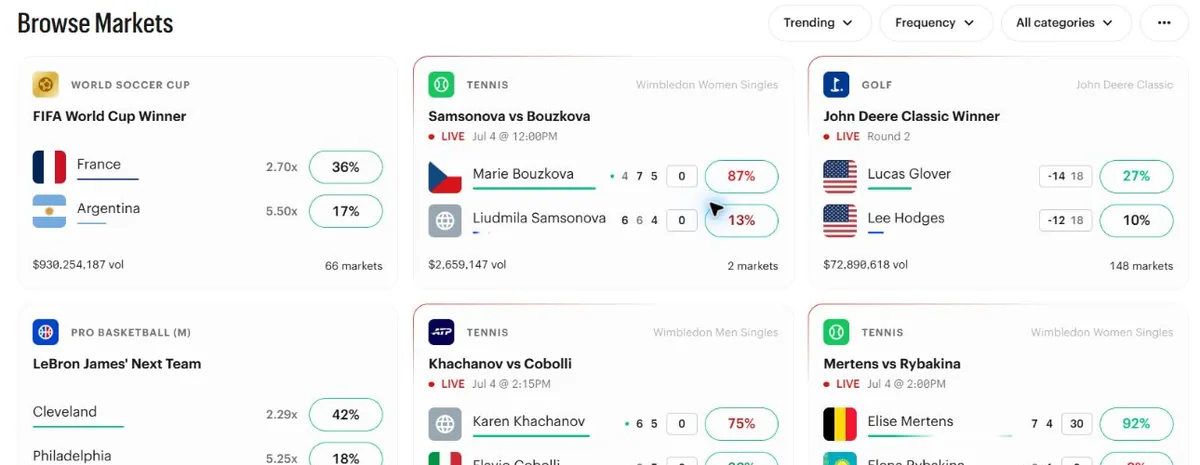
The public Kalshi browse screen shows event categories and cards with displayed prices/probabilities and volume cues. Market availability changes, so this review does not freeze a permanent category count. The practical question is whether the exact contract a reader wants has understandable rules, usable depth, and a reasonable spread.
Kalshi’s order-book help explains that resting bids and asks show the price and quantity other members are willing to trade. A quick order can consume more than one price level, which can raise the average execution price. A limit order controls price but may remain unfilled. The liquidity and spread guide explains why the displayed headline price is not always the actual cost to enter or exit.
Beginner Usability
- What is approachable: YES/NO-style contracts, visible bids/asks, a public browse screen, and market-level written rules create a learnable workflow.
- What needs work from the user: the interface cannot replace reading the rule, checking the source, inspecting the spread, and understanding what one contract pays at settlement.
- What can surprise beginners: fees are price- and series-dependent, funding availability depends on location/account status, and settlement can wait for official data.
- Best beginner habit: use a limit price, confirm the fee shown on the order ticket, and explain the exact settlement trigger in plain language before acting.
Funding and Withdrawals
Kalshi’s current help collection lists bank transfer, debit card, crypto, wire, and additional payment rails. Availability is not uniform. For U.S. users, the bank-deposit page lists a $10 minimum, no Kalshi bank-deposit fee, settlement typically within five business days, and possible immediate partial credit based on account and transfer checks.
The bank-withdrawal page says U.S. bank withdrawals have no Kalshi fee and generally arrive within a few business days, but recent deposits can create a security hold. Debit deposits may incur a 2% processing fee and can be available to U.S. and international users. I did not test any of these rails, so the review reports the official flow without promising timing or eligibility.
Resolution and Market Rules
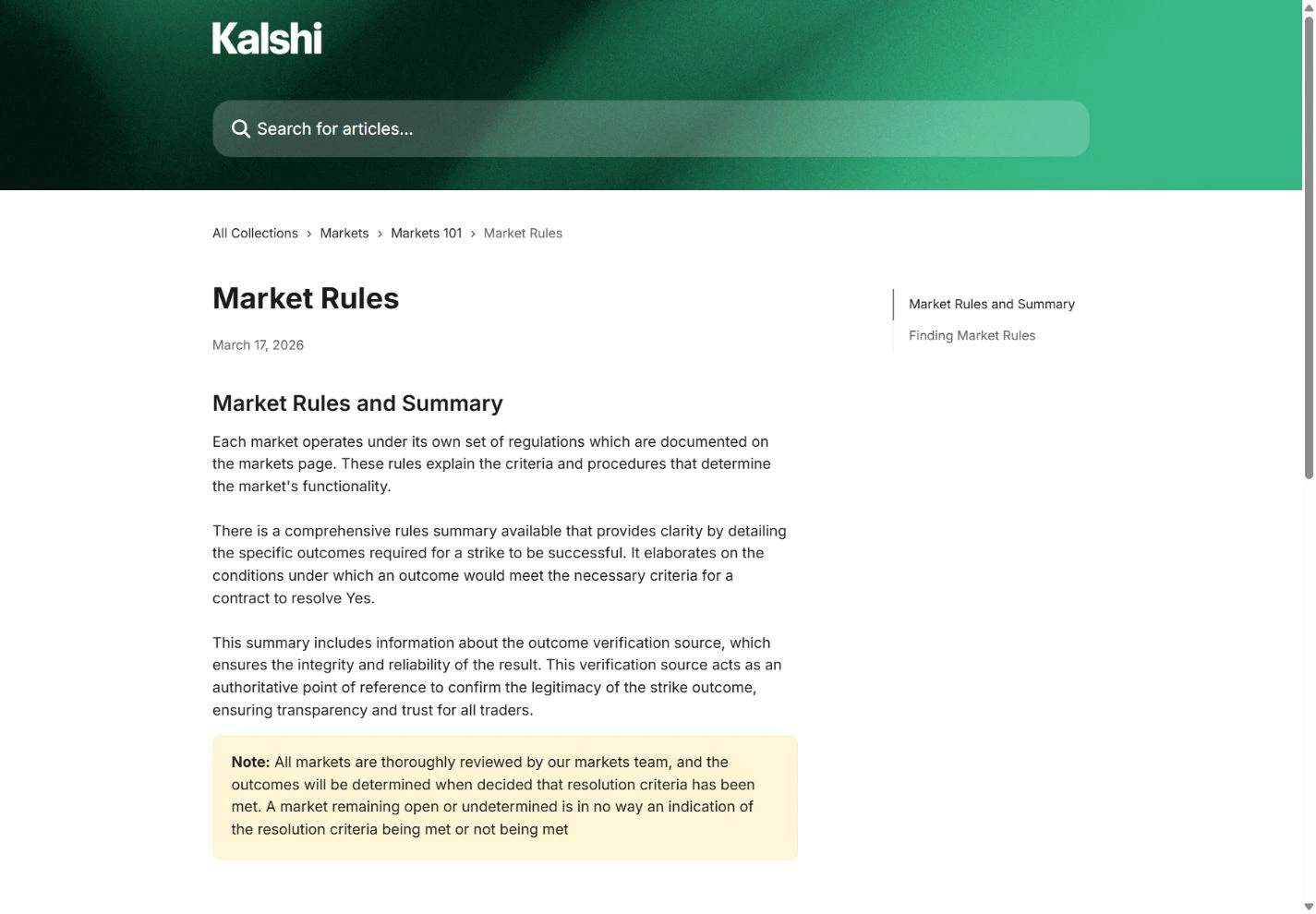
Each Kalshi market has its own rules, determination criteria, and named verification source. Kalshi says market close time can differ from determination time, and official data can delay settlement. A market remaining open is not proof that the outcome criteria have or have not been met.
- Read the full rule and Important Information section, not only the market title.
- Identify the official source agency and the determination date or time.
- Check edge cases such as revised data, did-not-play conditions, cancellations, combo treatment, and non-standard payouts where applicable.
- Use the market-rules checklist before treating an apparently obvious event as an obvious settlement.
What I Checked for This Review
- Regulatory status: CFTC amended order of designation plus Kalshi’s regulation help page.
- Account eligibility: individual signup, international-access help, and the June 2026 Member Agreement.
- Fees: July 2026 event-contract fee schedule, general examples, non-standard series, maker treatment, and payment-rail caveats.
- Funding and withdrawals: official bank, debit, international, and transfer-help material; no live transfer is claimed.
- Order-book mechanics: public bids/asks, resting orders, quick-order price levels, and limit-order fill risk.
- Market rules and outcomes: official rule, source-agency, determination, settlement, and payout explanations.
- Beginner usability: whether verdict, fees, rules, access caveats, screenshot evidence, comparison, methodology, and disclosure are findable.
Testing and Screenshot Status
- Official source refresh: completed 2026-07-26.
- Funded account test: not claimed. No completed KYC, deposit, withdrawal, order, or settlement test is represented.
- Private account screenshots: not published.
- Sanitized visual: preserved from the 2026-07-04 visual-proof pass; it shows a public English browse screen and excludes private account data.
Visual proof
Visual Proof From This Review Pass
This image was captured for SEO plan item 4.5 to make the review/tool evidence more concrete without exposing private account data.
Kalshi vs Polymarket vs PredictIt
- Polymarket: a more crypto-native comparison for readers comfortable with wallets, stablecoins, network choices, location restrictions, and UMA-based resolution. The main trade-off is extra operational and regional complexity.
- PredictIt: a narrower political-market comparison with its own no-action and platform-limit context. It should not be treated as a like-for-like substitute for every Kalshi category.
- Kalshi: the clearest fit of the three when a reader specifically wants to evaluate a CFTC-regulated DCM, exchange-style order book, current event-contract fee schedule, and region-appropriate funding options.
This comparison is neutral editorial context, not a paid placement or instruction to use any platform. The correct fit depends on eligibility, market availability, rules, fees, liquidity, funding, and the reader’s tolerance for operational risk.
Beginner Risks
A regulated venue can still host a contract that settles at zero for the losing side. A reader can also lose value through a poor entry price, wide spread, fee, slippage, an unfilled exit, a misunderstood rule, delayed official data, or a payment-rail problem. The review therefore separates platform regulation from market and user-execution risk.
Original value worksheet
Kalshi misconception check
Use this checklist when the question is about safety, fees, or regulated-event-contract language. It keeps the review focused on what a reader can verify.
Beginner mistakes
Beginner Mistakes to Avoid
These are review-level mistakes, not predictions about any one market. They keep the reader focused on rules, costs, sizing, and settlement.
- Keep account questions, platform rules, and event-contract risk as separate checks.
- If a beginner cannot explain the settlement trigger, the trade idea is not ready.
Disclosure
EventTradingHub has no approved affiliate, referral, sponsored, or paid-placement relationship on this page. Official Kalshi and CFTC links are evidence sources only. See the site Disclosure page for the broader policy.
Event Trading Hub Review Methodology: this review follows the review methodology for source quality, evidence limits, update cadence, platform comparisons, screenshots, and disclosure handling.
Risk Disclaimer
Event contracts involve financial risk and can settle with no payout for the losing side. You can lose money. This review is educational research, not financial, investment, legal, tax, or eligibility advice. Check current platform rules, fees, funding rails, market liquidity, resolution criteria, account terms, and applicable law before using real money.
Official Sources Checked
- CFTC amended order of designation — KalshiEX DCM status and applicable DCM obligations.
- Kalshi regulation help — Kalshi summary of CFTC/DCM status.
- Kalshi July 2026 fee schedule — formulas, examples, non-standard series, maker treatment, settlement/membership fees, and payment-rail costs.
- Kalshi individual signup — age, verification, and account-approval context.
- Kalshi Member Agreement — eligibility, restricted-jurisdiction, event-contract risk, rule, and access caveats.
- Kalshi deposits and withdrawals collection — available rail categories and transfer-help pages.
- Kalshi order-book help — bids, asks, prices, quantities, and resting orders.
- Kalshi market rules — market-specific criteria and verification source.
- Kalshi market outcomes — determination based on contract rules and official source information.
Update History
- 2026-07-26: rebuilt for SEO plan item 7.3 with a new verdict, fit/not-fit sections, CFTC context, corrected international-access wording, July 2026 fee examples, funding/withdrawal caveats, market-rule risks, neutral comparison, screenshot evidence, methodology, disclosure, and risk disclaimer.
- 2026-07-04: added source notes, evidence blocks, update-log structure, original-value worksheet, visual proof, What I Checked coverage, and beginner-mistake guidance.
Frequently Asked Questions
Is Kalshi regulated?
Yes. KalshiEX LLC is designated by the CFTC as a contract market. That status governs the exchange structure; it does not guarantee a contract outcome, liquidity, access, or a particular fee.
Is Kalshi only available in the United States?
No. Kalshi says it is accessible from many countries, but restricted jurisdictions, account approval, identity verification, applicable law, location, and product-specific funding options still apply.
Does Kalshi charge a flat profit fee?
That shortcut is inaccurate. The July 2026 event-contract schedule uses price-, count-, and multiplier-based formulas, with non-standard treatment for listed series. Check the live order ticket and current fee schedule.
Are bank deposits and withdrawals instant?
Not necessarily. Kalshi says U.S. bank deposits typically settle within five business days, sometimes with account-dependent immediate partial credit. Bank withdrawals generally take a few business days and can be affected by security holds.
What matters most before trading a Kalshi market?
Confirm eligibility, read the complete market rule, identify the official resolution source and timing, inspect spread and depth, and check the fee shown on the order ticket. A clear headline is not a substitute for the written contract.
Risk notice
Prediction markets involve risk
Prediction markets and event contracts involve financial risk. You can lose money, including the full amount committed to a contract.
Event Trading Hub is for education and research only. This is not financial, investment, legal, or tax advice. You are responsible for your own decisions and for checking platform rules, fees, availability, and local regulations before trading.