Guides

How Do Prediction Markets Work? (Beginner’s Guide)

How Do Prediction Markets Work? (Beginner’s Guide)

At first glance, prediction markets feel almost trivial. You pick “Yes” or “No,” place a trade, and wait.

But once you spend time inside a live market, the picture changes. Prices move constantly. News hits — probabilities shift. And you realize you’re not just guessing outcomes. You’re watching how the market processes information in real time. What looks simple on the surface quickly turns into something more dynamic — almost like a live feed of collective expectations adjusting second by second.

To understand how this works, it helps to first explore our beginner guides before diving deeper into how prediction markets turn opinions into tradable probabilities. At ET Hub, we’ve seen that this shift in perspective doesn’t happen immediately. It usually comes after you’ve watched a few markets react in real time — and start noticing patterns behind those moves.

How Pricing Works in Prediction Markets

Pricing is the core mechanism that makes prediction markets work in practice. It’s where opinions, data, and expectations meet and turn into something measurable. Without this pricing layer, the whole system would just be a collection of guesses, not a functioning market.

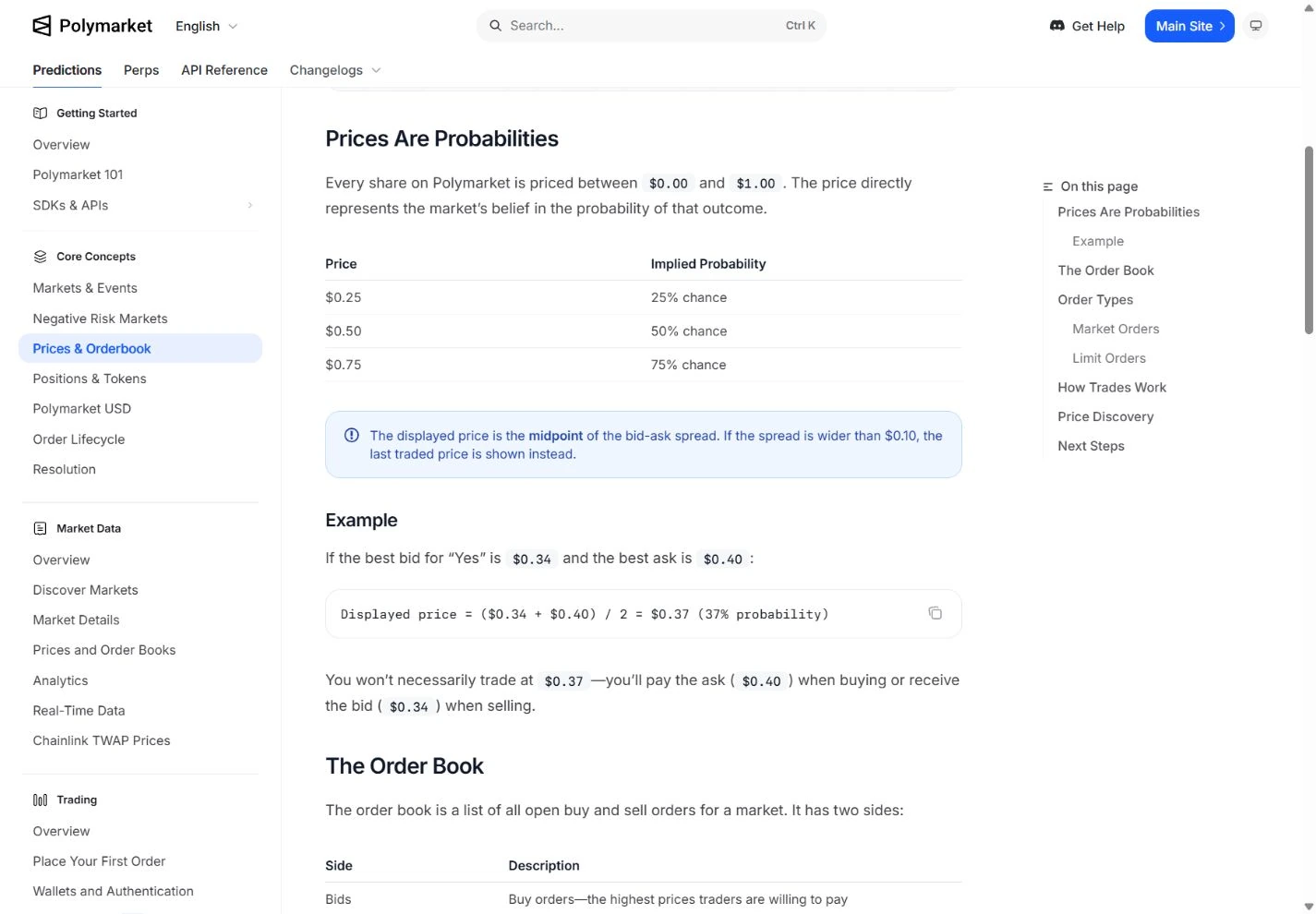
In prediction markets, price and probability are tightly connected. A contract trading at $0.60 implies roughly a 60% chance of that outcome happening.

But that number doesn’t come from a formula. It emerges from trading activity.

People enter positions based on:

  • their interpretation of data
  • expectations about future events
  • how they think others will react

And this is where it gets interesting. The price is not just about what is likely to happen — it reflects what participants believe right now, given the information available.

In practice, this becomes very visible during real events. For example, during the 2024 U.S. presidential race on PredictIt, Kamala Harris’ odds moved from 53% to 56% after the debate, while Donald Trump’s fell from 47% to 44%. Nothing “final” had happened yet — but the market updated its probability based on new information. 

Moves like that show what pricing really represents. It’s not certainty. It’s a constantly updating estimate shaped by thousands of small decisions.

In our experience, the market often reacts faster than traditional forecasts, but it’s not always cleaner. Sometimes it’s sharper. Sometimes it’s noisy. And sometimes the first move isn’t even the correct one — it’s just the fastest reaction.

What Are Yes/No Contracts

At first glance, Yes/No contracts look almost too simple to take seriously. But that simplicity is exactly what makes them scalable and efficient across thousands of different events.

In practice, this format removes unnecessary complexity and forces everything into a clear, tradable question. You’re not analyzing assets — you’re analyzing outcomes, and that shifts how decisions are made inside the market.

Most prediction markets are built on binary contracts.

Each market asks a simple question:
Will something happen — yes or no?

Behind that simplicity, there’s a very specific structure:

  • If the event happens → contract settles at $1
  • If it doesn’t → it settles at $0

That’s the entire payout structure. In practice, each contract resolves to a definitive outcome based on predefined rules — something we break down in more detail in our guide on market resolution.

But the key detail many miss is this: you’re not really trading the outcome — you’re trading the price of that outcome before it’s known.

Let’s take a real scenario.

During the 2024 U.S. election cycle on Polymarket, contracts on whether Donald Trump would win were trading around $0.48–$0.52 for a period of time — essentially a coin flip. After a strong debate performance and a shift in polling sentiment, the “Yes” contract moved to around $0.60+ within a relatively short window.

Nothing had been decided yet. The election was still months away.

But if you bought at $0.50 and sold at $0.60, you locked in profit without ever needing the final result. That’s the part that changes how these markets behave.

What makes this setup powerful is flexibility. You don’t have to wait for the final outcome. If the market moves in your favor, you can exit early.

And this is where prediction markets start to diverge from traditional betting. In betting, you’re locked into a position. Here, you’re operating in a market where price moves independently of resolution.

At ET Hub, we’ve seen many beginners treat these contracts like bets. But in practice, they behave much closer to tradable instruments. And once that clicks, the whole system starts to look very different.

How Market Prices Change

Prices in prediction markets don’t move randomly — even if it sometimes feels that way. Every move is a result of people reacting, reassessing, and repositioning based on new information or shifting expectations.

At ET Hub, we’ve seen that price changes are less about the event itself and more about how quickly and confidently the market processes what’s happening.

How Information Moves Prices in Prediction Markets

Markets react to information — but not always in a straight line.

A strong data release can push probability from 30% to 55% within minutes. But the same mechanism works in reverse. Weak data, unexpected statements, or negative developments can just as easily drag a market from 30% down to 15% or lower.

The key point is this: price moves when people trade — not when news exists.

Here’s what actually happens under the hood.

Let’s say a contract is trading at $0.30. That means the current balance of buyers and sellers agrees — more or less — on a 30% probability. Now new information hits. Some traders believe the true probability is now closer to 50%. They start buying “Yes” contracts aggressively.

To buy, they have to accept higher prices:

  • first at $0.32
  • then $0.35
  • then $0.40

Each trade pushes the market up. At the same time, sellers may step back, waiting for even higher prices — which accelerates the move.

That’s how probability “changes.” Not because the event itself changed, but because people are willing to trade at different prices.

A real-world example makes this clearer.

During major macro events — like U.S. inflation releases — markets on rate cuts often move within seconds. A contract priced at 40% before the data can jump to 60% if inflation comes in lower than expected. Or drop to 20% if it comes in hotter. The reaction isn’t smooth — it’s driven by orders hitting the market all at once.

Why? Because it’s not just about the information itself. It’s about how participants interpret it.

Some react immediately. Others wait. Some disagree entirely.

That mix creates movement.

You’ll often see:

  • sharp spikes after unexpected news
  • hesitation when information is unclear
  • partial moves when the market isn’t fully convinced

And importantly — the market can be wrong.

Prices reflect belief, not truth. The final outcome doesn’t care whether the market was at 70% or 30%. It either happens or it doesn’t.

Why Prices Move Over Time

Not all movement comes from breaking news.

Prices also shift gradually as expectations evolve. Traders adjust positions, new participants enter, others exit. Over time, this creates trends.

Sometimes the move is slow and steady. Other times it’s messy — up, down, sideways.

A market might drift from 25% to 40% over several days, not because of one major event, but because of a series of smaller signals — comments, reports, sentiment shifts. Each one nudges participants slightly, and those small adjustments add up.

There’s also another layer: positioning.

If too many traders are on one side, even neutral news can trigger movement. People take profits, reduce exposure, or hedge — and price moves even without a clear “reason” on the surface.

Here’s the part many miss: markets are not just reacting to events. They’re constantly recalibrating belief.

And that recalibration is continuous. It doesn’t wait for confirmation. It doesn’t wait for certainty.

That’s why you can see a market sit at 65% for days — and still be completely wrong in the end.

Liquidity in Prediction Markets

Liquidity is one of those concepts that sounds technical, but the idea behind it is actually simple.

Think of it like a market with buyers and sellers. If there are many people willing to trade at similar prices, everything works smoothly. If there are only a few — things get awkward very quickly.

A simple analogy: imagine you’re trying to sell your phone.
If ten people are ready to buy it around the same price, you can sell instantly without dropping the price.
If only one person is interested — and they’re offering less than you want — you either wait or accept a worse deal.

That’s liquidity.

In prediction markets, it works the same way — just faster and less obvious.

Let’s say you want to buy $1,000 worth of contracts at $0.50 (which implies a 50% probability).

In a high-liquidity market:

  • there might be $5,000–$10,000 worth of orders sitting at $0.50
    → your entire order fills instantly at that price

In a low-liquidity market:

  • maybe only $150 is available at $0.50
  • another $200 at $0.52
  • another $300 at $0.55

Now your $1,000 order gets filled like this:

  • $150 at $0.50
  • $200 at $0.52
  • $300 at $0.55
  • the rest even higher

Your average price ends up closer to $0.54–$0.56, not $0.50.

Same idea. Same market. Completely different result.

At ET Hub, we’ve seen this catch people off guard more than anything else. The trade looks good on paper — but the actual execution tells a different story.

And it works both ways.

Even if the market moves in your favor, low liquidity can make it hard to exit. You might be “right” about the direction — but unable to sell at the price you expected.

That’s why liquidity isn’t just a technical detail. It directly affects:

  • whether you can fill your full position size (for example, $1,000 vs only $150)
  • the actual average price you get filled at (not $0.50, but $0.55+)
  • whether you can exit the trade without losses, even if the market moved in your favor

Most beginners ignore it at first. Then they run into it — and suddenly it becomes very real.

Step-by-Step Example: From Opening a Position to Closing a Trade

Let’s walk through a simple scenario — but this time a bit closer to how things actually play out in real markets.

Take a typical macro event. For example, markets on Polymarket around U.S. Federal Reserve rate decisions. These markets tend to be active, reactive, and driven by incoming data.

A few days before a key inflation report, a contract like “Will the Fed cut rates this month?” might be trading around 35%. There’s uncertainty, but no strong signal yet.

You decide to enter early and buy contracts at $0.35.

At this point, you’re not saying the event will happen. You’re saying the market might be underestimating the probability.

Then the data drops.

Let’s say inflation comes in lower than expected — a scenario that increases the likelihood of a rate cut. Within minutes, the market reacts. Buyers step in aggressively, and the price moves from $0.35 to around $0.52–$0.58.

Now your position looks very different.

You bought at $0.35. The market is now pricing the same outcome closer to $0.55.

At this point, you have a choice:

  • hold until final resolution
  • or sell at $0.55 and lock in profit

If you sell, your trade looks roughly like this:

  • Entry: $0.35
  • Exit: $0.55
  • Profit: $0.20 per contract (around +57%)

And importantly — the final outcome hasn’t happened yet. The Fed hasn’t made a decision. The market just updated its expectations.

Many traders choose to sell early.

Not because they are sure the event will happen, but because the price has already moved in their favor. If you bought at $0.35 and can now sell at $0.55, that price difference is already your profit — no need to wait for the final result.

What matters here is not being “right” in the end. It’s recognizing that the market has adjusted its probability and acting on that change. 

Because in these markets, the opportunity often comes from price movement — not from the final outcome. And one important thing to remember: the expectations of traders do not influence the actual outcome of the event.

Where Beginners Go Wrong in Prediction Markets

Most beginners focus on the wrong thing from the start. The instinct is to ask, “Will this happen?” — but that’s not really how these markets work. The better question is whether the current price makes sense. A 70% probability doesn’t mean something will happen. It just means the market currently leans that way based on what it knows.

For example, if the market shows 70% ($0.70), and you believe the real probability is closer to 50%, you don’t buy — you either sell or stay out. If you think it’s 80%, then buying below $0.70 makes sense.

Prices move all the time, but most of those moves don’t mean much. A quick spike doesn’t automatically signal an opportunity, and a pullback doesn’t mean you were wrong. What usually happens is pretty simple: people chase the move, enter late, then panic when the price reverses. Or they open too many positions without a clear reason. It feels like activity, but in reality it’s just reacting, not thinking.

Don’t trade every move. If the price jumps and you don’t know why — stay out.

Prediction markets don’t reward guessing. You don’t get paid for simply being right at the end. You get paid when you buy at a lower price and sell at a higher one. If the market is at $0.40 and moves to $0.60, that change is the opportunity. The price itself tells you how expectations are shifting — and that’s what you trade.

Once you start looking at price this way, it stops being an “answer” and becomes a signal you can act on.

About Machiawelli

Machiawelli edits EventTradingHub as a practical research notebook for prediction markets and event trading. The focus is on platform mechanics, risk, fees, limits, and how market probabilities are interpreted.

Read more about EventTradingHub

Scroll to Top