


Kalshi does not use one flat fee for every event contract. Its general formula changes with contract price and quantity, while some market series use different multipliers or no trading fee. This guide turns the current official schedule into practical examples and shows what to check before submitting an order.
How Kalshi event-contract fees work
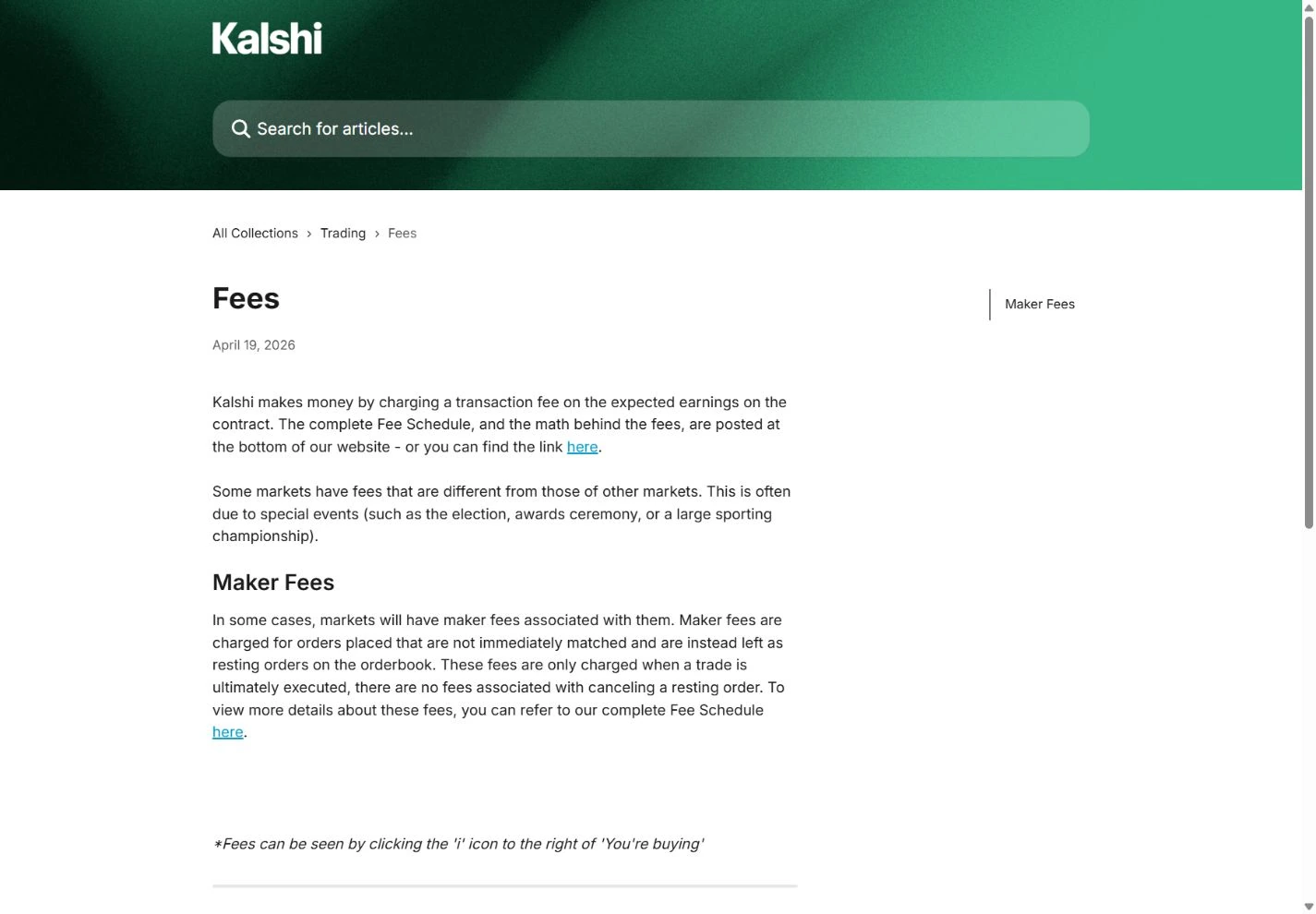
For the standard schedule, an order that matches immediately is treated as a taker order. Kalshi calculates the fee from the contract price, number of contracts, and any series multiplier. A resting limit order normally does not pay the taker fee, but specified series can have maker fees if that resting order later executes.
Fee = round up (M × 0.07 × C × P × (1 − P))
P = contract price in dollars · C = contracts · M = series multiplier, normally 1 unless the schedule says otherwise
The factor P × (1 − P) is highest near a 50-cent contract price. That is why the standard fee curve is largest around the middle and smaller near 1 cent or 99 cents. This is a fee calculation, not a prediction of whether a trade is good value.
Concrete examples from the July 2026 schedule
The following numbers come directly from Kalshi’s general trading-fee table for 100 contracts. They assume the standard multiplier and do not override a market-specific fee schedule.
At 10 cents and 90 cents, the official standard-table fee is the same because the formula is symmetric: 0.10 × 0.90 equals 0.90 × 0.10. At 50 cents, expected earnings are most balanced and the standard fee is highest.
What about maker orders?
A maker order rests on the orderbook instead of matching immediately. The current general maker formula uses a lower coefficient, but the series multiplier controls whether a maker fee actually applies. A multiplier of zero means no maker fee under that row; a multiplier of one activates the listed maker formula. Canceling an unfilled resting order does not itself create a maker fee.
This distinction makes the exact series important. Before assuming a limit order will reduce fees, inspect both the live order ticket and the non-standard-fee section of the official Kalshi fee schedule.
Trading fees versus other costs
| Cost | Current treatment | Beginner check |
|---|---|---|
| Settlement | No settlement fee in the current schedule. | Do not confuse the $1 winning payout with a fee-free trade; entry or exit fees may already have applied. |
| Membership | No membership fee in the current schedule. | Account access and market eligibility are separate questions. |
| ACH | No Kalshi fee for ACH deposits or withdrawals. | Confirm availability and any bank-side conditions. |
| Card deposit | Kalshi may charge up to 2%. | Review the transfer screen before funding. |
| Crypto or other rail | Processor, network, or rail fees may apply. | Keep funding costs separate from trading fees. |
| Spread and slippage | Not a platform fee. | A poor execution price can matter more than the displayed transaction fee. |
What beginners should check before trading
- Read the market rules and confirm what resolves Yes or No.
- Check whether the order matches immediately or rests on the orderbook.
- Open the fee detail beside the order summary before submitting.
- Confirm whether the market series appears in the non-standard-fee table.
- Compare the displayed fee with the spread and the maximum possible payout.
- Include funding-rail costs separately if using card or crypto.
If the contract wording is unclear, start with our guide to reading prediction-market rules. For platform workflow and evidence notes, see the Kalshi review.
How this differs from other platforms
Prediction platforms do not all charge fees at the same moment or with the same formula. Some use probability-sensitive transaction fees, some charge fees on profitable sales, and some show a platform or exchange commission at order confirmation. For a maintained cross-platform view, use Prediction Market Fees Compared rather than treating the Kalshi formula as an industry standard.
Sources and update note
This guide uses Kalshi’s fee schedule effective July 7, 2026 and the official Kalshi Help Center fee explanation. The schedule contains market-specific exceptions and can be updated, so recheck it and the order ticket before every trade.
Browse the broader learning sequence in the EventTradingHub Guides hub.
Last updated: July 11, 2026
Educational information only. Event contracts involve risk, and fees reduce potential returns. This page does not provide financial, legal, or tax advice.