


Polymarket resolution guide
A market does not resolve from the headline alone
Polymarket uses written market rules together with UMA’s Optimistic Oracle. After an event is eligible for resolution, someone proposes the outcome and posts a bond. Other participants then have a limited window to challenge that proposal. Most proposals pass without a dispute; contested cases can take several days and may reach a vote by UMA token holders.
The mechanism
How a Polymarket market resolves
- The event becomes eligible. The end condition, deadline, or another rule-defined trigger has been reached.
- An outcome is proposed. A proposer selects the answer and posts a bond through the UMA Oracle.
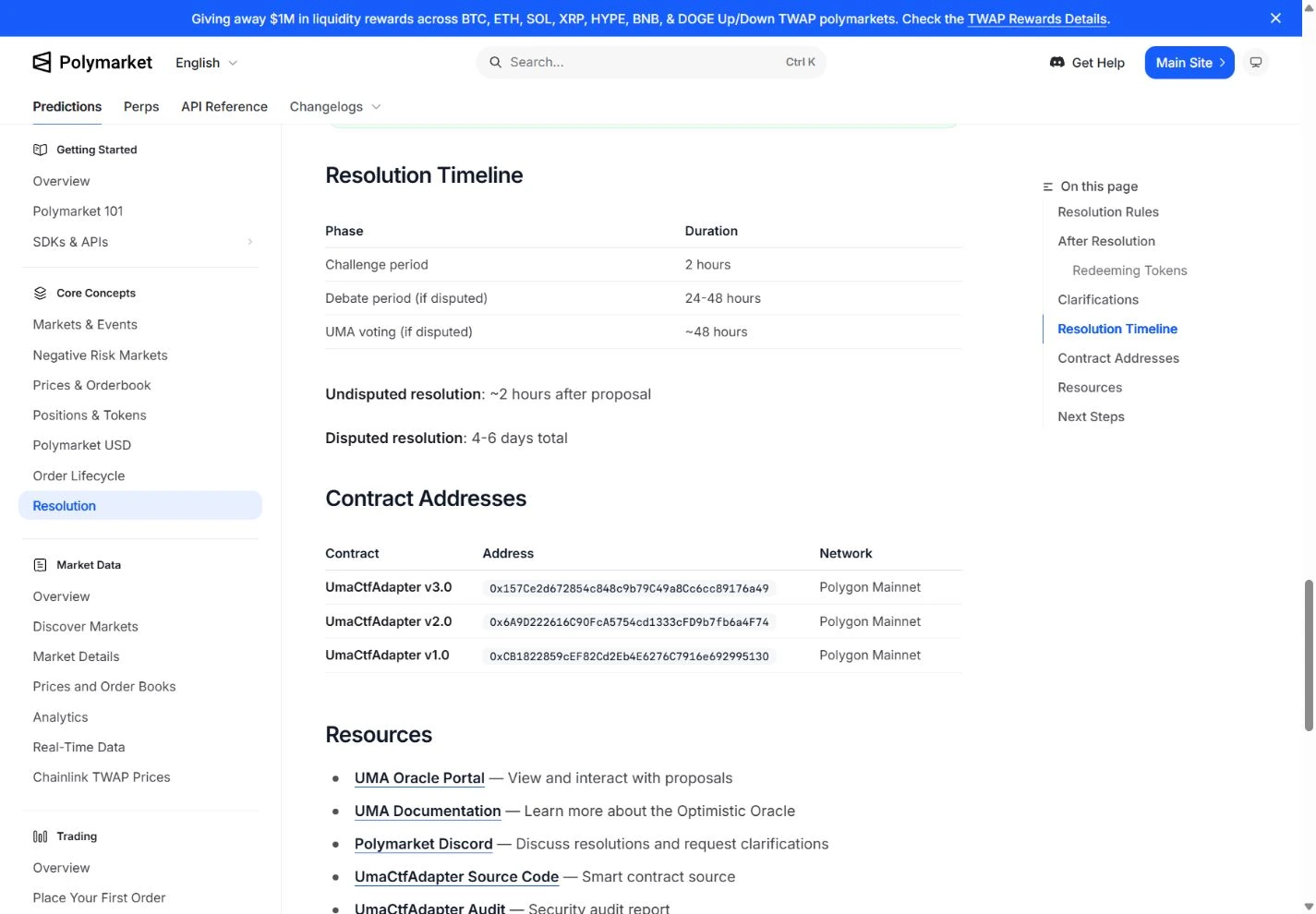
- The challenge window opens. Polymarket’s current documentation describes a two-hour period in which another participant can post an equal counter-bond and dispute the proposal.
- An undisputed proposal settles. If nobody challenges it, the answer is accepted after the window and the proposer receives the bond back plus the stated reward.
- A challenged proposal escalates. Under Polymarket’s documented flow, one dispute starts another proposal round; if the second proposal is also disputed, the case moves to debate and UMA’s Data Verification Mechanism.
- The result becomes final. After the oracle reports the outcome, winning outcome tokens can be redeemed and losing tokens have no payout.
For the platform-neutral foundation, read Market Resolution Explained. For the wording checks that come before this process, use How to Read Market Rules Before Trading.
What UMA does
What is UMA in this context?
UMA is the oracle and dispute-resolution layer used to verify the answer supplied to Polymarket’s settlement contracts. It is “optimistic” because a bonded proposal is treated as correct if nobody challenges it during the liveness period. The system does not continuously decide every market from scratch; it focuses costly arbitration on the relatively small set of proposals that are disputed.
UMA’s Data Verification Mechanism, or DVM, is the final arbitration layer for escalated cases. UMA token holders use a commit-reveal vote to determine the answer to the disputed data request. The relevant question is still framed by the market rules and accompanying oracle data—not by which side was more popular while trading was open.
Primary documentation: Polymarket Resolution and UMA Oracle FAQs.
Disputes
What a dispute changes
| Stage | What happens | Why a trader cares |
|---|---|---|
| Proposal | A bonded participant submits an outcome. | A proposal is not final while its challenge window remains open. |
| Challenge | A disputer posts a matching bond and rejects the proposed answer. | Redemption can be delayed and the disputed answer can change. |
| Debate | Participants can submit rule-based evidence and rationale. | Screenshots and headlines matter only insofar as they address the controlling criteria. |
| DVM vote | UMA token holders vote on the oracle question. | The final result can differ from a casual reading of the title or prevailing market price. |
Polymarket currently documents four possible vote outcomes: the proposer wins; the disputer wins and a new proposal is needed; the proposal was too early; or the rare Unknown/50-50 result, where each side redeems for $0.50. These are protocol outcomes, not predictions about how any specific disputed market will end.
Examples
Three hypothetical dispute patterns
These examples explain process risk; they are not accounts of real disputes and do not imply how UMA voters would decide a live case.
Risk
Why disputes matter before you trade
- Timing risk: Polymarket estimates about two hours for an undisputed proposal, while a disputed resolution can take roughly four to six days.
- Interpretation risk: being right about the real-world story is not enough if the market rules define a narrower test.
- Liquidity risk: prices near the end can reflect thin order books, uncertainty, or settlement expectations rather than a guaranteed payout.
- Operational risk: proposing or disputing is an onchain action that requires a bond; an incorrect or premature claim can lose that bond.
- Clarification risk: unforeseen circumstances may lead Polymarket to publish additional context. Its documentation says such clarification cannot change the question’s fundamental intent and is published onchain for voters to consider.
Use Prediction Market Risk Management to connect resolution uncertainty with position sizing and maximum-loss controls.
Beginner checklist
Before holding a Polymarket position into resolution
- Read the full rules, not only the market title.
- Write down the exact source, deadline, time zone, and required publication state.
- Check whether preliminary, certified, revised, cancelled, postponed, or “too early” outcomes are addressed.
- Treat a proposed outcome as provisional until the challenge period has ended.
- Do not assume the last traded price guarantees the resolution.
- Size the position so a delayed or unexpected settlement does not create unacceptable loss or liquidity pressure.
Risk note: this guide describes the documented resolution process as checked on July 10, 2026. Protocol parameters and platform procedures can change. Verify the live market rules and current official documentation before acting. This material is educational and is not financial, investment, legal, or tax advice.