


Practical guide
The title is the invitation. The rules decide the payout.
A prediction market title is built to be readable. Resolution rules are built to decide what actually counts. Before entering a YES or NO position, translate the contract into a test you could apply without relying on headlines, intuition, or what you think the creator meant.
Step 1
Rewrite the market as a decision test
Start by copying the operative language into a short sentence: “This resolves YES only if ___ is confirmed by ___ by ___.” If you cannot complete all three blanks, you do not yet understand the contract.
What counts — and what does not
- Action versus announcement: “announces,” “signs,” “implements,” and “takes effect” describe different milestones.
- Preliminary versus final: an estimate, projection, unofficial result, or first release may not satisfy rules requiring certified or finalized data.
- Exact threshold: “above 5%” is not the same as “5% or above.” Watch greater-than, at-least, before, by, and during.
- Named subject: confirm the person, office, jurisdiction, league, dataset, product, or event edition.
- Cancellation and postponement: look for explicit treatment of delays, recounts, revisions, substitutions, or no-result outcomes.
Step 2
Find the controlling resolution source
The source is not decorative. It defines the evidence the market will accept. A news report can accurately describe an event while still being irrelevant if the rules name a government release, league record, court docket, company filing, or another specific authority.
| Question | Why it matters | Safer reading habit |
|---|---|---|
| Is one source named? | Other credible reports may not control resolution. | Bookmark the named source before trading. |
| Is a source hierarchy provided? | A fallback may apply if the primary source is unavailable. | Write down the order of precedence. |
| Must the data be final? | Early releases can be revised. | Separate first publication from final determination. |
| Can the source be silent? | Silence may delay settlement rather than imply NO. | Check the rule for missing or delayed data. |
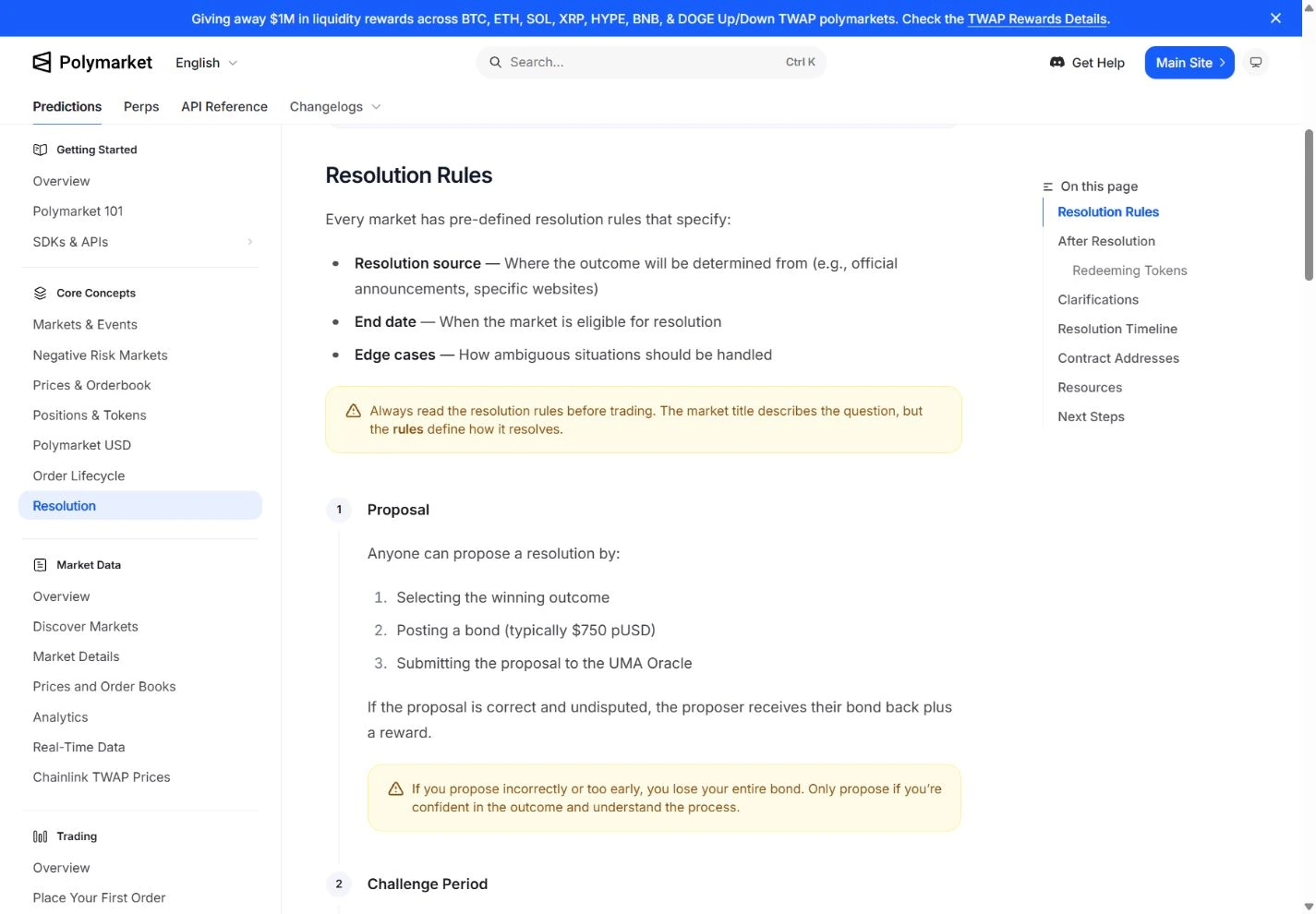
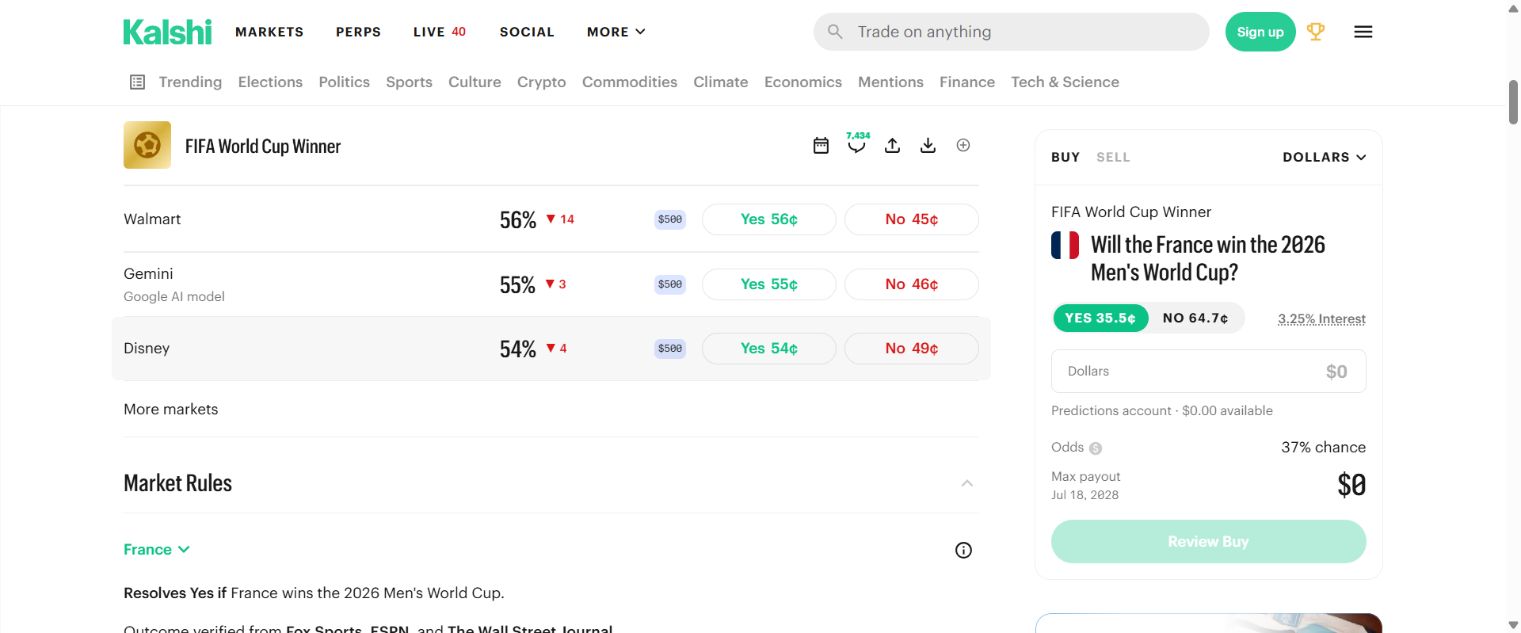
Checked again on 2026-09-06: Kalshi’s official help explains that its market rules and summaries identify the measured value, timeline, and verification source. Polymarket’s official documentation likewise says its rules specify the resolution source, end date, and edge cases. See the Kalshi market-rules guide and Polymarket resolution documentation.
Two interface examples
Use these captures to learn where rule facts appear, then open the live market and read the complete text before trading.
Step 3
Separate trading close, event deadline, and determination time
These can be different moments. Trading may stop before a source publishes final data, or remain available while official confirmation is pending. A market still being open does not prove that the condition has or has not been met.
- Trading close: when new orders stop.
- Event deadline: the last moment when the qualifying event may occur.
- Determination time: when the platform evaluates the named source.
- Settlement: when the result is finalized and payouts become available.
Always record the time zone. “By Friday” can produce a different answer depending on whether the contract uses Eastern Time, UTC, local event time, or a timestamp defined elsewhere in the full rules.
Ambiguity test
Look for the sentence that could create a dispute
Ambiguity is a position risk, not merely a writing flaw. Highlight undefined terms, conflicting dates, unclear source precedence, and events that could satisfy the headline but not the operative criteria. Check whether the rules explain edge cases or allow clarifications.
For the mechanics after a result, read Market Resolution Explained. For broader exposure controls, use Prediction Market Risk Management.
Hypothetical examples
How small wording differences change the contract
These examples teach wording analysis; they are not claims about any current market. Apply the actual rules shown on the market page.
Pre-trade checklist
Read the rules in this order
- 1. Outcome: write the exact YES condition in one sentence.
- 2. Exclusions: list the closest events that do not count.
- 3. Source: identify the controlling authority and any fallback.
- 4. Timing: record deadline, time zone, close time, and determination time.
- 5. Edge cases: check postponement, cancellation, revision, recount, tie, and missing-data language.
- 6. Ambiguity: identify any term that needs clarification.
- 7. Position: size the trade for the possibility that your interpretation is wrong.
- 8. Save evidence: keep the rules and source link you relied on; rules and clarifications can matter later.
Beginner mistakes
What to avoid
- Trading from the title, social post, or price chart without opening the full rules.
- Assuming the most widely reported source is the resolution source.
- Treating an open market as evidence about the eventual resolution.
- Ignoring the distinction between event time and official publication time.
- Using a large position when the wording or source hierarchy is unclear.
- Assuming a platform will resolve according to “common sense” rather than the written criteria.
Risk note: reading rules reduces avoidable interpretation errors; it does not remove market, liquidity, event, platform, or resolution risk. This guide is educational and is not financial, investment, legal, or tax advice.
Continue with the Guides hub or review the broader Prediction Markets Beginner Guide.