


Prediction market risk management starts before you choose YES or NO. A trader can understand the event, read the news correctly, and still lose money because the position was too large, the market was too thin, the rules were unclear, or several positions were exposed to the same event.
This guide is a practical checklist for bankroll, position sizing, maximum risk per trade, correlated markets, event risk, liquidity risk, resolution risk, and common psychological mistakes. If you need the beginner foundation first, start with the Prediction Markets Beginner Guide.
Quick answer
Risk management means deciding the loss before the trade
What Risk Management Means in Prediction Markets
In a YES/NO prediction market, the maximum loss is usually easier to see than in many other trading formats: if you buy contracts, the most you can lose on that position is the amount paid, before considering fees or withdrawal costs. That simple math does not make the trade safe. It only gives you a starting point for sizing the position.
Risk management asks four questions before every trade:
- How much money can this position lose if the outcome goes against me?
- How many other positions depend on the same event or news source?
- Can I exit at a reasonable price if I change my mind?
- Do I understand exactly how the market will resolve?
Bankroll: Separate Learning Money From Life Money
A bankroll is the money set aside for this activity. It is not a profit target and it is not a reason to trade. It is a boundary. For a beginner, the most useful boundary is simple: use only an amount you can afford to lose without changing your rent, debt payments, emergency fund, taxes, or normal living costs.
Do not treat a platform balance as a reason to keep trading. A cash balance still belongs to you. If a market is unclear, thin, or emotionally charged, doing nothing is part of bankroll management.
Position sizing worksheet
Translate a Trade Idea Into Maximum Loss
These are educational examples, not recommendations. The point is to see how quickly a percentage rule becomes a dollar limit.
| Example bankroll | 1% position cap | 2% position cap | 5% position cap | Risk note |
|---|---|---|---|---|
| $100 | $1 | $2 | $5 | Small accounts can be distorted by fees, spread, and minimum order sizes. |
| $500 | $5 | $10 | $25 | A few correlated positions can still add up quickly. |
| $1,000 | $10 | $20 | $50 | Bigger accounts need the same discipline, not bigger impulses. |
Maximum Risk Per Trade
Maximum risk per trade is the amount you are willing to lose if the position goes to zero. Write it down before choosing the number of contracts. If the market is priced at 40 cents and you buy 25 YES contracts, the upfront cost is about $10 before fees and spread. That $10 is the position risk if the outcome resolves NO.
Use a calculator before you trade, not after. The YES/NO Contract Calculator can model cost, maximum loss, and payout for simple contract examples. It does not remove risk; it just makes the risk visible.
Correlated Markets: The Hidden Double Bet
Correlation means several positions can depend on the same underlying story. A beginner may think they have five different trades, but all five might be exposed to the same election result, court ruling, central-bank decision, weather forecast, or injury report.
Correlation check
Ask What Single Headline Could Hurt Several Positions
Event Risk
Event risk is the chance that the real-world event changes faster than your position plan. Breaking news, injury updates, regulatory headlines, weather model shifts, and late rule clarifications can move a market before a beginner has time to react.
A practical rule is to separate slow research trades from fast news trades. If you cannot monitor the event, understand the source, and accept the maximum loss, the position is probably too large or too fragile.
Liquidity Risk
Liquidity risk is the chance that you cannot enter or exit near the price you expected. A market can show a clean headline probability while the actual bid/ask spread is wide. If you need a refresher, read Liquidity and Spread in Prediction Markets before sizing a position.
The key risk question is not only “What is the current price?” It is “How much can I actually buy or sell near this price?” Thin order books can turn a good idea into a bad execution.
Resolution Risk
Resolution risk is the chance that the market settles differently from the way you casually interpreted the title. The title may be short, but the rules, deadline, resolution source, and edge cases decide the outcome. Before trading, read the market rules and compare them with your real-world thesis.
For a deeper explanation, use Market Resolution Explained. If you cannot explain what counts, what does not count, the deadline, and the source used for settlement, skip the trade or reduce the size.
Fee and Cost Risk
Fees and cash-movement costs can change the result of a small trade. Spread, trading fees, profit fees, withdrawal costs, network costs, and payment processing costs are not all the same thing. Before increasing size, check the relevant fee path and the live ticket. See Prediction Market Fees Compared for the broader fee framework.
Psychological Mistakes
The biggest prediction-market mistakes are often behavioral, not mathematical. Common patterns include:
- Doubling down after a loss. A larger second trade does not repair a weak first decision.
- Confusing confidence with sizing. A strong opinion still needs a maximum loss.
- Trading every headline. Some events are already priced in by the time they feel obvious.
- Ignoring sleep and attention. A position that requires constant monitoring may be too fragile.
- Using platform balance as permission. Available cash is not the same as risk budget.
Risk Examples With Numbers
Worked examples
Three Simple Ways Risk Shows Up
| Scenario | Position | Visible risk | Hidden risk | Risk-control move |
|---|---|---|---|---|
| Single YES trade | 100 YES at 62 cents | About $62 before fees if it resolves NO | The trader may anchor to the possible $100 payout and ignore the $62 loss | Decide whether $62 fits the bankroll cap before entering |
| Correlated event markets | $40 on one market and $30 on a related market | $70 total exposure | Both positions may lose on the same headline | Treat them as one event bucket, not two independent bets |
| Thin market exit | 100 YES bought near 55 cents | About $55 maximum loss if held to zero | Best bid may be 45 cents when the trader wants out | Check bid/ask spread and depth before sizing the trade |
Beginner Risk Checklist
Before you trade
A 10-Point Checklist
- Write down your total bankroll for prediction-market learning or trading.
- Choose the maximum dollar loss for this position before entering.
- Check whether other open positions depend on the same event.
- Read the market rules, deadline, and resolution source.
- Check the bid, ask, spread, and available size near the price.
- Estimate fees, spread cost, and any cash-movement cost.
- Decide whether the position needs active monitoring.
- Write the reason for entering in one sentence.
- Write the reason you would exit or stop adding size.
- Skip the trade if any answer is unclear and the position size is not small.
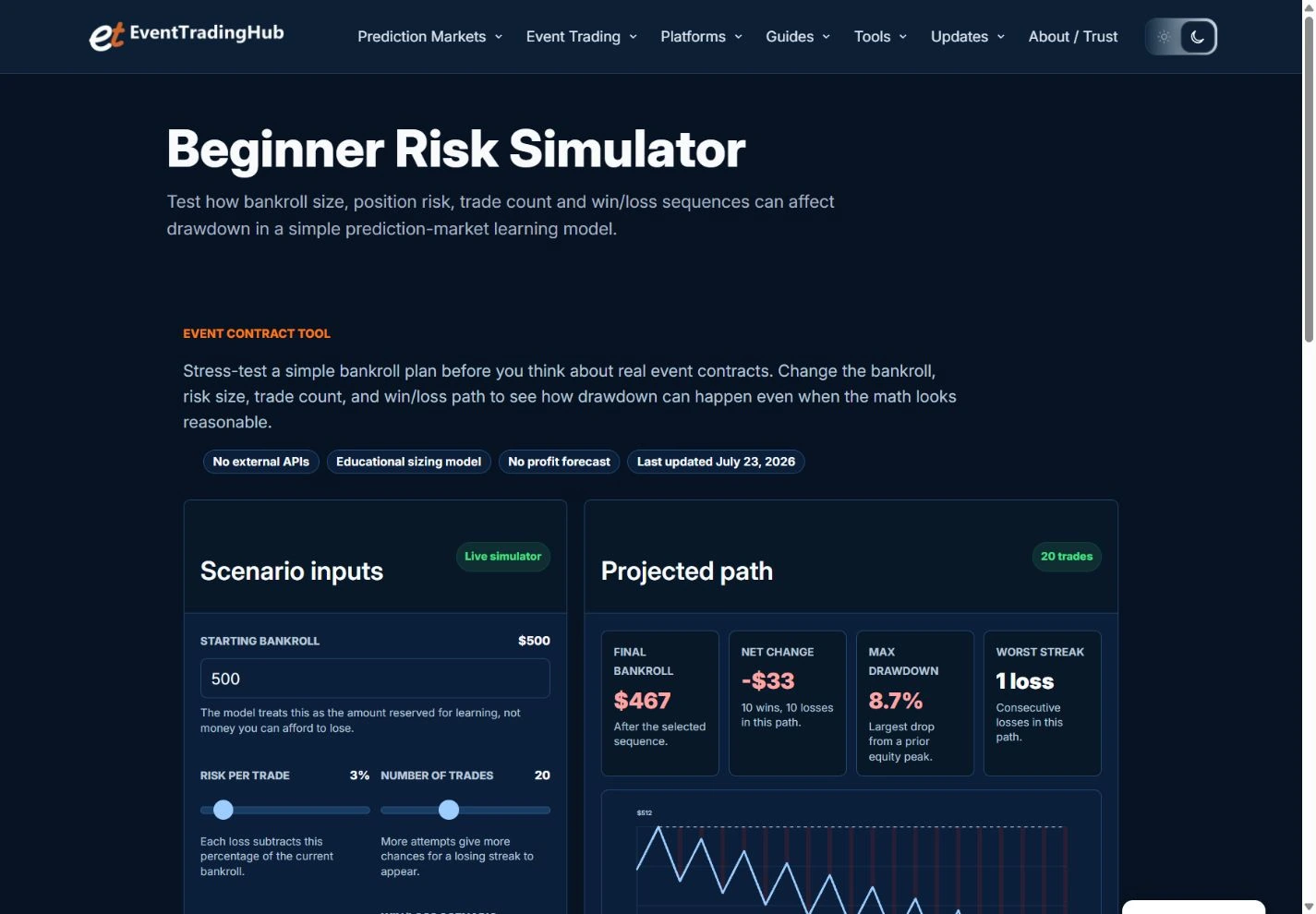
Calculator and Simulator Links
Use the calculator to model contract cost and maximum loss before placing a trade. Use the guides hub when you need the broader sequence from pricing to settlement to fees.
- YES/NO Contract Calculator for cost, payout, and maximum-loss examples.
- Guides hub for the full beginner learning path.
Source and Methodology Notes
This page uses the site’s existing educational explainers for probability pricing, liquidity, settlement, fees, and platform review methodology. Numeric examples are simplified worksheets, not live market quotes. This is educational content, not financial advice, legal advice, or a recommendation to trade.
Last editorial review: 2026-07-05.
FAQ
What is the most important risk rule for a beginner?
Know the maximum dollar loss before entering. If the loss would feel too large after the market resolves against you, the position is too large before you place it.
Is a small position always safe?
No. A small position can still be poorly researched, emotionally driven, or exposed to unclear rules. Smaller size only limits the dollar damage.
Does risk management improve prediction accuracy?
No. It does not make a forecast correct. It helps prevent one wrong forecast, one thin market, or one confusing resolution from doing too much damage.