


Liquidity is the part of a prediction market that tells you whether a displayed price is actually tradable. A market can show a neat probability, but if the order book is thin or the bid/ask spread is wide, your real entry and exit price can be much worse than the headline number.
This guide explains liquidity, bid/ask spread, market depth, and the simple checks a beginner should make before treating a prediction market price as usable. If you need the probability-pricing foundation first, start with Probability Pricing Explained.
What Liquidity Means in Prediction Markets
Liquidity means there are enough buyers and sellers near the current price for you to enter or exit without moving the market too much. In a liquid market, the best bid and best ask are usually close together, and there is meaningful size available at nearby prices.
In a thin market, the displayed price can be misleading. The last trade might have happened at 0.55, but the best ask could now be 0.66 and the best bid could be 0.42. That is not a clean 55% market for a new trader. It is a market where execution quality matters more than the headline chart.
Bid, Ask, and Spread
Most order-book markets have two sides:
- Bid: the highest price someone is currently willing to pay.
- Ask: the lowest price someone is currently willing to accept.
- Spread: the difference between the bid and the ask.
If a YES contract has a 0.48 bid and a 0.52 ask, the spread is 0.04. If you buy immediately, you may pay 0.52. If you sell immediately, you may receive 0.48. That four-cent gap is a real cost of fast execution.
For platform-specific terminology, Polymarket’s official documentation explains price and order-book concepts in its prices and orderbook guide. Kalshi’s official developer documentation also exposes market order-book data through its orderbook responses reference. Always check the current platform interface and rules before relying on a simplified example.
Spread cost worksheet
How Spread Can Consume Your Edge
Use the spread as a quick friction check before you trade. The wider the gap, the more the market has to move in your favor before your position is easy to exit cleanly.
Why the Spread Matters More Than the Last Price
The last traded price is history. The bid and ask are the live market. A beginner can be right about the event and still get a bad result if the entry price is too high, the exit price is too low, or the market is too thin to close the position without moving through several price levels.
That is why a market at 0.50 can behave very differently depending on liquidity. A 0.49 / 0.51 market is easier to trade than a 0.35 / 0.65 market, even if both charts show a recent trade near 0.50.
How to Read Market Depth
Market depth is the amount of size available at each price level. Beginners do not need a professional trading terminal to make a useful check. Look for three practical signals:
- Size at the best bid and ask. Is there enough size for the trade you are considering?
- Size one or two ticks away. If the best level is small, will your order jump into worse prices?
- Symmetry. Are there real buyers and sellers on both sides, or is one side mostly empty?
If the order book is thin, reduce the size, use a limit order, or skip the market. Liquidity is not just a detail; it is part of the risk.
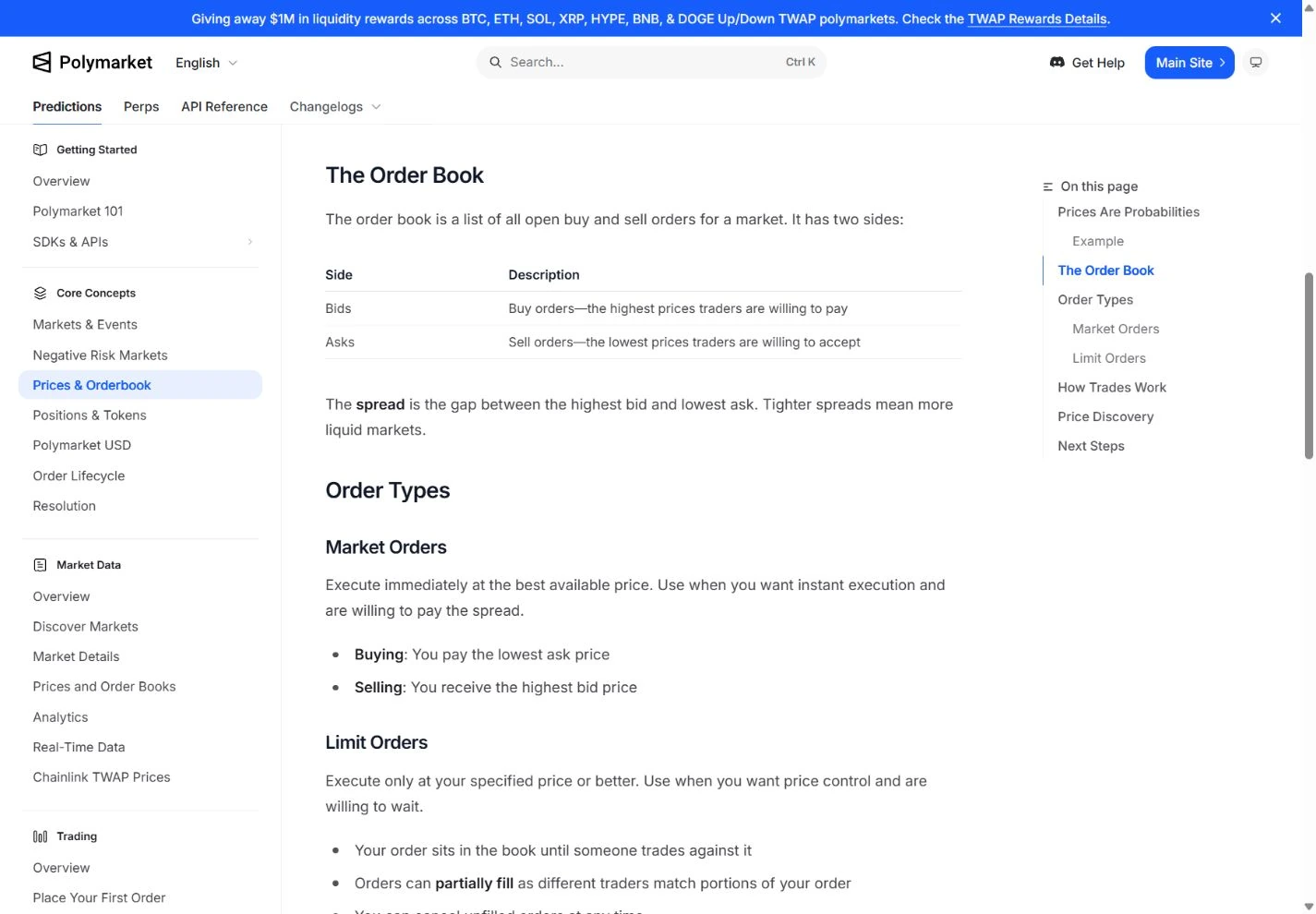
Limit Orders Versus Immediate Fills
A market order or aggressive immediate fill prioritizes speed. A limit order prioritizes price. For beginners, the difference is simple:
- Immediate fill: you get in quickly, but you accept the available ask or bid.
- Limit order: you name the price, but you may not get filled.
Neither choice is automatically better. If news is moving fast, waiting can mean missing the price. If the market is slow and the spread is wide, accepting the ask can be unnecessarily expensive.
When It Is Better Not to Enter
There are times when the cleanest decision is no trade. Consider staying out when:
- the spread is wider than the edge you think you have;
- there is not enough size near the displayed price;
- the market rules or resolution source are unclear;
- you would need to exit quickly but the book is thin;
- the market has not traded recently and the chart may be stale;
- your estimate depends on a headline you have not verified.
If the wording or final outcome source is the problem, read Market Resolution Explained before you focus on price. If the issue is position size, use the YES/NO Contract Calculator to model cost, payout, and maximum loss.
Beginner checklist
A 60-Second Liquidity Check
- Write down the best bid and best ask.
- Calculate the spread in cents or percentage points.
- Check how many contracts are available at the best ask if you are buying, or the best bid if you are selling.
- Look one or two price levels deeper to see whether your size would move the average fill.
- Decide whether your reason for the trade is larger than the execution friction.
How Liquidity Fits With Analysis
Liquidity is a filter, not a prediction model. It does not tell you whether YES or NO is correct. It tells you how much trust to put in the quoted price and how costly it may be to act on your view.
For a broader framework, use Prediction Market Analysis after this guide. For position sizing and maximum-loss checks, use Prediction Market Risk Management. For beginner risk basics, use the Prediction Markets Beginner Guide.
Source and Update Notes
This page uses official platform order-book documentation for the bid/ask and market-depth concepts it names. The numeric examples are simplified educational examples, not current quotes from a live market. Last editorial review: 2026-07-04.
FAQ
Is a liquid prediction market always more accurate?
No. Liquidity can make the price easier to trade and sometimes more informative, but a liquid market can still be wrong. It only means more trading interest is present near the current price.
What is a bad spread for a beginner?
There is no universal cutoff. A practical rule is to compare the spread with your expected edge. If the spread is larger than the advantage you think you have, the trade probably needs a better price or no entry.
Can I avoid spread by using limit orders?
You can try to improve your price with a limit order, but there is no guarantee it fills. A limit order trades certainty of execution for better price control.
For the full learning sequence, return to the Guides hub.