


Market resolution is the point where a prediction market stops being a live price and becomes a final outcome. The chart, the spread, and the last trade no longer matter. What matters is the written market question, the official source, and the platform’s settlement process.
This guide explains how prediction markets settle, why resolution wording matters, what can go wrong in ambiguous markets, and what a beginner should check before putting money at risk. If you want the pricing side first, read Probability Pricing Explained.
What Market Resolution Means
In a simple yes/no prediction market, resolution determines which side is worth 1.00 and which side is worth 0.00. If the market resolves YES, YES holders receive the winning value and NO holders do not. If the market resolves NO, the reverse happens.
The hard part is not the payout formula. The hard part is deciding which outcome actually satisfies the market rules.
The Four Things That Decide Settlement
| Item | Why it matters | Beginner question |
|---|---|---|
| Market title | Frames the question people see first. | What exactly has to happen? |
| Resolution rules | Define the source, timing, and edge cases. | What document or data point settles it? |
| Close or expiration time | Controls when trading stops or when the result is expected. | Can the event happen after trading closes? |
| Dispute process | Determines what happens if traders disagree. | Who reviews the evidence if the answer is unclear? |
Who Decides the Outcome?
The answer depends on the platform and market type. The safest beginner rule is to read the actual market rules, not only the headline.
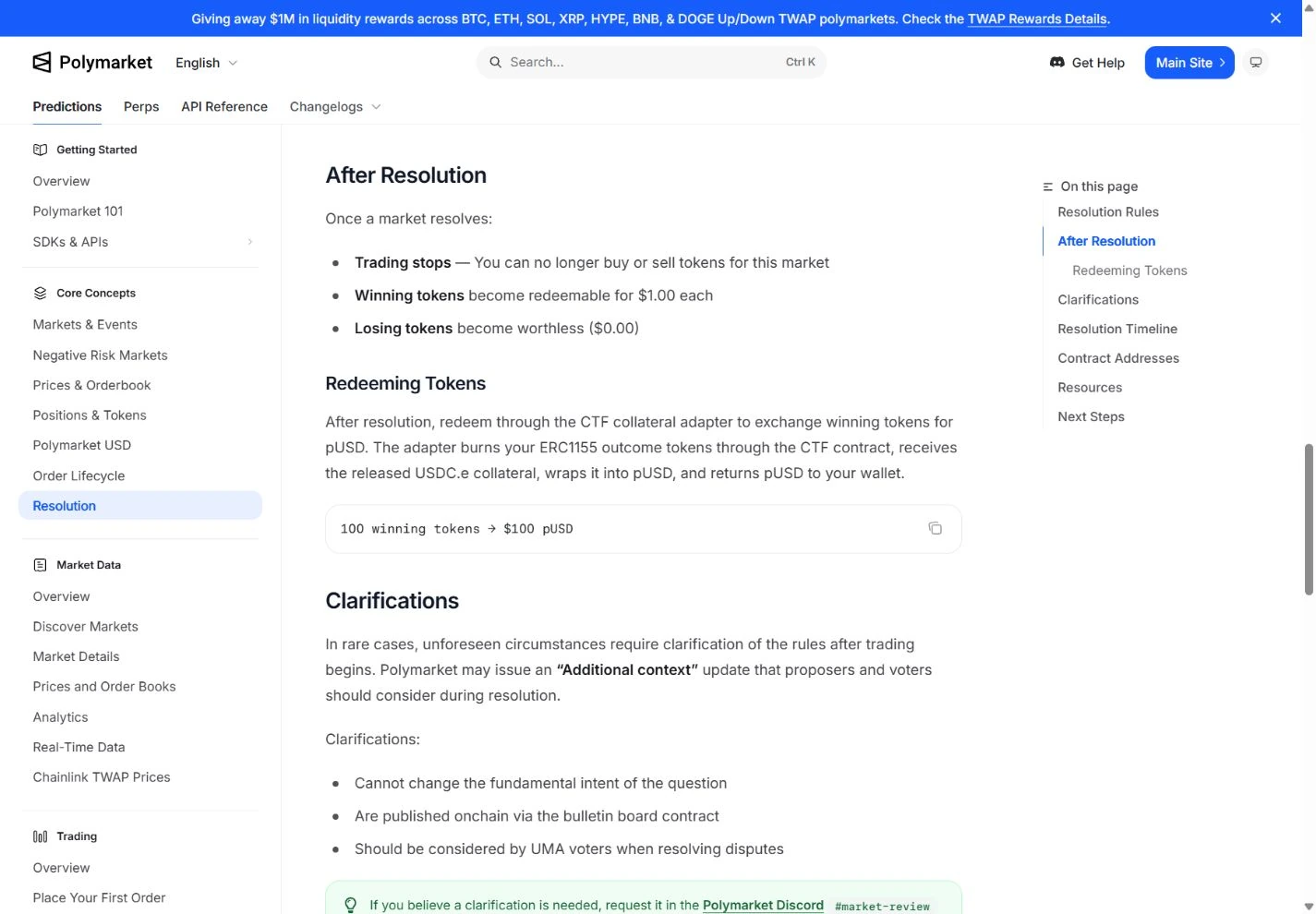
Polymarket’s current official documentation says markets use the UMA Optimistic Oracle for resolution, with a challenge period and possible escalation if a proposal is disputed. The details are in Polymarket’s resolution documentation.
Kalshi’s current API documentation describes a lifecycle where markets move through states such as active, closed, determined, disputed, amended, and finalized. It also says settlement timing can vary by market type, source availability, and review requirements. See Kalshi’s market settlement documentation for the official description.
PredictIt markets have their own market-specific rules and constraints. For beginner context, use our PredictIt guide and then check the live market terms before relying on any settlement assumption.
Why Wording Matters More Than the Headline
Many bad trades begin with a good prediction and a bad reading of the rules. A headline might say “Will Candidate X win?” but the rules may specify a particular office, deadline, source, certification standard, or media call. Those details can decide the result.
Before trading, rewrite the market in your own words:
- What exact event would make YES correct?
- What exact event would make NO correct?
- What source settles the answer?
- What happens if the event is delayed, cancelled, revised, or disputed?
If you cannot answer those questions clearly, the market has resolution risk.
Ambiguous Markets: A Simple Example
Consider a market that asks whether a company will “announce” a product by a certain date. Does a teaser count? Does a CEO interview count? Does a regulatory filing count? Does a product page count if the product is not available yet?
The price may look attractive, but the settlement risk can dominate the trade. A market with ambiguous wording can move against you even if your real-world intuition was reasonable. For this reason, resolution criteria belong in the trade checklist, not in the after-the-fact review.
What Happens During a Dispute?
A dispute means someone challenges the proposed or expected answer. The exact process depends on the platform. In general, disputes can delay settlement, lock capital longer than expected, and force the final answer to depend on narrower evidence than casual readers expect.
This is why market resolution is not just an operational detail. It is part of risk management. A trader who ignores settlement rules is not fully reading the contract.
Pre-Trade Resolution Checklist
- Read the full market rules. Do not rely only on the title.
- Find the resolution source. Look for the official data release, governing body, platform rule, or named source.
- Check timing. Know the close time, expected resolution time, and any deadline language.
- Identify edge cases. Delays, recounts, revised data, ties, cancellations, and partial outcomes can matter.
- Compare platform style. Polymarket, Kalshi, and PredictIt do not use identical resolution processes; use the relevant review pages for context: Polymarket review, Kalshi review, and PredictIt guide.
- Size for delay risk. If a dispute could tie up your capital, size the position accordingly.
Resolution Risk for Beginners
Resolution risk is the chance that the final settlement path differs from your intuitive reading of the event. It can come from unclear wording, source selection, revised data, platform-specific rules, or an actual dispute.
The practical lesson: a market can be correctly priced on probability and still be a poor beginner trade if the rules are hard to interpret. Read the rules before reading the chart.
Source and Update Notes
This page links to official Polymarket and Kalshi documentation for platform-specific resolution mechanics. Platform rules can change, and individual markets can have their own terms. Last reviewed: 2026-07-04.
FAQ
How long does market resolution take?
It depends on the platform, source, and dispute path. Some markets settle quickly after a clear result; others can take longer when evidence or rules are contested.
Can a market resolve differently than public opinion expects?
Yes. Markets resolve by their written rules and selected sources, not by the broadest social-media interpretation of the event.
Should beginners avoid ambiguous markets?
Usually, yes. If you cannot explain the resolution criteria in one or two plain sentences, it is better to pass or keep the position very small.
For the broader learning path, return to the Guides hub or start with the Prediction Markets Beginner Guide.