


This beginner guide is a learning path. It is not the full definition page, the full pricing manual, or a platform review. Use it to decide what to read first, how to practice safely, and what to check before a first small trade.
If the basic idea is still unclear, read what prediction markets are first. If you want the math and mechanics, read how prediction markets work.
Start Here: The Simple Learning Order
- Understand the definition: a market trades contracts tied to real-world outcomes.
- Understand price as probability: $0.63 roughly means the market prices the event around 63%.
- Understand payout: a winning YES/NO contract usually settles at $1.00 and a losing contract at $0.00.
- Understand platform rules: availability, fees, funding, market rules, and resolution sources vary.
- Practice with very small size before treating any result as meaningful.
The First Concept to Master
The first beginner mistake is asking only, “Will this happen?” A better question is: “Does the current price make sense for the probability I believe?”
A YES contract at $0.90 can still lose. A YES contract at $0.20 can still win. Price is not certainty. It is the market’s current estimate.
How to Choose a Platform Without Getting Lost
Do not start by asking which platform is best. Start with access, rules, funding, event categories, and regulation. A platform that is useful for one user may be unavailable or unsuitable for another.
Use the prediction market platforms database when you need a structured comparison. Use individual platform reviews only after you know what kind of venue you are evaluating.
Your First Practice Trade: A Safe Checklist
The first trade should be about learning the workflow, not proving a theory. A small test is enough to learn how order entry, price movement, and resolution rules feel in practice.
- Pick a market you already understand.
- Read the market rules and understand how market resolution works before entering.
- Check the current price, spread, and available liquidity.
- Use a tiny position that you can afford to lose completely.
- Write down why you entered and what would make you exit.
- After the market moves, compare your original reasoning with what actually happened.
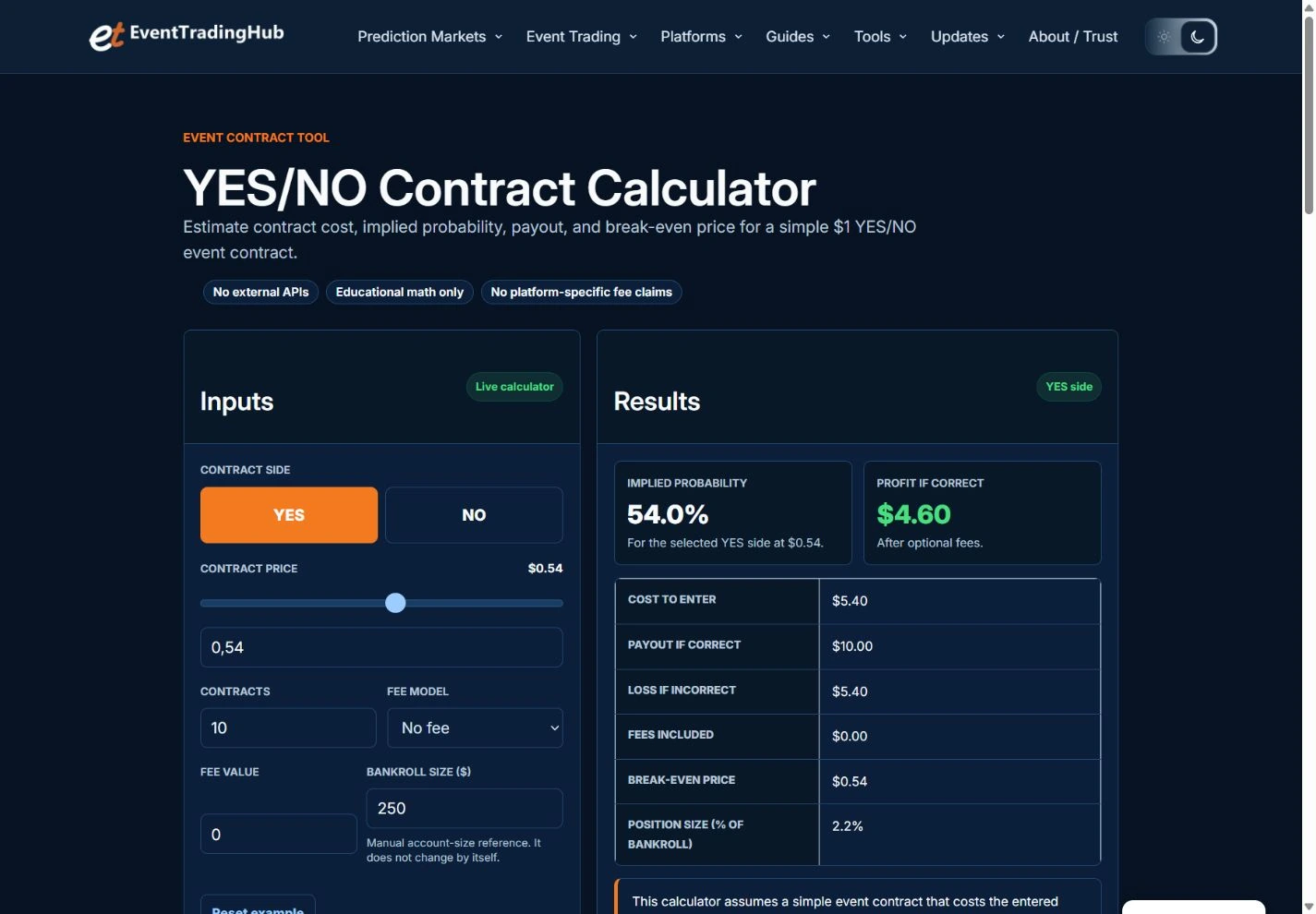
Before committing real size, run the numbers in the YES/NO contract calculator so you know the possible payout and loss.
Mini Case Study: When a Market Gets Humbled
Case study table
Case Study Summary
Use this table to compare the core case-study facts before reading the detailed fields below.
| Event | Date | Platform | Before Price | After Price | Final Result | Lesson |
|---|---|---|---|---|---|---|
| Eurovision Song Contest 2024 final | May 11, 2024 | Public prediction/odds markets; this beginner guide does not rely on a platform-specific archived price. | Not carried forward here as a verified chart claim; a reader should record this from the market they are studying. | Not carried forward here as a verified chart claim; the point is to compare the saved pre-event price with the final result. | Switzerland's Nemo won with "The Code." | Use a real event to practice recording what the market believed, what changed, and how the final rules resolved. |
Mini case study
Eurovision 2024: confidence is not the same thing as certainty
Use examples like this in a learning journal. Write down what the market believed, what information changed, how quickly price moved, and whether the final rules matched what participants expected.
Good Beginner Markets to Practice Reading
- Weather markets where the event and resolution source are easy to understand.
- Sports or entertainment markets only if you already follow the category.
- Economic-data markets only if you understand the release schedule and source.
- Avoid obscure events, thin order books, and markets where you do not understand the resolution wording.
Bankroll and Risk Rules
Prediction markets can go to zero. That is the risk profile beginners need to internalize first. A small position is not a lack of confidence; it is how you buy learning without letting one mistake dominate the account. Use the beginner risk-management guide to turn that principle into position and maximum-loss limits.
- Do not deposit money you need for bills, rent, debt, or emergencies.
- Assume your first trades are tuition, not income.
- Keep position size small until you have a written track record.
- Avoid chasing a price after breaking news has already moved the market.
- Treat fees, spread, and bad exits as part of the cost of trading.
Common Beginner Mistakes
- Confusing a high probability with a guaranteed result.
- Entering a trade without reading the rules.
- Choosing a platform before checking access and funding constraints.
- Betting on a story instead of comparing the story to the price.
- Using one lucky win as proof of skill.
- Ignoring liquidity because the headline market looks interesting.
What to Read Next
Use the guides hub for the full learning library. Once you are ready to compare venues, move to the platform database. Use a platform-specific review only after you know which venue and access model you need.
Frequently Asked Questions
How much should a beginner start with?
Start small enough that a complete loss is educational, not damaging. The goal of a first trade is to learn the workflow and risk profile.
Do I need to understand politics?
No. Prediction markets can cover politics, weather, sports, economics, crypto, entertainment, and other event categories. Start with categories you already follow.
Should I pick the platform first or the market first?
Check platform access and rules first, then choose a simple market. A market is only useful if you can legally and practically access the venue and understand the resolution rules.
Can prediction markets be wrong?
Yes. Markets can overreact, underreact, suffer from thin liquidity, or misunderstand edge cases. Treat prices as useful signals, not final truth.
Original value worksheet
First-session decision tree
Use this as a practical path before placing a real-money trade. It turns the beginner guide into a checklist, not just background reading.
- Stop if you cannot explain why the contract could settle at $0.00.
- Stop if you are relying on a headline instead of the written market rules.
Source notes
Figure and Source Notes
This note explains how to read the numbers on this page so examples are not mistaken for unsourced platform facts.
- The Eurovision example does not carry a platform-specific archived price claim; it is a beginner worksheet for recording event date, market view, and final outcome.
- Recheck the official contest archive before using the Eurovision result as a standalone data point.
- $1.00 and $0.00 settlement examples describe gross binary-contract mechanics before fees, spreads, taxes, withdrawal costs, or platform-specific rules.
- Example prices and probabilities on this page are teaching math, not historical platform-price records or performance data.
- Fees, limits, country/state availability, deposit methods, withdrawal methods, and resolution rules can change by platform and market. Check the current official rules before using real money.
Beginner mistakes
Beginner Mistakes to Avoid
Use this before a first real-money test. The goal is not to find a perfect trade; it is to avoid errors that make the result hard to learn from.
- Pause if the written market rules do not match the headline you are reacting to.
- Pause if you cannot explain the difference between probability, payout, and maximum loss.
Risk notice
Prediction markets involve risk
Prediction markets and event contracts involve financial risk. You can lose money, including the full amount committed to a contract.
Event Trading Hub is for education and research only. This is not financial, investment, legal, or tax advice. You are responsible for your own decisions and for checking platform rules, fees, availability, and local regulations before trading.