


An event-trading strategy should define the contract question, the evidence that could change its probability, the entry and exit rule, and the maximum loss. Without those four parts, labels such as news reaction, trend, or arbitrage do not describe a repeatable method.
The seven patterns below use 2024 and 2025 case notes to compare triggers, evidence, liquidity constraints, rule risk, and failure cases. Platform references to Polymarket, Kalshi, and PredictIt are examples, not endorsements or claims that one pattern will be profitable.
If you’re brand new, start by reading our event trading hub for the basics. This article assumes you know what a binary YES/NO contract is and how shares settle at $1 or $0.
Before You Start: Risk Management Rules
Risk controls belong in the strategy before entry. Record the maximum dollar loss, the contract rule, the exit condition, and any other positions exposed to the same event.
Never bet more than you can afford to lose
Use only funds whose full loss would not affect rent, food, debt payments, emergency savings, or other essential spending. There is no universal beginner bankroll: platform minimums, fees, contract sizing, and personal finances differ.
Position sizing: define a loss cap
A percentage cap is a worksheet rule, not a universal recommendation. For example, a 5% cap on a $200 learning bankroll limits one position to $10 before fees; use a lower cap when rules, liquidity, or correlated exposure are unclear.
Keep a trading journal
Write down every trade: the market, your entry price, your thesis in one sentence, your exit price, and the result. After 30 trades, patterns emerge. You’ll find out which strategies actually work for you and which ones you should drop.
Separate your event-trading bankroll
Track deposits, withdrawals, fees, and position losses in a separate ledger or account view. Separation makes the learning cost visible; it does not reduce market or platform risk.
Strategy 1: News-Driven Probability Hunting
Scheduled releases provide a known time and primary source, which makes them easier to study than an unexpected headline. Speed alone is not an edge: first check whether the release changes the exact contract rule and whether the order book has already repriced.
Case study table
Case Study Summary
Use this table to compare the core case-study facts before reading the detailed fields below.
| Event | Date | Platform | Before Price | After Price | Final Result | Lesson |
|---|---|---|---|---|---|---|
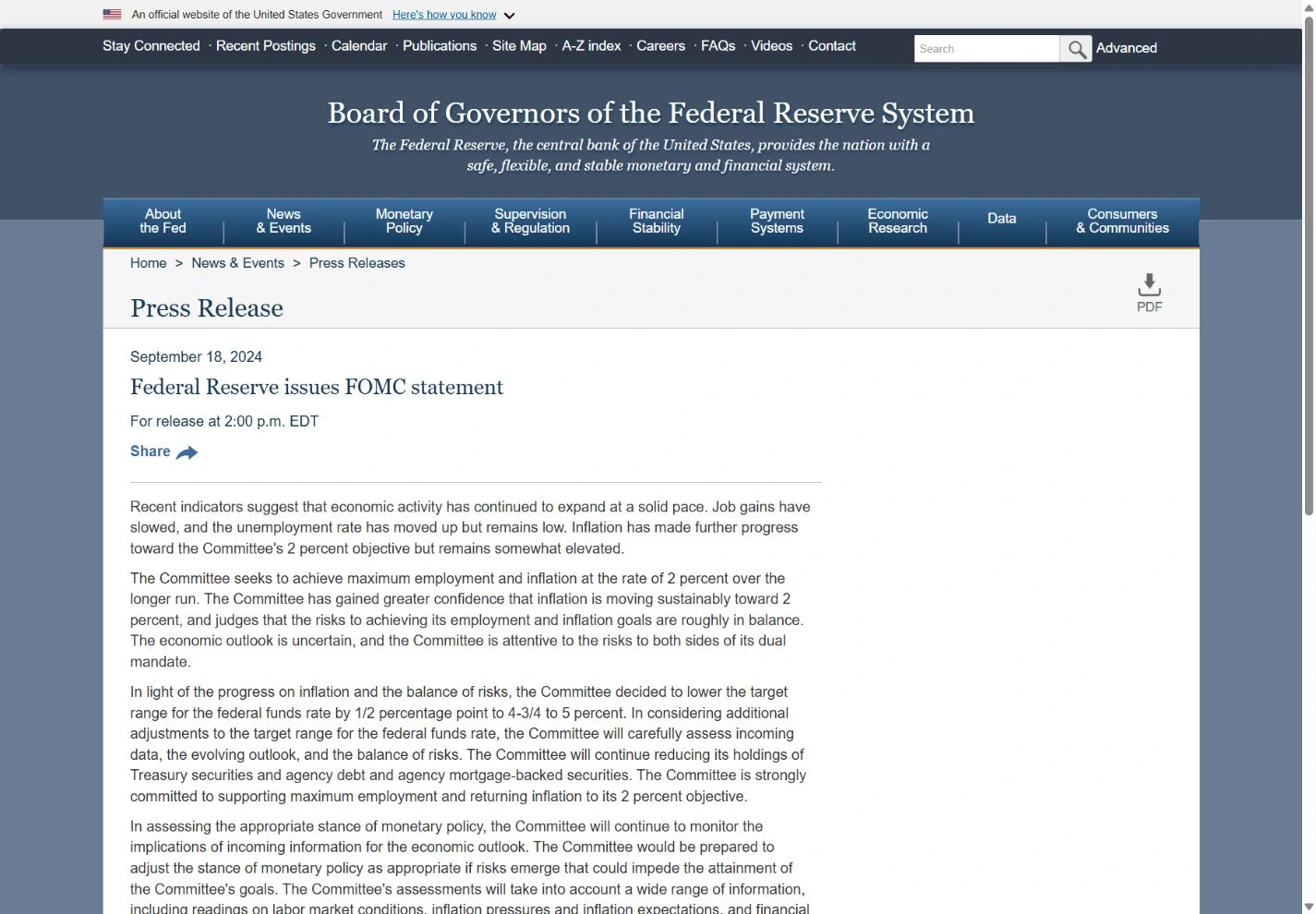
| September 2024 FOMC rate decision | September 18, 2024 | Kalshi | The 50 bps cut side had traded near the low $0.30s earlier in the setup. | It moved into the $0.50s before settlement and paid $1.00 after the decision. | The Federal Reserve lowered the target range by 1/2 percentage point to 4.75%-5.00%. | A scheduled event can reprice before the headline if speeches, labor data, and inflation data change the setup. |
Mini case study
September 2024 Fed decision: pre-positioning before a scheduled catalyst
The lesson: scheduled events (Fed meetings, CPI prints, jobs reports, debates) have predictable news flow. Watch the wires, understand what each piece of new information implies for the contract, and act before the herd. If you need a refresher on the mechanics, start with what event trading is. Also useful: our Kalshi review if you’re new to that platform.
Strategy 2: Polling Convergence Trade
A single poll and a multi-poll average answer different questions. Before treating apparent convergence as evidence, compare field dates, sample design, likely-voter assumptions, house effects, and whether the polls are genuinely independent.
Pattern note: a state-level outlier poll can drag a headline contract several cents even when the broader trend has barely moved. Treat that as a setup to investigate, not as proof of a trade. Compare rolling averages, related markets, and the written contract before deciding whether the move is signal or noise. Our Polymarket review explains the platform context.
The takeaway: an outlier-driven price move is a prompt to inspect the polling average and contract rules, not an automatic buy signal. A broader trend can still be stale, correlated, or already reflected in the market price.
Strategy 3: Event Calendar Pre-Positioning
Macroeconomic data has the world’s most predictable calendar. CPI drops on a schedule. The jobs report drops on a schedule. FOMC meetings are announced months in advance. You don’t need to time the news perfectly — you can take positions days or weeks before the event.
Case-study link: the September 2024 FOMC example above is the same pattern in calendar form. The event was known months ahead, but the market view changed as labor data, inflation data, and Fed communication narrowed the range of plausible outcomes.
How to use this: build a calendar of upcoming events (Fed meetings, key data releases, election debates, earnings for big-tech-related markets). Identify which ones you have a view on. Take small positions early, with a clear plan to exit before, during, or right after the event depending on the strategy. For the broader mechanics behind those probability moves, see our prediction markets beginner guide.
Strategy 4: Settlement Arbitrage
Markets sometimes lag reality. As an event nears certain resolution, the price should snap to $0.99 or $0.01 — but human inertia and thin late-stage liquidity sometimes leave a gap. That gap, captured at scale and with discipline, is real money.
How it shows up: a year-end price-target market on an asset that has already crossed its threshold with weeks of runway left. Or a sports-championship market where the heavy favorite has just opened a 30-point fourth-quarter lead. Or a Senate-race market where the AP has already called the seat but the contract still reads $0.97 because limit orders haven’t filled. In all three patterns, the contract should snap to $0.99 immediately but human inertia and thin late-stage liquidity leave a 2-3 cent gap for hours. That gap, captured at scale and with discipline, is real money. A clean version of this pattern is a year-end threshold market after the underlying asset has already crossed the threshold well before the settlement window.
The math is simple: if a contract reads $0.95 YES with 24 hours until a near-certain settlement, you’re risking 5 cents to make 5 cents — roughly 1-to-1 odds on something that’s 98%+ likely. The catch is that capital is tied up, and “near certain” is doing heavy lifting. If you misjudge the certainty, the loss is total. The safest beginner habit is to read the platform’s written resolution rule before you enter, not after the market gets tense.
Strategy 5: Cross-Platform Arbitrage
The same event sometimes trades at different prices on different platforms. A championship-winner contract might read $0.43 on one venue and $0.31 on another at the same moment, simply because the platforms have different user bases pricing the same outcome differently. In theory, you buy the cheaper exposure and hedge or sell the richer exposure where the venue’s rules allow it, then capture the spread when both markets converge or settle.
The theory is beautiful. The practice is brutal. Funds on the global Polymarket venue sit in USDC on the Polygon blockchain. Funds on Kalshi sit in USD via ACH. Moving capital between them takes hours to days, plus on-chain fees, plus exchange fees if you’re converting through a centralized exchange. By the time you’ve routed everything, the spread has often closed.
Cross-platform execution requires equivalent contract rules, legal eligibility, funded accounts, transfer time, fee estimates, and enough depth on both venues. No bankroll threshold makes the spread low-risk or guarantees frequent profit.
Strategy 6: Tail-Risk Hedge (Longshot YES)
A low-price contract offers a large gross payout only if it settles in your favor. The price alone does not prove underpricing; the thesis needs a base rate, contract-rule check, source trail, and an explicit maximum-loss calculation.
Pattern note: longshot baskets only work if the implied probabilities are genuinely too low and the sizing is disciplined. Treat small-price markets as forecast exercises first: write the base rate, the reason the market may be mispricing it, and the maximum loss if every leg goes to zero.
A basket does not remove event or correlation risk. Calculate the combined maximum loss and check whether several contracts depend on the same election, policy decision, team, or economic release.
The hard part is honest probability assessment. If you’re buying $0.07 longshots that are actually 3% likely, you’re losing money. This strategy demands discipline about your own forecasting accuracy.
Strategy 7: Liquidity Provision
Instead of crossing the spread, place limit orders on it. When someone is willing to pay $0.62 and someone else is willing to sell at $0.64, the 2-cent spread is the cost of immediate execution. Patient traders place limit orders inside that spread and earn the difference whenever orders cross them.
This is most attractive on markets where fees are low and the spread is wide enough to pay you for the risk. Do not assume Polymarket is always 0% fee anymore: fee schedules now vary by venue, market type, and whether you are using the global crypto venue or the regulated US venue. On Kalshi, per-contract fees also eat into the spread, so the math is tighter.
How it works in practice: Pick a market with steady volume and a 2-3 cent spread. Place small limit orders at $0.61 buy and $0.63 sell. As the market churns, both sides eventually fill. You’ve bought at 61, sold at 63, and walked away with 2 cents per share at zero net directional exposure.
The risk is “adverse selection” — you fill on the buy right before bad news and the price drops to $0.50. That’s the cost of providing liquidity. Mitigate by sizing small, focusing on stable markets rather than headline-driven ones, and pulling orders before known events.
Common Beginner Mistakes
Watch yourself for these — every beginner makes at least three of them.
Chasing news after the price has moved
The dopamine hit of “buy now before it’s too late” usually means you’re buying the top. If the price has already repriced 80% of the news, you’re buying the last 20% at full risk.
Going all-in on a conviction trade
“This one is different” is the most expensive sentence in trading. If you find yourself wanting to put 50% of your bankroll on one position, that’s a flashing warning light, not a green light.
Ignoring fees and spreads
A 3-cent spread on a $0.50 contract is a 6% round-trip cost. If your strategy doesn’t beat that consistently, you’re paying the platform to lose money. Track your fees as carefully as your wins.
Not tracking results by strategy
Lumping all your trades into one P&L number hides which strategies actually work for you. Tag every trade with the strategy you used. After a few months, the data tells you what to keep and what to drop.
How to Practice These Strategies
Don’t start with real money. Start with a paper-trading journal — a simple spreadsheet that tracks every hypothetical trade as if you had placed it.
Paper-trade journal template
Columns: Date, Platform, Market, Strategy used, Entry price, Position size (in dollars), Thesis (one sentence), Resolution date, Exit price, fees, and net P&L. Choose a review window before starting. A small sample is a learning record, not proof that a strategy works.
Start small with real money
If you move from paper tracking to real money, use only an amount you can lose in full and first confirm platform minimums, fees, eligibility, funding, withdrawal, and contract rules. No fixed dollar amount is appropriate for every reader.
Track win rate per strategy
Review each pattern separately: observation count, entry price, spread, fees, maximum loss, exit rule, and net result. Do not increase size from a short winning sample; first check whether the result survives costs and different market conditions.
For more practical depth, our event trading hub gathers the core concepts, and the platform reviews cover quirks that affect execution.
Frequently Asked Questions
Which strategy is best for an absolute beginner?
No pattern is best by default. Scheduled-event study is easier to document because the release time and primary source are known, but that does not predict direction or profit. Cross-platform and liquidity-provision setups add execution, fee, and rule complexity.
Can I automate any of these event trading strategies?
Some venues expose APIs for market data and order management, but automation adds code, latency, monitoring, and execution risk. A manual journal is sufficient for testing whether the written decision rule is coherent before building software around it.
How long until these strategies become profitable?
There is no evidence-based timetable to break even or become profitable. Track net results after fees and compare them with the maximum loss taken; a positive short sample is not a forecast of future performance.
Should I specialize in one strategy or use all seven?
Study one pattern long enough to apply the same checklist consistently, then review the record before adding another. The useful threshold is evidence quality and repeatable process, not a fixed trade count.
Are these event trading strategies legal in the United States?
Kalshi describes itself as a CFTC-regulated exchange, but user eligibility and product availability still depend on current account and market rules. PredictIt operates under an amended CFTC no-action framework with caps. Polymarket access depends on product, region, and current terms. Always check the current rules for your jurisdiction before trading.
How much money do I need to start?
Use a small learning bankroll only if the current platform minimums, fees, and contract sizing make the exercise practical. The 1-5% position-sizing examples on this page are teaching math, not a claim that every platform supports the same minimum trade size — small, but enough to learn from. Don’t fund more than you’d be willing to lose entirely while you’re still learning.
Original value worksheet
Strategy mistake analysis
A strategy is only useful if the failure mode is visible before the trade. Use this table to pressure-test a setup instead of treating a named strategy as a signal.
Source notes
Figure and Source Notes
This note explains how to read the numbers on this page so examples are not mistaken for unsourced platform facts.
- The September 18, 2024 FOMC outcome and target-range figure are supported by the Federal Reserve statement.
- The Kalshi case-study price path is retained as an approximate market-chart/reference note from the 4.2 case-study pass; re-open the archived market chart before reusing it as a standalone statistic.
- Position-size, bankroll, spread, and strategy numbers outside the case study are teaching examples or conservative practice notes, not audited performance claims.
- Legal, fee, and eligibility references are reminders to check current official rules, not new platform availability claims.
Beginner mistakes
Beginner Mistakes to Avoid
A strategy label is not a reason to enter. Use this checklist to pressure-test the setup before treating a market move as an opportunity.
- Write the failure case before entry: what would prove the setup was wrong?
- Read the rules before trading the headline version of a strategy.
Risk notice
Prediction markets involve risk
Prediction markets and event contracts involve financial risk. You can lose money, including the full amount committed to a contract.
Event Trading Hub is for education and research only. This is not financial, investment, legal, or tax advice. You are responsible for your own decisions and for checking platform rules, fees, availability, and local regulations before trading.