


Prediction markets work by turning a future event into a tradable contract. The contract price becomes a live probability signal, and the final resolution determines whether the contract pays out.
This is the mechanics page. If you need the simple definition first, start with what prediction markets are.
The Basic YES/NO Contract
Most beginner-friendly prediction markets use YES/NO contracts. The market asks one clear question, and each side represents one possible answer.
- YES wins if the event happens under the market rules.
- NO wins if the event does not happen under the market rules.
- The winning side usually settles at $1.00.
- The losing side usually settles at $0.00.
The important detail is that you can often trade before the event resolves. You are not always locked into waiting for the final outcome.
What a $0.63 Price Means
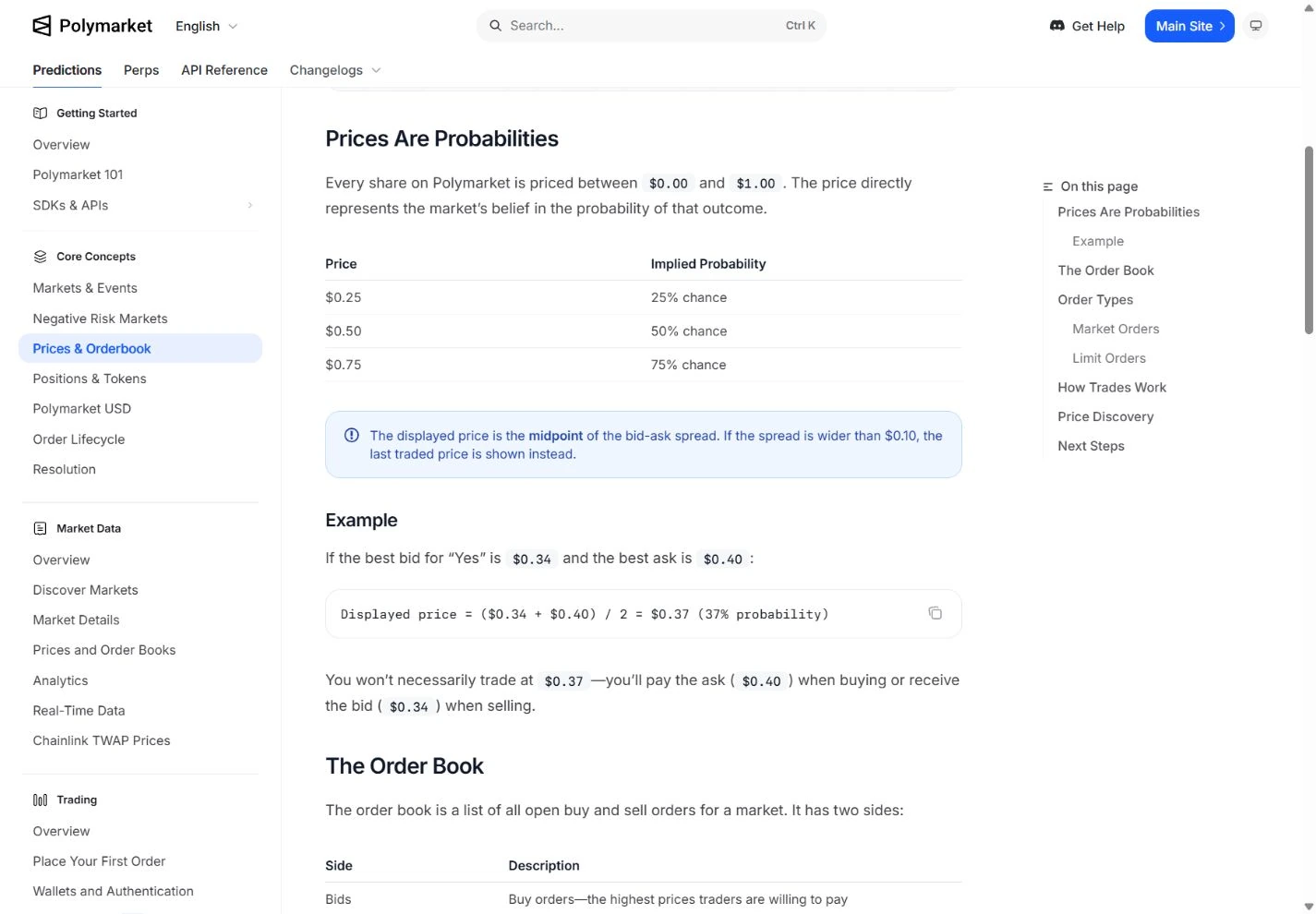
If a YES contract trades at $0.63, the market is roughly pricing the event at a 63% probability. If it trades at $0.28, the market is roughly pricing the event at 28%. The probability pricing explained guide develops this relationship with bid, ask, fees, and break-even examples.
That number is not a promise. It is a traded estimate. Buyers and sellers are constantly pushing the price up or down based on data, news, positioning, and risk appetite.
How Payout Math Works
The simple payout formula is easy to remember: if you buy a contract at $0.40 and it settles at $1.00, the gross gain is $0.60 per contract before platform costs. If it settles at $0.00, the loss is the $0.40 paid.
A 100-contract position at $0.40 costs $40. If it wins and settles at $1.00, the position pays $100. If it loses, it pays $0. If the market moves to $0.70 before resolution, selling early would return $70 before any costs.
For quick sizing and payout checks, use the YES/NO contract calculator.
Why Prices Move
Prices move when traders revise their view and actually trade. News by itself does not move a market unless participants act on it.
A rate-cut market might trade at 35% before an inflation report. If the report is weaker than expected, traders may buy YES and push the price toward 55%. If a later official comment pushes against that interpretation, the same market can fall back again.
That is why price movement is useful: it shows how the market is processing information in real time. For a deeper reading framework, see how traders read probability movements.
Liquidity and Spread
Liquidity is how easy it is to trade without moving the price too much. A liquid market has enough buyers and sellers near the current price. A thin market may have wide gaps between bids and asks.
The spread is the difference between the best price someone is willing to pay and the best price someone is willing to sell for. A tight spread can make entry and exit cleaner. A wide spread can quietly make a trade worse before the event even moves. Use the liquidity and spread guide for order-book depth and executable-price examples.
Resolution Rules
Every prediction market needs rules that define what counts as YES and what counts as NO. Those rules matter. A headline may sound obvious, but the contract resolves according to the written criteria.
- Check the exact event deadline.
- Check the named data source or resolution source.
- Check whether edge cases are included or excluded.
- Check whether the wording matches the claim you think you are trading.
Step-by-Step Example
Here is a clean mechanics example using a rate-decision market. The question is whether the central bank cuts rates at the next meeting.
- The YES contract trades at $0.35.
- You buy 100 YES contracts, so the position costs $35.
- New economic data comes in weaker than expected, and YES rises to $0.55.
- You can sell at $0.55 for $55 before resolution, or keep holding and accept the final settlement risk.
- If YES eventually wins, the position settles at $100. If YES loses, it settles at $0.
The example is not a recommendation. It is a mechanics walkthrough: entry price, position cost, price movement, exit option, and resolution.
Where Beginners Misread the Mechanics
- They treat a 70% price as a guarantee instead of a probability.
- They ignore spread and liquidity.
- They do not read resolution rules before entering.
- They focus only on being right, not on whether the current price is reasonable.
- They size positions too large before understanding settlement risk.
What to Read Next
Once the mechanics are clear, use the prediction markets beginner guide for a learning path, platform-selection steps, and a first-trade checklist.
Original value worksheet
100-contract payout worksheet
This calculation keeps the mechanics concrete. The numbers are generic examples, but the workflow is the same: entry cost, possible payout, possible loss, and optional exit before resolution.
Source notes
Figure and Source Notes
This note explains how to read the numbers on this page so examples are not mistaken for unsourced platform facts.
- The 100-contract worksheet is gross payout math before platform costs.
- $1.00 and $0.00 settlement examples describe gross binary-contract mechanics before fees, spreads, taxes, withdrawal costs, or platform-specific rules.
- Example prices and probabilities on this page are teaching math, not historical platform-price records or performance data.
- Fees, limits, country/state availability, deposit methods, withdrawal methods, and resolution rules can change by platform and market. Check the current official rules before using real money.
Quick answers
How Prediction Markets Work FAQ
Beginner mistakes
Beginner Mistakes to Avoid
These mistakes are about mechanics. A reader can understand the headline and still misread how price, payout, spread, and settlement work.
- Check entry cost, possible payout, and maximum loss as separate numbers.
- If a market can be exited early, separate that price-move decision from waiting for final resolution.
Risk notice
Prediction markets involve risk
Prediction markets and event contracts involve financial risk. You can lose money, including the full amount committed to a contract.
Event Trading Hub is for education and research only. This is not financial, investment, legal, or tax advice. You are responsible for your own decisions and for checking platform rules, fees, availability, and local regulations before trading.