


Event study · Updated October 10, 2026
One Battle After Another won Best Picture at the 2026 Oscars. Kalshi’s pre-show favorite got that race right, but the more revealing result came in Live Action Short Film: two films won the award, and both of their individual Kalshi contracts resolved No. A separate Tie contract resolved Yes.
The 98th Academy Awards, held on March 15, offer two different tests of a prediction market: whether its forecasts were useful, and whether a reader understood the outcome being traded. This review separates the pre-ceremony snapshot, the Academy’s results and the completed market records. All six screenshots were captured on October 10, 2026; none is presented as a screenshot taken on awards night.
If the difference between a film winning and a contract resolving Yes is unfamiliar, the prediction markets beginner guide explains the basic contract structure. Here, that difference decides the central case.
1. What the pre-show forecast actually measured
In its March 16 recap, Kalshi reported that its favorites won 19 of 24 categories. The article specifies a forecast cutoff of 7 PM ET, when the ceremony began. That is approximately 79.2%, calculated as 19 divided by 24. It is Kalshi’s own scorecard; we did not independently reconstruct every category’s price history.
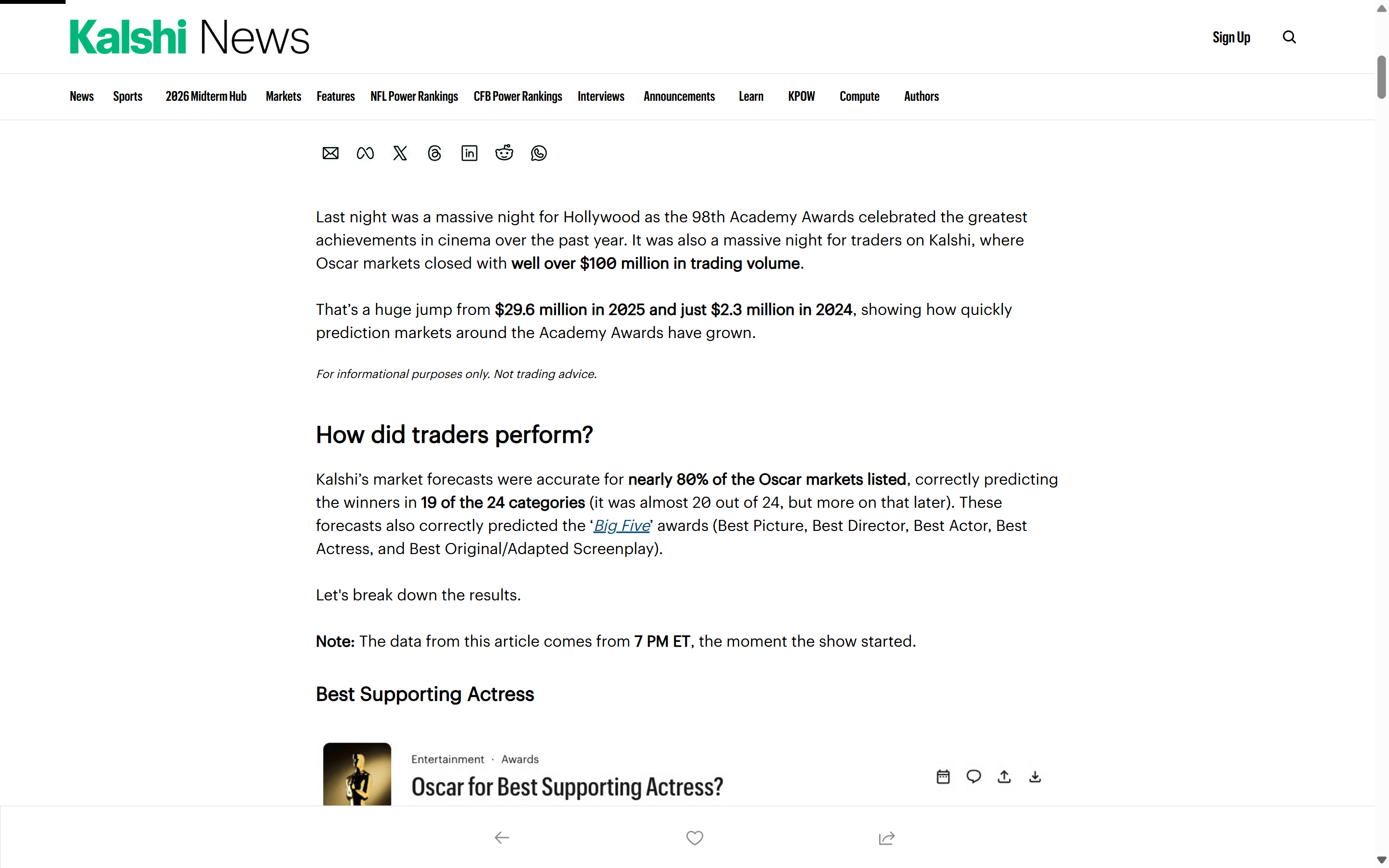
A hit rate answers a limited question: how often did the highest-ranked outcome win? It does not tell us whether every probability was well estimated, or whether buying the favorites would have been profitable. A strategy’s result also depends on the prices actually available, transaction costs and which positions were taken.
| Category | Favorite at cutoff | Final result |
|---|---|---|
| Best Picture | One Battle After Another · 78% | One Battle After Another |
| Cinematography | One Battle After Another · 77% | Sinners · 19% at cutoff |
| Live Action Short Film | Two People Exchanging Saliva · 55% | Joint winners; Kalshi Tie · 1% at cutoff |
The table deliberately keeps forecast and outcome in separate columns. A completed market’s 100% label describes its final state. Using that label as evidence of pre-show confidence would erase the uncertainty traders faced.
2. Best Picture: the same winner, two market records
The Academy named One Battle After Another the Best Picture winner. The completed Kalshi and Polymarket pages agree on that outcome. They also provide a useful example of why a volume figure needs both a label and an observation date.
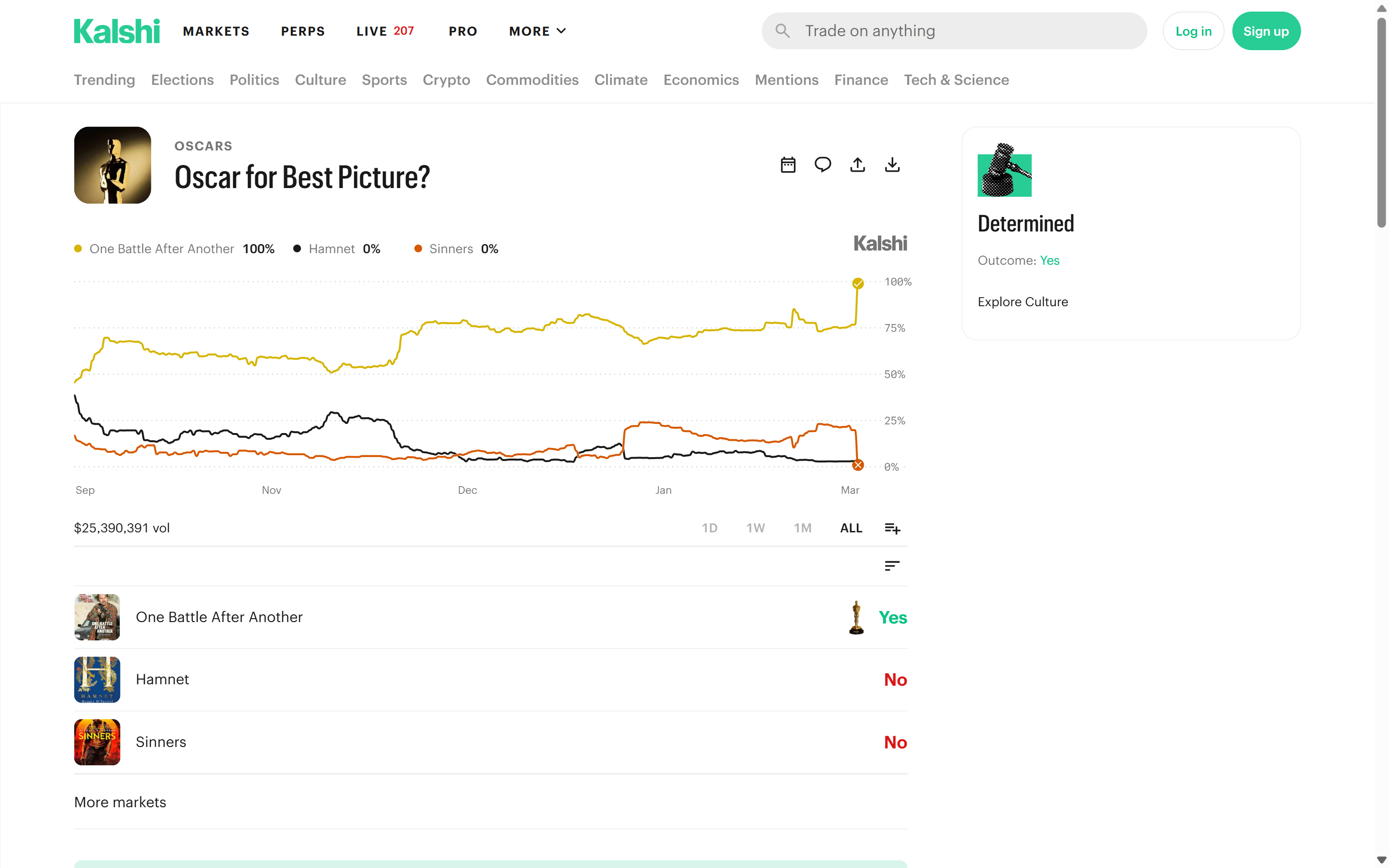
Kalshi’s category page displayed $25,390,391 when checked on October 10. Its March 16 recap used a rounded $23 million for Best Picture. Those are different dated observations; we have not established the reason for the difference. The number in the summary card above is the later, directly visible figure. The Kalshi review provides the broader platform context.
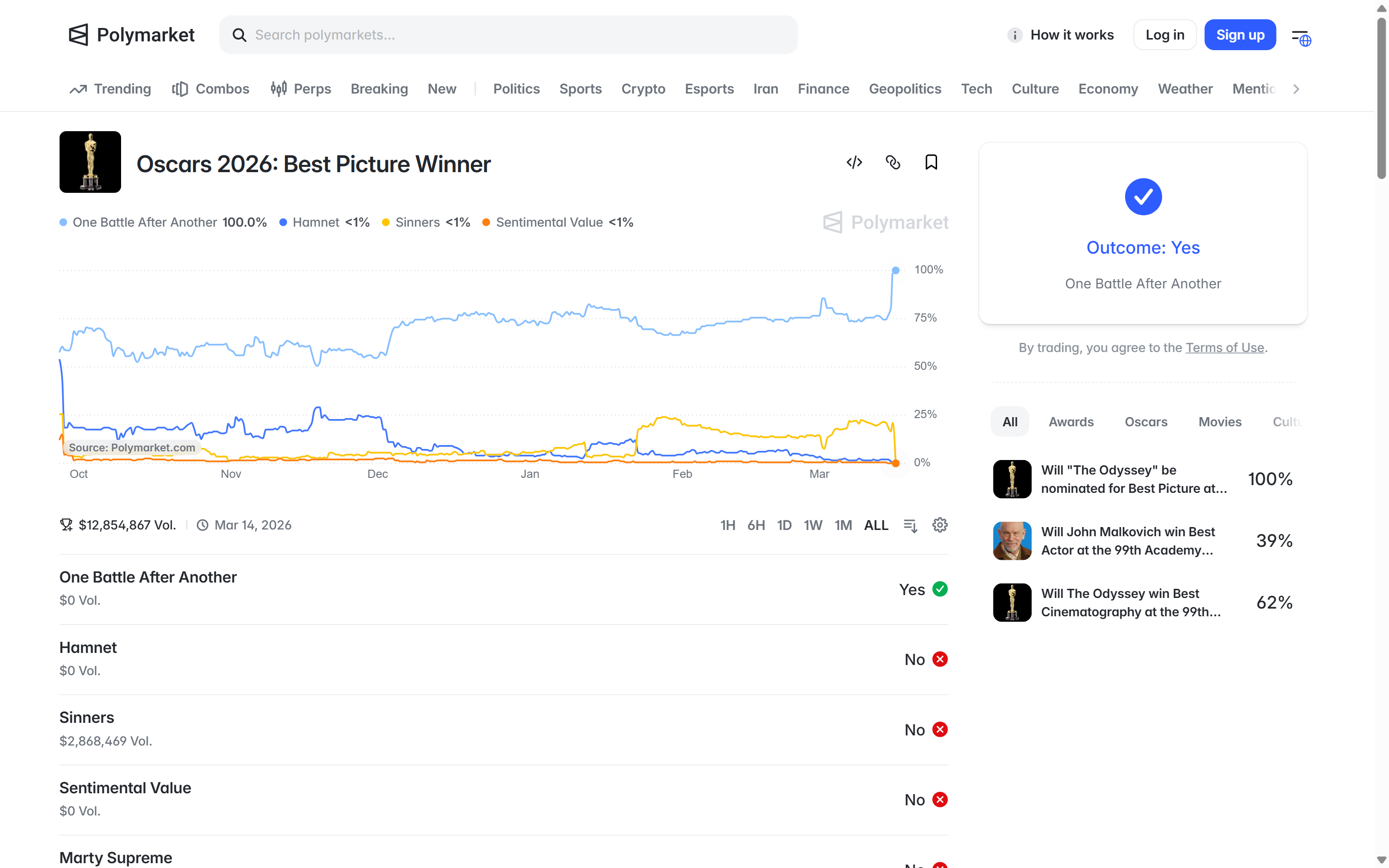
Polymarket’s Best Picture event displayed $12,854,867. That is the event total under its chart, not the volume of the selected winning film alone. Some individual rows in this completed page show zero; those row labels are not a sound basis for reconstructing all historical activity. For platform mechanics, see the Polymarket review.
We keep the two venue totals separate. Reported trading volume does not identify how much unique money entered a market, how many people traded, or how much they earned. It also does not establish how easily a particular position could have been bought or sold at a particular time. The screenshots support the displayed totals, not those additional claims.
3. Cinematography: a favorite can lose
The cinematography result reversed the ranking in Kalshi’s published snapshot. Sinners won, with Autumn Durald Arkapaw named by the Academy, while One Battle After Another did not. The completed category page displayed $3,706,857 in volume and marked Sinners Yes.
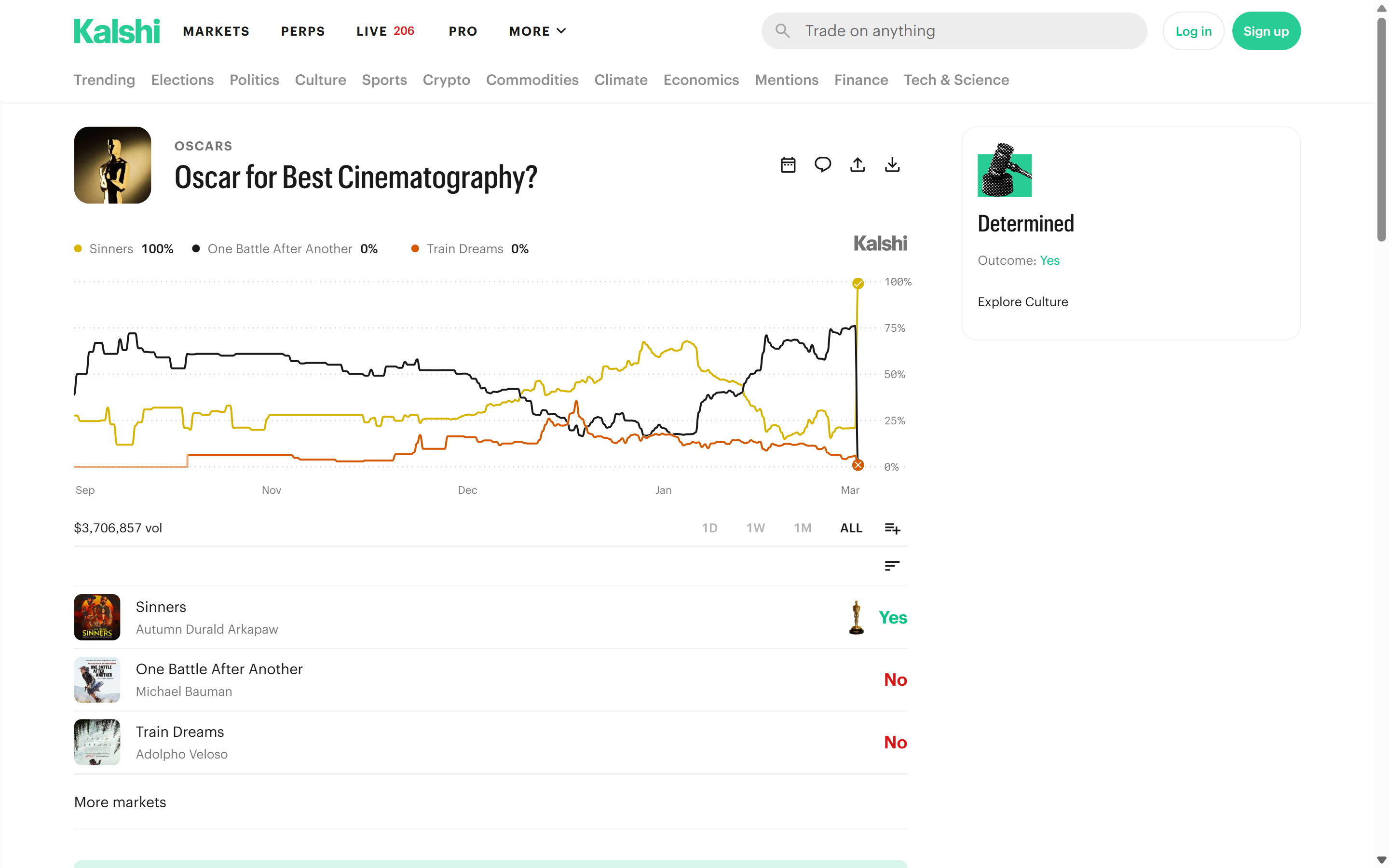
This is a useful limit on the phrase “the market was wrong.” The favorite lost. But a probability forecast leaves room for other outcomes. To evaluate calibration, we would need many predictions grouped by their forecast probabilities and checked against subsequent results. One surprising award cannot establish that a whole forecasting system is either reliable or unreliable.
Nor does the historical chart alone establish what caused each price movement. Its long-range view provides context, but it is not a timestamped news attribution study. The guide to probability and pricing explains how to read an implied probability without turning it into a guarantee.
4. Case study: two Oscar winners, two No contracts
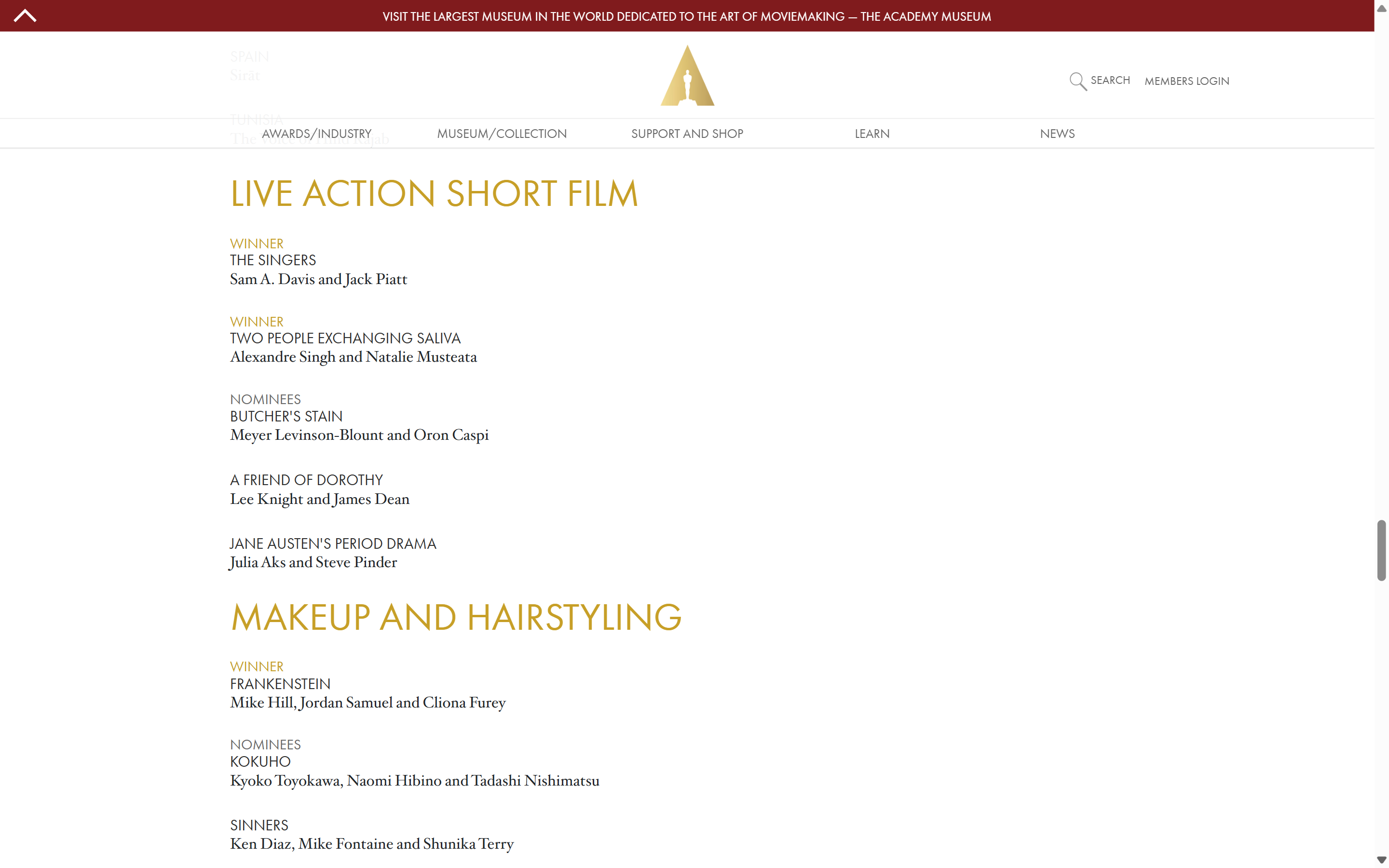
On March 15, Live Action Short Film ended in a joint win. The Academy’s results list both The Singers and Two People Exchanging Saliva as winners. Someone who had simply written down the latter film as an Oscar prediction could reasonably count it as a successful pick.
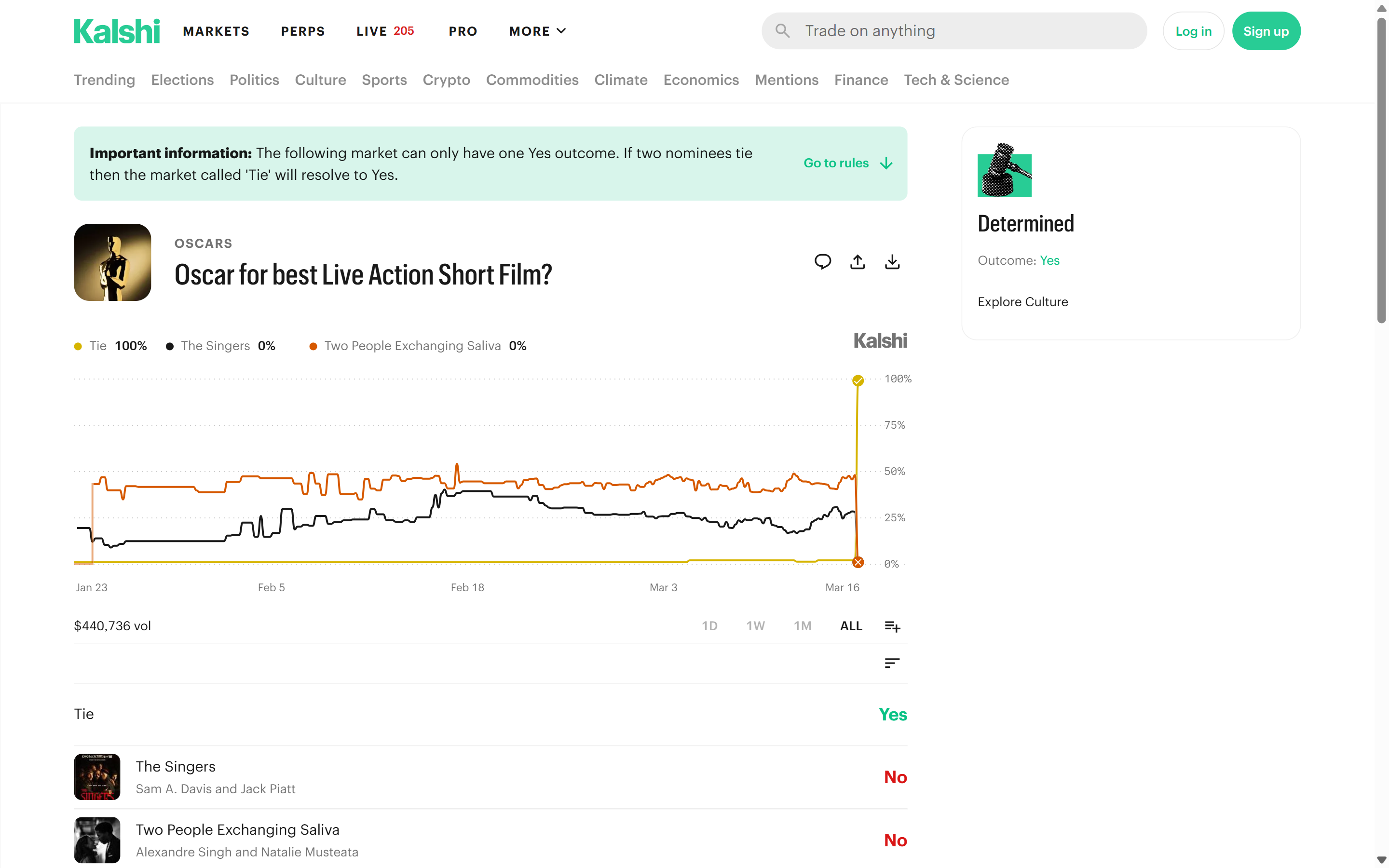
Kalshi’s contract asked a more specific question. The event allowed only one Yes outcome, and its notice assigned a joint win to the separate Tie outcome. The decisive wording is: “If two nominees tie then the market called ‘Tie’ will resolve to Yes.” That clause changes what a position on an individual film means.
The March 16 recap treated the category as a missed favorite. On October 10, we checked both the official award record and the completed market: the Academy still listed two winners; Kalshi showed Tie as Yes, The Singers as No and Two People Exchanging Saliva as No. The category displayed $440,736 in trading volume.
These records describe different things. The Academy determines who receives the award. The market maps that result to its listed outcomes. A joint winner of the award did not satisfy the individual-film contract once the tie provision applied.
The practical check is to rewrite the contract in plain language before treating a film as your pick. In this event, the individual outcome effectively required an outright win rather than a shared win. Being right about the award recipient was insufficient. The tie clause was part of the proposition that had to be right too.
| Listed outcome | Academy result | Kalshi result |
|---|---|---|
| The Singers | Joint winner | No |
| Two People Exchanging Saliva | Joint winner | No |
| Tie | Describes the shared award | Yes |
5. A tie clause belongs to a specific contract
There is no single rule that can safely be assumed for every awards market. The Polymarket Best Picture contract linked in Figure 3 specified a different tie procedure: among tied nominated films, the one whose listed name came first alphabetically would win the market. We read that clause in the page’s Rules section.
This is a comparison of contract designs, not a claim that Best Picture tied in 2026 or that Polymarket used the same procedure for Live Action Short Film. Before comparing prices across platforms, check that the contracts would resolve the same way in the scenario you care about.
The market resolution guide explains how the designated source, special clauses and final determination fit together. This Oscars case supplies a concrete reason to read those details before relying on a headline.
6. A practical checklist for the next awards market
- Save the exact question and rules. Include the category, year, eligible nominees, deadline and any tie provision.
- Record the forecast time. A price before the ceremony and a settled result answer different questions.
- Separate award and contract outcomes. Check the official winner, then apply the market’s stated treatment of that result.
- Label every volume. Identify the venue, event or individual contract, and observation date.
- Assess execution separately. A retrospective percentage does not show the price or size available to a specific trader, and it is not a verified return.
The most transferable lesson from this ceremony is the distinction between a forecast and the contract attached to it. Write down what must happen for your exact outcome to resolve Yes. Then test an edge case, such as a shared award, against that sentence. If the answer changes after reading the rules, the headline did not describe the position fully.
Frequently asked questions
Kalshi’s published pre-show favorite won. The completed Kalshi and Polymarket pages both show One Battle After Another as the winning outcome. That does not establish that every trader, every price or every earlier forecast was correct.
The event had a separate Tie outcome and allowed only one Yes. Under the displayed rule, a joint award selected Tie, rather than either individual film.
No. A retrospective snapshot is not a record of an executable order. Establishing a return would require the actual entry price, position size, costs and outcome. This article does not reconstruct a trading strategy.
No. They were captured on October 10, 2026. Pre-show percentages come from Kalshi’s dated recap; award results come from the Academy; final outcomes and displayed volumes come from the completed market pages.