


Event study · Updated October 10, 2026
Polymarket’s “US forces enter Iran by April 30?” contract traded $269,049,107 and resolved Yes. The resolution turned on a rescue. On April 4, according to U.S. Central Command, U.S. forces completed the rescue of two F-15E crew members from Iran. Whether that rescue counted under the contract’s rules was disputed twice before a UMA token-holder vote settled the market on April 9.
This case study is about contract wording, not about the conflict itself. It separates what the official military source says, what the market rules asked, how the price moved, and how the resolution process played out. All six screenshots were captured on October 10, 2026, from public pages; they show those pages as observed that day, not live views from early April.
1. One question, nine deadlines
Polymarket did not list a single “Will US forces enter Iran?” market. It listed one event with nine dated contracts, each asking whether qualifying U.S. military personnel would physically enter Iran by a given date. The completed event page shows seven deadlines from January 31 through March 31 resolved No, while April 30 and December 31 resolved Yes.
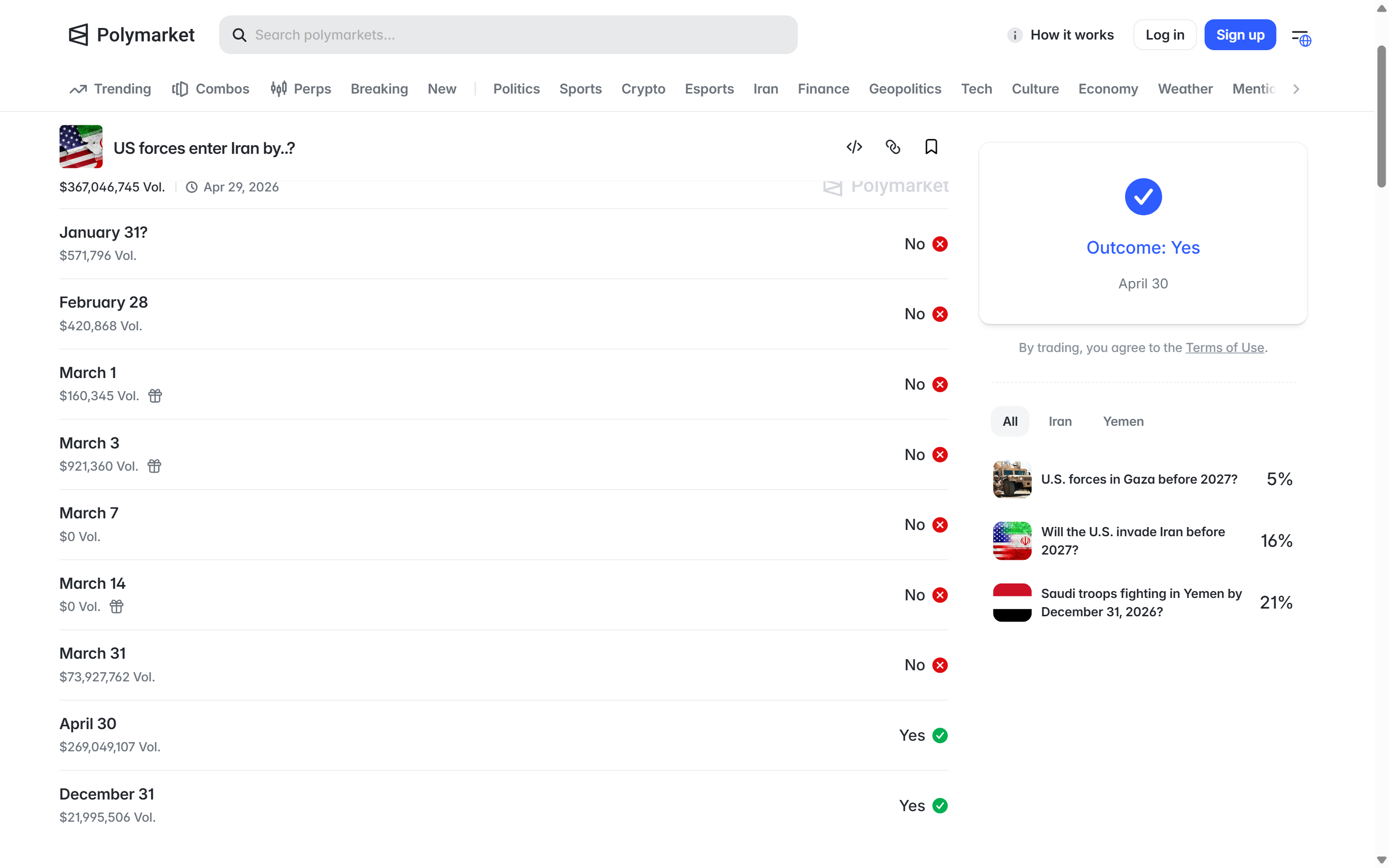
The volume was very unevenly distributed. The table transcribes each contract as displayed on October 10. The nine contract volumes add up to $367,046,744, one dollar below the displayed event total, which is consistent with rounding of the individual figures.
| Deadline | Displayed volume | Share of event | Outcome |
|---|---|---|---|
| January 31 | $571,796 | 0.2% | No |
| February 28 | $420,868 | 0.1% | No |
| March 1 | $160,345 | <0.1% | No |
| March 3 | $921,360 | 0.3% | No |
| March 7 | $0 | 0% | No |
| March 14 | $0 | 0% | No |
| March 31 | $73,927,762 | 20.1% | No |
| April 30 | $269,049,107 | 73.3% | Yes |
| December 31 | $21,995,506 | 6.0% | Yes |
The ladder structure explains why the same set of facts produced opposite outcomes. Under the rules, the event had to happen “by the listed date (ET).” The rescue CENTCOM describes was completed on April 4, four days after the March 31 deadline. The March 31 contract, with almost $74 million in volume, therefore resolved No, while the April 30 and December 31 contracts resolved Yes. Volume here is reported trading turnover, not the number of traders or the amount paid out.
2. What the April 30 contract actually asked
The contract opened on March 18, 2026, at 12:30 PM ET. Its rules are narrower than the headline suggests. A Yes required active U.S. military personnel to physically enter Iran’s terrestrial territory. Special operations forces counted; intelligence operatives did not. Entering Iranian airspace or waters did not count. Contractors, advisers and senior personnel entering for diplomatic purposes were excluded. The stated resolution source was “a consensus of credible reporting.”
Two further passages decided the case. A note in the rules says that only personnel who “deliberately enter the terrestrial territory of Iran for operational purposes (e.g., military, humanitarian, etc.)” qualify, and that “Pilots who are shot down” do not. And an “Additional context” notice, dated March 20 on the page, says that land de facto controlled by Iran as of February 28, 2026, 12:00 PM ET, counts as Iranian territory.
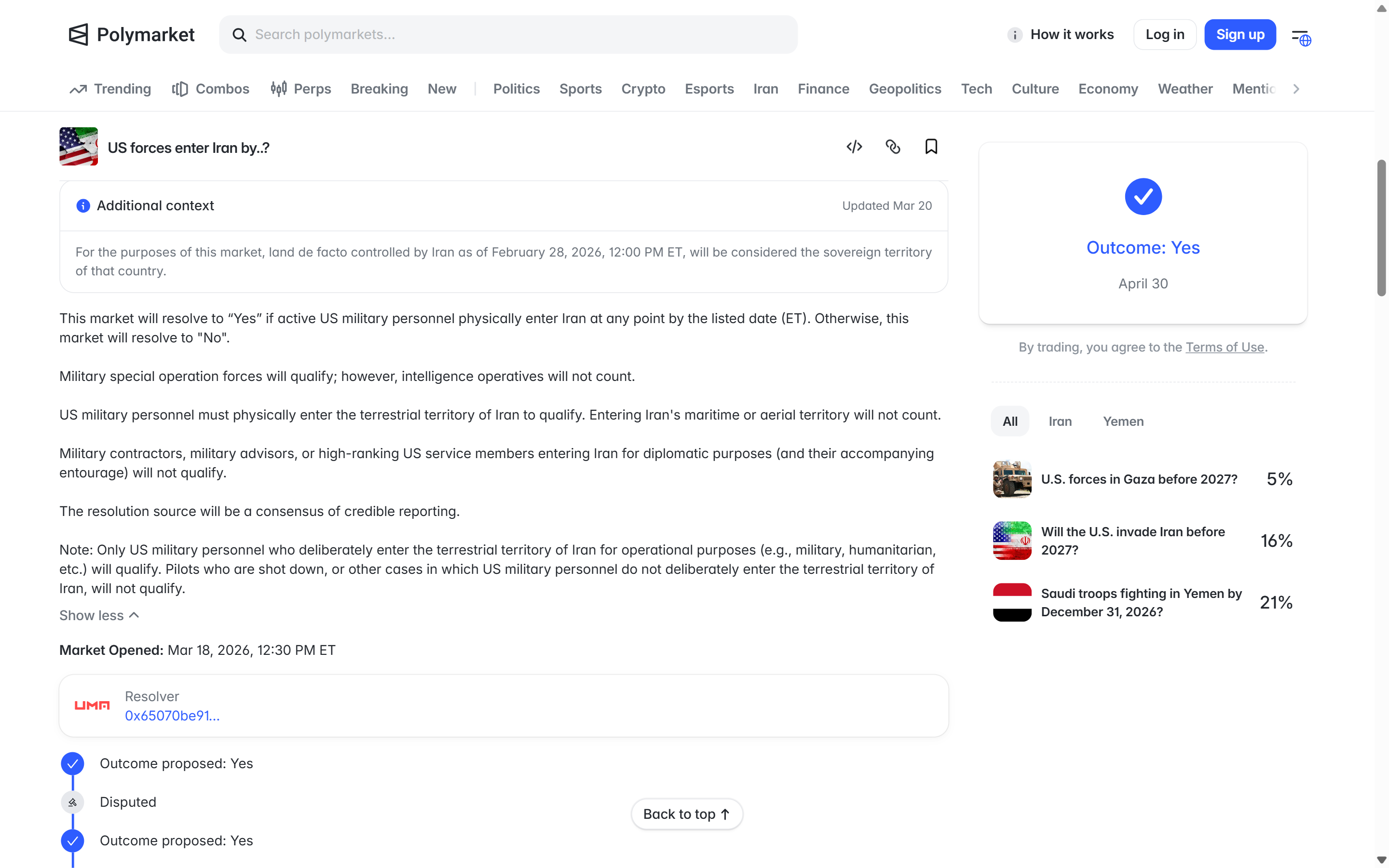
Read together, the clauses split one rescue operation into two parts. The aircrew who came down in Iran were not, by themselves, a qualifying entry. Personnel who deliberately went in to recover them could qualify, because the note names humanitarian purposes as an example of an operational purpose. That reading is the most direct explanation of the final Yes. It is our interpretation of the published text, not a published rationale from the voters.
We could not establish from the reviewed pages when the note was first added. It appears in the April 30 rules on Polymarket and in the request text recorded by the UMA oracle, discussed below. Polymarket’s resolution documentation says “Additional context” clarifications are published onchain, cannot change the fundamental intent of a question, and should be considered by UMA voters.
3. What the official source says happened
U.S. Central Command’s public release dated April 5, 2026, states that on April 4 “U.S. forces successfully completed the rescues of two American service members from Iran after their F-15E fighter jet was shot down April 2 during a combat mission.” It adds that the two were recovered “during separate search and rescue missions.”
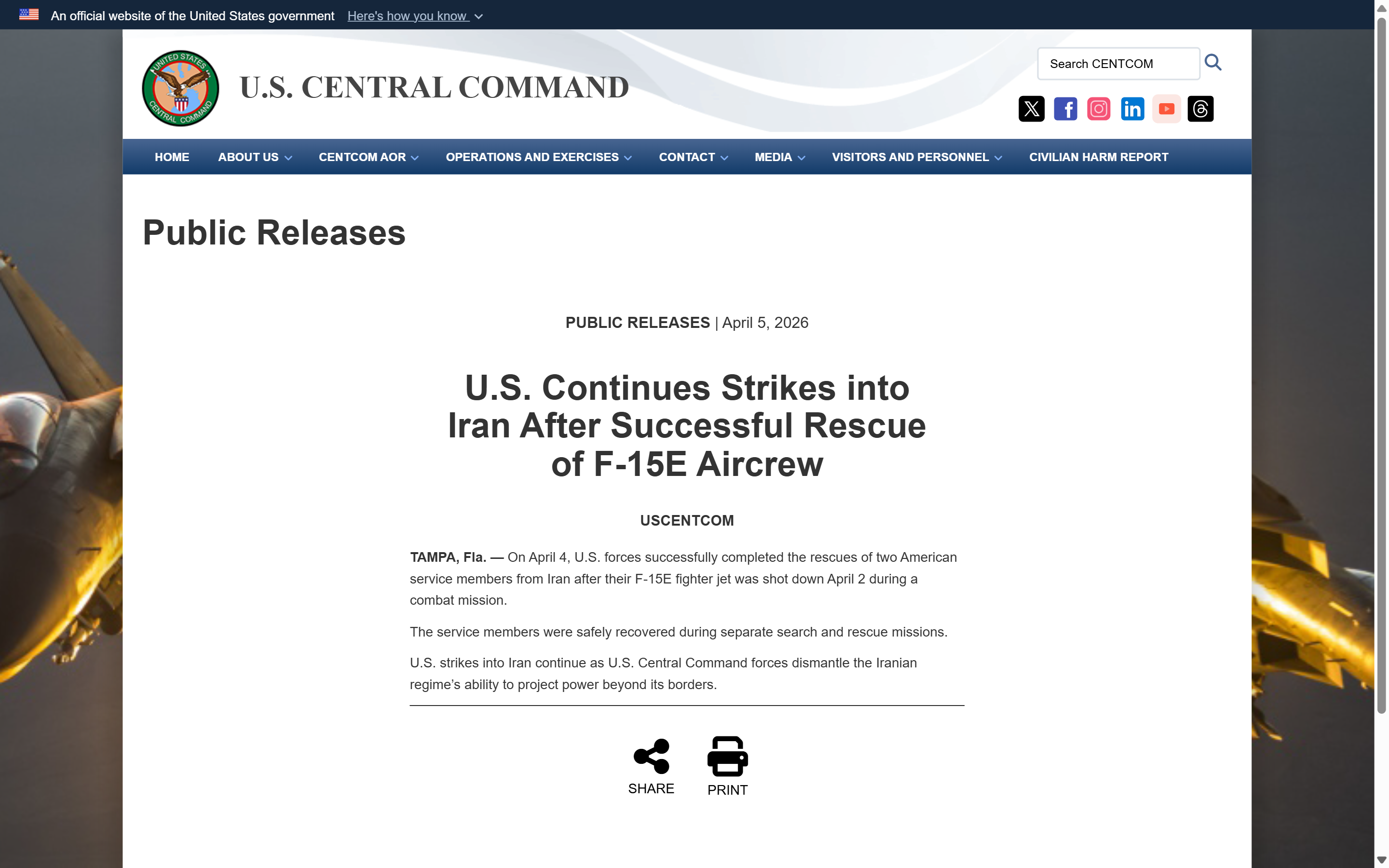
The release is short, and its limits matter for the contract. It confirms the dates and that the crew were rescued “from Iran.” It does not say whether rescuers landed on Iranian soil, for how long, or which units took part. The contract asked for a consensus of credible reporting, and media accounts of the operation were outside the scope of this review. We therefore do not describe operational details of the rescue, and we do not claim that this single release by itself satisfied the contract.
4. How the price moved
Polymarket’s chart for the April 30 contract shows the Yes price in the 50s for much of late March, followed by a rise to above 99%. The chart in Figure 4 is the platform’s ALL view. It is smoothed and its time axis is coarse, so it is useful for the overall shape, not for timing.
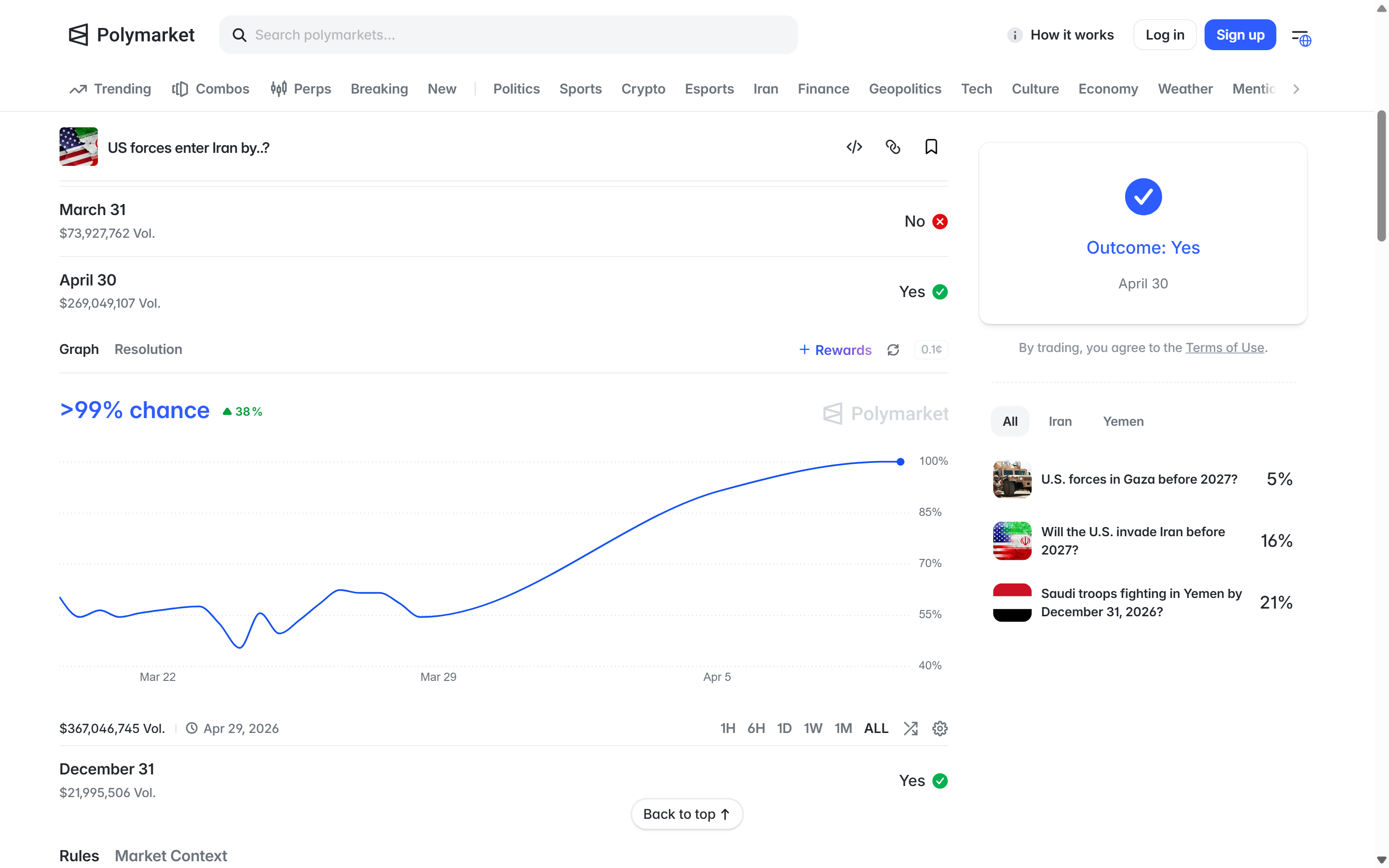
For timing, we read the contract’s hourly price history from Polymarket’s public price-history API on October 10. The table lists selected points. Times are UTC; in April, Eastern Time was four hours behind.
| Time (UTC) | Yes price | Context from dated sources |
|---|---|---|
| Mar 28, 00:00 | 58.5¢ | Before the shoot-down |
| Apr 1, 14:00 | 52.0¢ | Lowest selected point; March 31 contract has expired |
| Apr 2, 22:00 | 66.5¢ | CENTCOM dates the F-15E loss to April 2 |
| Apr 3, 11:00 | 65.5¢ | — |
| Apr 3, 16:00 | 86.5¢ | UMA round shown in Figure 5 is requested at 16:49 |
| Apr 4, 19:00 | 82.5¢ | CENTCOM dates completion of the rescues to April 4 |
| Apr 5, 00:00 | 91.5¢ | CENTCOM release is dated April 5 |
| Apr 5, 04:00 | 99.55¢ | Yes proposed 03:51; disputed 04:17 |
| Apr 8, 12:00 | 99.85¢ | Before final settlement on April 9 |
Two observations follow from the data, without needing a causal story. First, the price rose substantially on April 2 and 3, before CENTCOM’s stated completion date. Second, it stayed below 90¢ through April 4 and reached near-certainty only in the early hours of April 5 UTC. Traders were pricing an unsettled question for roughly two days. We cannot tell from these data which reports traders were reacting to, and the series has gaps, so it is not a complete minute-by-minute record.
These figures are history points from the platform’s API, not executed trades or quotes guaranteed to be available at size. Before using any chart point as an entry or exit price, check the order book, spread and fees. Our guide to how markets react to breaking news covers that distinction with other examples.
5. Two disputes and a vote
Polymarket resolves markets like this one through UMA’s Optimistic Oracle. According to Polymarket’s documentation, anyone can propose an outcome by posting a bond. A dispute starts a new proposal round, and if the second proposal is also disputed, the question escalates to a vote of UMA token holders. The April 30 contract followed that longest path. Its resolution history on Polymarket reads: Yes proposed, disputed; Yes proposed, disputed; final outcome Yes.
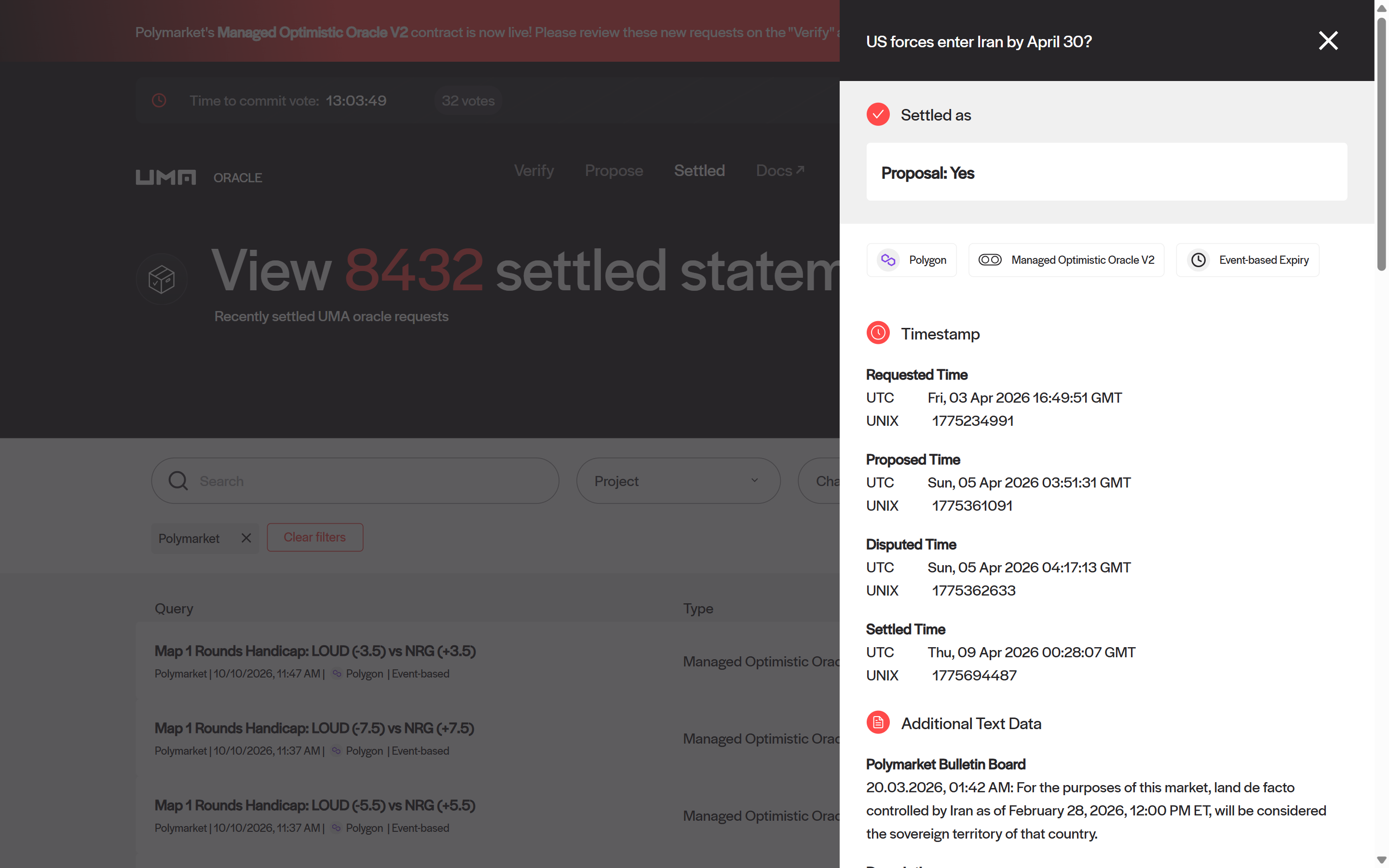
The record establishes a clear sequence for the second round. The request opened on April 3 at 16:49 UTC. A Yes proposal followed on April 5 at 03:51 UTC and was disputed 26 minutes later. The vote concluded and the request settled on April 9 at 00:28 UTC, about three days and twenty hours after that dispute. Polymarket’s market record lists the same closing time and the same status sequence: proposed, disputed, proposed, disputed.
Because a new round opens after a dispute, the April 3 request time indicates that the first Yes proposal had already been made and challenged by then, before CENTCOM’s April 4 completion date. The record does not show the arguments made by proposers, disputers or voters. Comments under the market, more than 12,000 on the capture date, include accusations of unfairness as well as replies citing the rules. They are participant opinions, not evidence of how the vote was decided.
| Date and time | Event | Source |
|---|---|---|
| Mar 18, 12:30 PM ET | April 30 contract opens | Polymarket |
| Mar 20 | Clarification on de facto Iranian-controlled land | Polymarket, UMA record |
| Apr 2 | F-15E shot down during a combat mission | CENTCOM |
| Apr 3, 16:49 UTC | UMA round shown in Figure 5 is requested | UMA |
| Apr 4 | Rescues of both crew members completed | CENTCOM |
| Apr 5, 03:51 / 04:17 UTC | Yes proposed, then disputed | UMA |
| Apr 9, 00:28 UTC | Request settled; contract resolves Yes | UMA, Polymarket |
For a trader, the practical lesson is about time and capital, not about who was right. A disputed contract can stay unresolved for days after the underlying news, and its price can sit near, but not at, $1. Our market resolution guide explains the difference between an event occurring, an outcome being decided, and funds becoming available.
6. Same headline, different question
A Manifold community market asked “When will U.S. ground forces first enter Iranian territory? (April 2026)” and resolved to “Not in April 2026” on May 1. This does not contradict Polymarket. The two markets asked different questions over different windows.
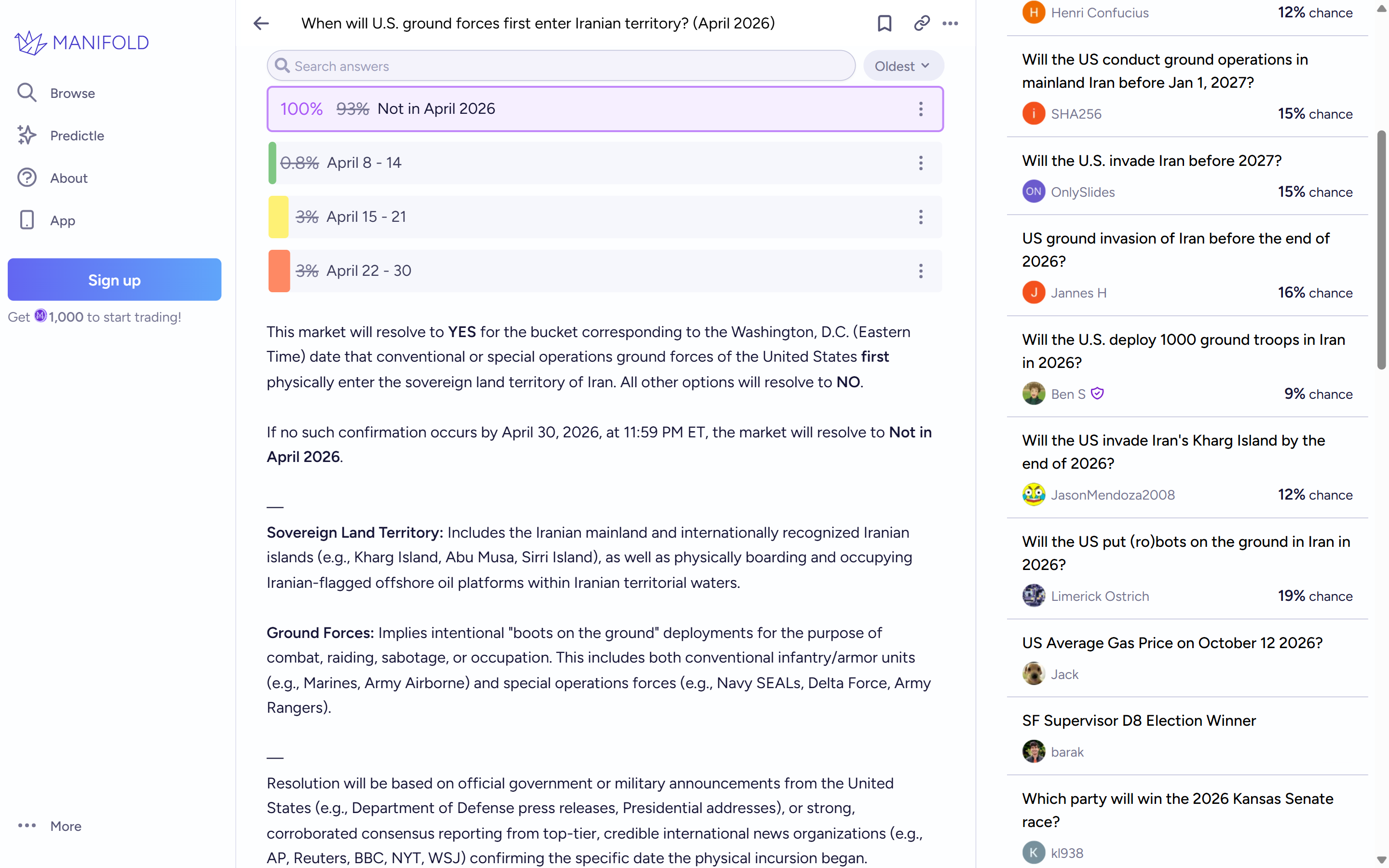
Manifold’s rules require intentional “boots on the ground” deployments “for the purpose of combat, raiding, sabotage, or occupation.” Lower in the same rules, its exclusions list “temporary personnel recovery/Combat Search and Rescue (CSAR) missions strictly deployed to rescue downed aircrew.” Polymarket’s note, by contrast, names humanitarian purposes as a qualifying example. Manifold’s buckets also begin on April 8, after the rescue, so its question concerned a later window in any case.
| Question | Polymarket, April 30 contract | Manifold, April 2026 market |
|---|---|---|
| Who must enter? | Active U.S. military personnel; special forces count | Conventional or special-operations ground forces |
| Purpose required | Deliberate entry for operational purposes, e.g. military or humanitarian | Combat, raiding, sabotage or occupation |
| Rescue of downed aircrew | Not excluded; downed pilots themselves do not count | Explicitly excluded |
| Window | By April 30 (ET) | April 8–30, Washington date |
| Result | Yes | Not in April 2026 |
The page shows 17 holders and 89 trades. Those Mana counts are not comparable with Polymarket’s dollar volume and should not be added to it. Kalshi, the CFTC-regulated U.S. exchange, did not offer a comparable contract: its banned-markets policy says war markets are not listed. For broader context on Polymarket itself, see our Polymarket review.
7. How to read a geopolitical contract before trading it
- Read the inclusions and the exclusions. “Enter Iran” meant terrestrial entry, by active military personnel, for an operational purpose. The decisive words were in a note below the main rule.
- Imagine the edge cases. A downed aircrew and a rescue team are the kind of scenario that splits a question in two. Ask how the rules treat accidents, rescues, short incursions and covert activity before you price the obvious scenario.
- Check which deadline you hold. The same rescue made April 30 a Yes and left March 31 a No. In a ladder, being right about the event but wrong about the date is a total loss for that contract.
- Look for clarifications. The March 20 notice changed how territory was defined. Clarifications can appear after trading starts and should be part of your trade record.
- Allow for a disputed resolution. Two disputes added days between the April 4 rescue and settlement on April 9. Capital tied up in a disputed contract cannot be redeployed until it resolves, unless you sell at the prevailing price.
- Do not compare markets by headline. Manifold’s similar-sounding question excluded exactly the operation that settled Polymarket’s contract. Compare the full rules before treating two prices as the same forecast.
Frequently asked questions
Did US forces invade Iran in April 2026?
This article does not make that claim. The primary source reviewed, CENTCOM’s April 5 release, describes the rescue of two F-15E crew members from Iran completed on April 4. The Polymarket contract asked a narrower question about physical, deliberate entry by military personnel. A Yes on that contract is not a finding that an invasion took place.
Why did the market resolve Yes if downed pilots did not count?
The rules exclude pilots who are shot down, but they include personnel who deliberately enter for operational purposes, naming humanitarian purposes as an example. The most direct reading is that the rescue missions, rather than the crew, met the rule. UMA voters did not publish a reasoned decision, so this remains an interpretation of the rule text.
Why did the March 31 contract resolve No?
Each contract asks about entry “by the listed date (ET).” CENTCOM dates the loss of the aircraft to April 2 and the completed rescues to April 4, both after March 31. Displayed volume of $73,927,762 on that contract does not change its deadline.
How long did resolution take?
The UMA round shown here was requested on April 3 at 16:49 UTC and settled on April 9 at 00:28 UTC. Polymarket’s documentation describes a total of about four to six days for disputed resolutions. The times of the first proposal and dispute were not available in the reviewed record.
Can the Polymarket and Manifold figures be combined?
No. Polymarket reports dollar trading volume; Manifold shows play-money holders and trades. The two markets also asked different questions over different windows, so neither their activity nor their results can be merged into one figure.
Author: Machiawelli. Evidence research and draft prepared with Claude in Cursor; captures October 10, 2026. Sources and capture dates are identified beside the relevant evidence. The hero artwork is an editorial composition that contains an unmodified crop of the Polymarket chart in Figure 4; it is not a screenshot of a single page.