


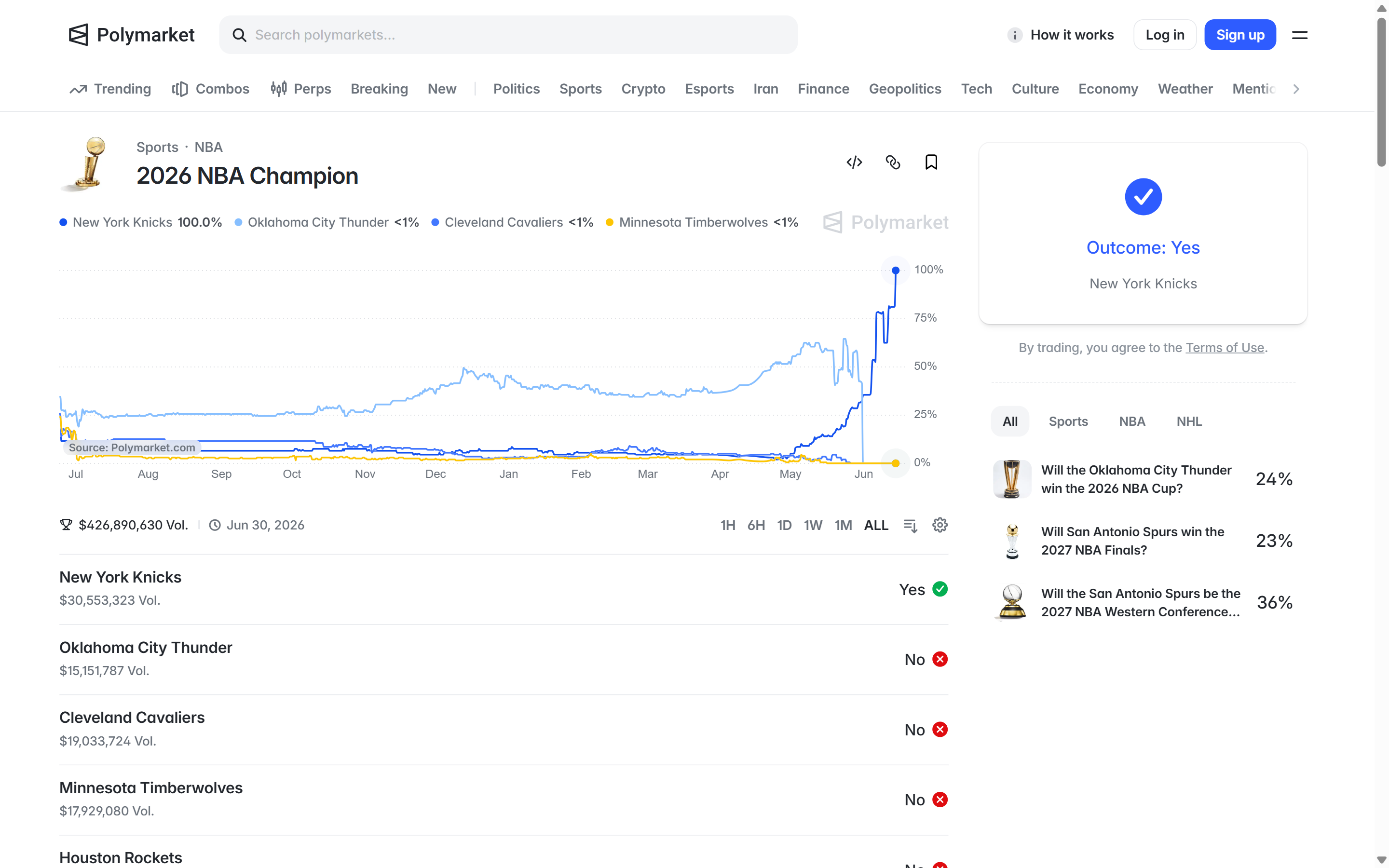
The Knicks won the 2026 NBA Finals 4–1. The completed championship pages now show $426,890,630 on Polymarket and $335,653,533 on Kalshi. Those observations establish the winner and displayed trading volume; they do not reconstruct the price a trader could have obtained before each game. This review separates the official result, the contracts and the evidence needed to make that historical claim.
Updated October 8, 2026. Evidence review prepared with Codex; original author retained. All six source captures below were taken on October 8. Market-page dates are platform labels, not the capture date.
1. The result: New York won in five games
The NBA’s official results list New York as champion, with the series ending in a 94–90 Game 5 win over San Antonio. The title ended the Knicks’ wait since 1973. The final game was played at Frost Bank Center in San Antonio, as the official Game 5 box score records.
| Game | New York | San Antonio | Series after game |
|---|---|---|---|
| 1 | 105 | 95 | NY 1–0 |
| 2 | 105 | 104 | NY 2–0 |
| 3 | 111 | 115 | NY 2–1 |
| 4 | 107 | 106 | NY 3–1 |
| 5 | 94 | 90 | NY 4–1 |
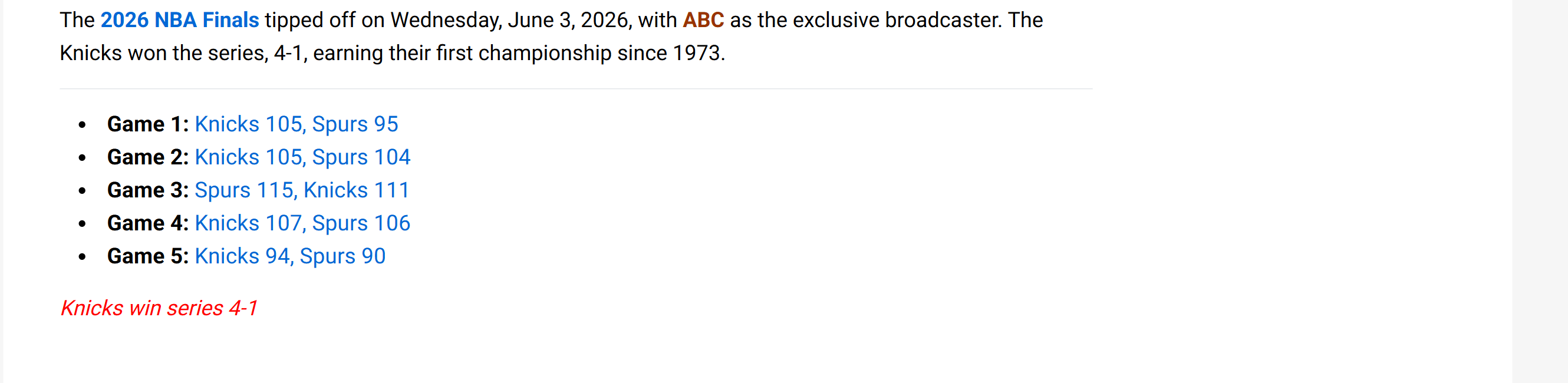
A championship contract asks who wins the series. A Game 3 winner contract asks who wins one game. The distinction matters here: New York lost Game 3 and still won the championship. Comparing those two outcomes as though they measured the same forecast would reverse the meaning of the evidence.
2. What the completed market pages establish
Polymarket’s completed 2026 NBA Champion event displays New York as Yes and event volume of $426,890,630. The Knicks row itself shows $30,553,323. The event headline and the selected team row have different scopes; neither is a count of people or a balance available for withdrawal.
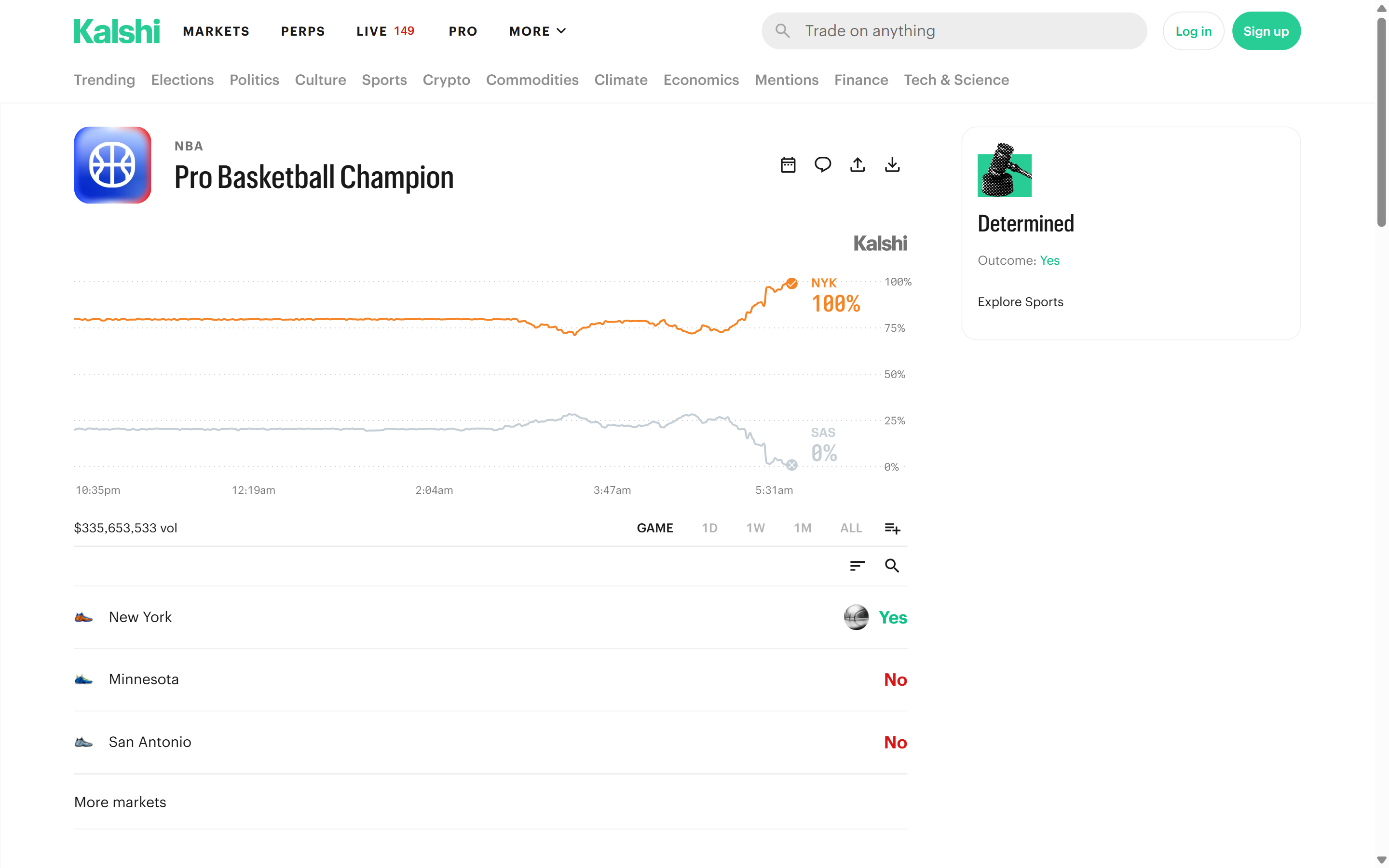
Kalshi’s matching event is KXNBA-26, with the New York market KXNBA-26-NYK. Its completed page displays $335,653,533 and New York Yes. The GAME chart ends at NYK 100% and SAS 0%. The event identifier is essential: a current “NBA Champion” recommendation can refer to the next season, even when it appears beside the resolved 2026 page.
| Observation | Supported reading | Not established |
|---|---|---|
| Polymarket $426,890,630 | Displayed event volume | Unique traders or open interest |
| Knicks row $30,553,323 | Displayed team-market volume | Profit earned by Knicks buyers |
| Kalshi $335,653,533 | Displayed KXNBA-26 volume | A directly comparable liquidity measure |
| Final 100% / Yes | Completed winning outcome | A pre-Finals forecast or available fill |
These are venue-specific display readings. Adding them would not produce a verified total for all NBA betting or a like-for-like measure of capital at risk. A comparison of turnover requires each venue’s counting convention; a comparison of executable liquidity requires contemporaneous order-book depth and spread. A large cumulative number provides neither by itself.
Hypothetical turnover example: 100 contracts bought at $0.60 cost $60; the same 100 later sold at $0.70 change hands for $70. Under a convention that sums the cash consideration of each trade once, those two trades produce $130 of turnover. This arithmetic is an illustration, not a claim about how either displayed venue total was calculated or the maximum risk across all counterparties.
3. The contract rules and the resolution display
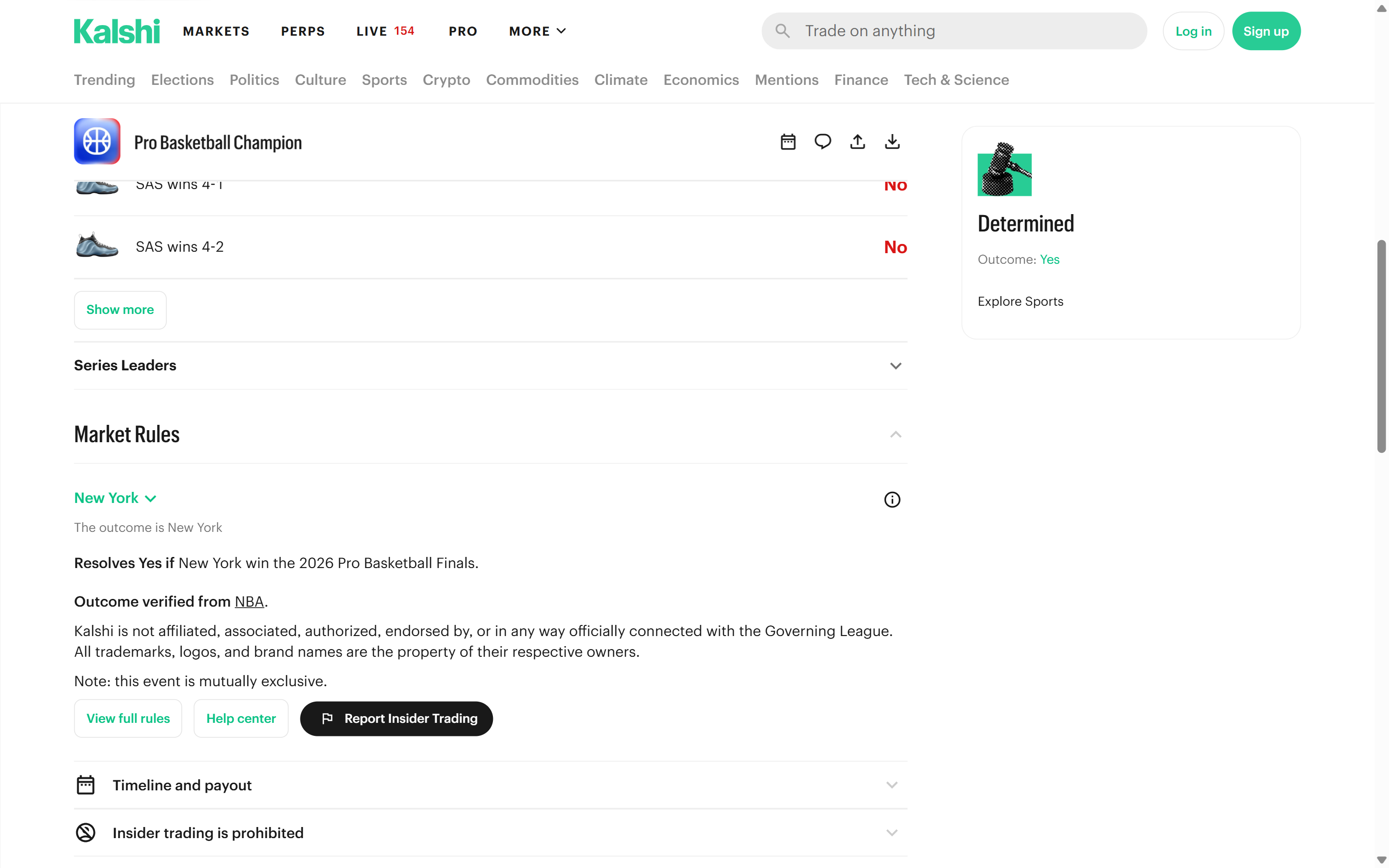
Kalshi’s New York panel says the contract resolves Yes if New York wins the 2026 Pro Basketball Finals and names the NBA as the verification source. It also labels the event mutually exclusive. The archived event identity and the stated condition, rather than an adjacent market recommendation, determine what the trade was about.
The timeline on the same page displays “5 minutes after closing” under Paid out. That is a platform timeline label. It does not establish an individual account’s receipt time or the time a bank withdrawal arrived. Those would require different records.
Polymarket’s selected Knicks rules say Yes if the team wins the 2026 NBA Finals and No if winning becomes impossible, with the NBA as the resolution source. The visible resolution panel shows a Yes proposal, no dispute and a final Yes. A resolver address identifies a contract; it is not a transaction receipt or a verified payout timestamp.
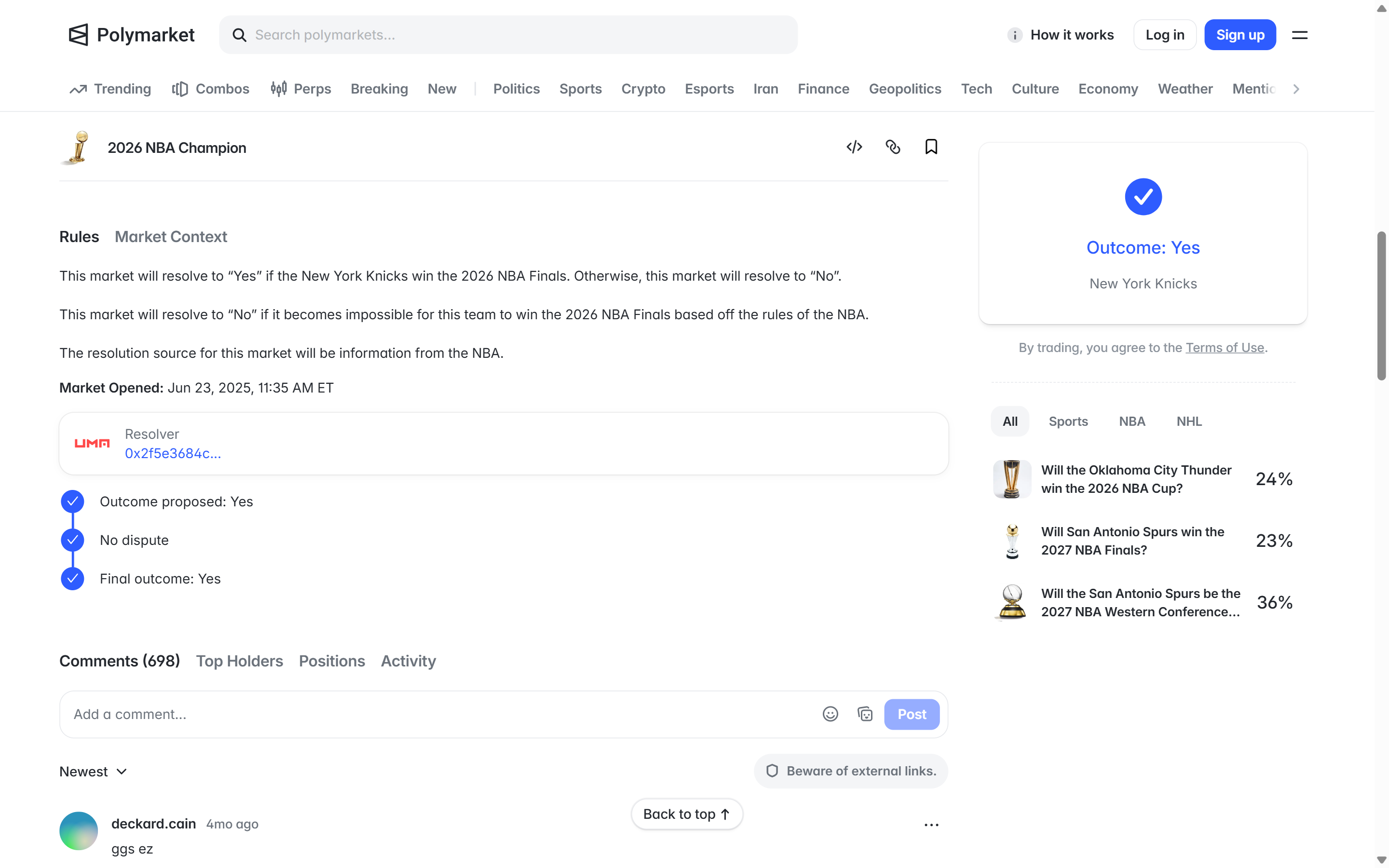
Polymarket’s resolution documentation explains the proposal and dispute process and the winning-token redemption value of $1. The current trading documentation describes an order-book system. Calling the venue’s price formation an automated market maker would misdescribe that system. Documentation explains the mechanism; it does not replace a historical execution log for this specific event.
For the distinction between the sports result and the contract’s formal outcome, see our market resolution guide.
4. A Manifold market with a different question
The Manifold capture below concerns Game 3 on June 8, with Yes for the Knicks and No for the Spurs. It resolves No, consistent with San Antonio winning that game. The page shows approximately M50k in Mana volume. That is a different unit and question from the dollar-denominated championship events above.
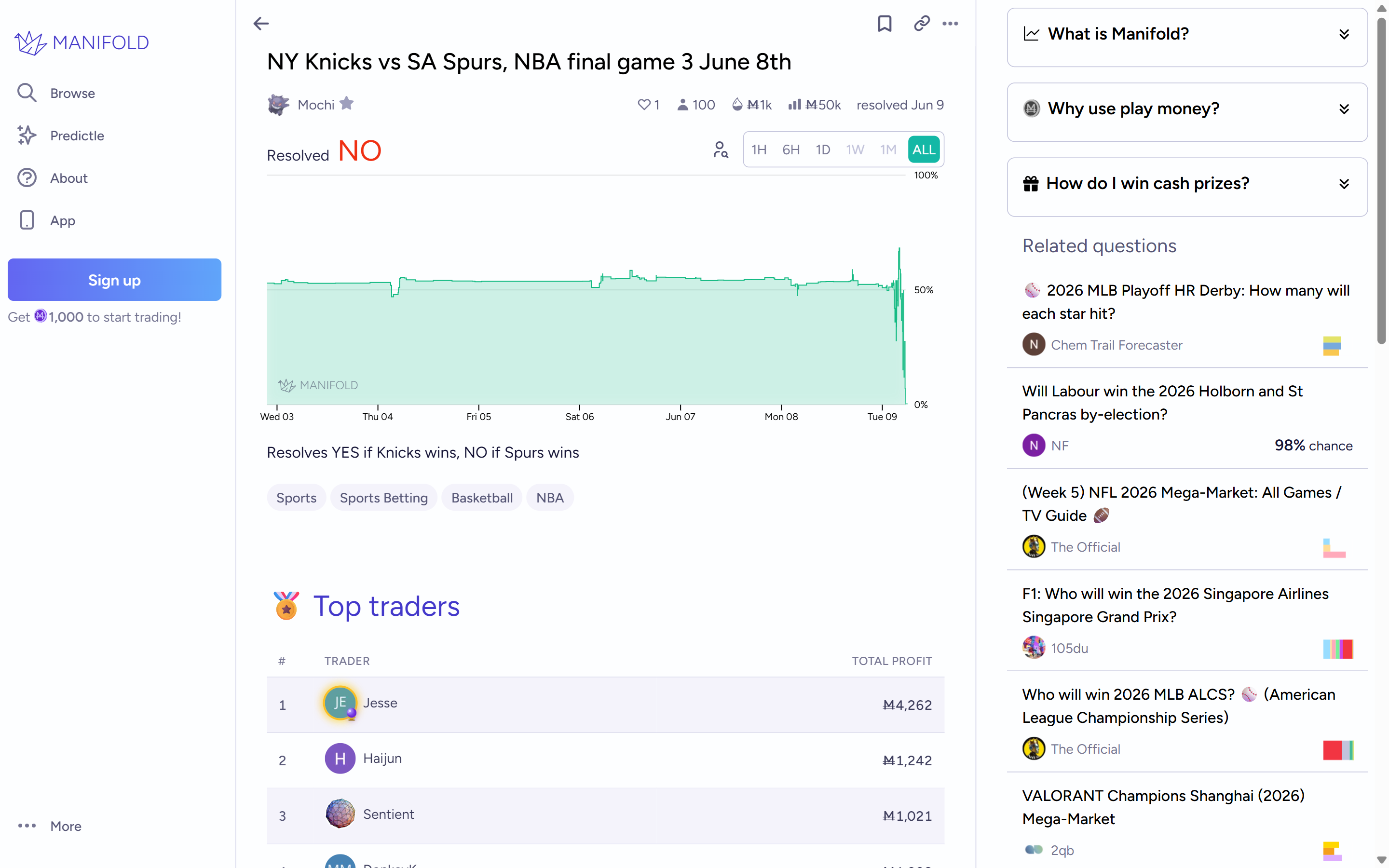
This is a useful check on research quality: matching the team names is insufficient. Match the season, the event, the question and the resolution condition before comparing prices. This Game 3 page cannot establish that Manifold’s series forecast tracked another venue within two or three percentage points.
5. Why the historical price ladder has been removed
The available captures do not establish a dated sequence of Knicks prices before and after every Finals game. They also do not establish an exact pre-Finals 58.2% quote, a particular bid–ask spread, a minute-by-minute reaction delay or which trades were placed by bots. The genuine Kalshi GAME chart is retained as a source image, without assigning its displayed clock labels to a broadcast timeline or inventing point values from the curve.
A defensible reconstruction would need timestamped price or trade records, their timezone, the exact market identifier and a clear choice between last trade, bid, ask and midpoint. Our guide to reading probability movements explains why those distinctions affect interpretation. A resolved 100% reading cannot stand in for any earlier forecast.
6. Payoff arithmetic without an invented trade
Hypothetical example: buying 100 winning Yes contracts at $0.60 costs $60. If each redeems for $1, the gross redemption is $100 and the gross profit is $40, or 66.67% of the purchase cost. If the condition fails, the same position loses its $60 purchase cost. Fees, spread and execution can change the net result. No evidence here shows that a reader could have bought this size at that price.
The arithmetic separates three things often conflated in a retrospective: whether the team won, whether a contract settled Yes, and whether a particular trader made money. The first two have public evidence here. The third requires an entry price, quantity, fees and an actual execution record.
7. What to retain from this case
Save the event identifier with every capture. Keep an official result beside the applicable rules. Record historical quotes while they are observable, with a timestamp and quote type. Treat displayed volume as its own metric, and keep game-specific community markets separate from championship markets. Our Polymarket review provides broader platform context; this article’s conclusions are limited to the evidence shown for the 2026 Finals.
Correction note: this revision replaces the unsupported $315.11M Kalshi headline, next-season screenshots, historical price ladder and synthetic hero chart. It corrects the Game 5 venue, removes unsupported game-flow and payout-time claims, and identifies the Manifold market as Game 3. The six figures are fresh native source captures; the hero contains a crop of the genuine Kalshi chart.
Risk disclosure: this retrospective is educational, not a trading recommendation. Event contracts can lose the full purchase cost plus applicable fees. A correct sports forecast does not guarantee a profitable execution.