


Event study · Updated October 8, 2026
Eurovision 2026 ended with Bulgaria’s DARA winning 516 points, while Finland—the favourite in Kalshi’s published May 16 snapshot at 47%—finished sixth. The useful lesson is about the distance between a forecast and a result. Bulgaria won both the jury vote and the public vote, so this was not a case of the public overturning a different jury winner.
This review separates three kinds of evidence: a dated pre-final report, the official contest results, and market pages captured after settlement. The screenshots below were taken on October 7, 2026. They document the pages as observed that day; they are not live captures from the night of the final.
1. What the market totals actually measure
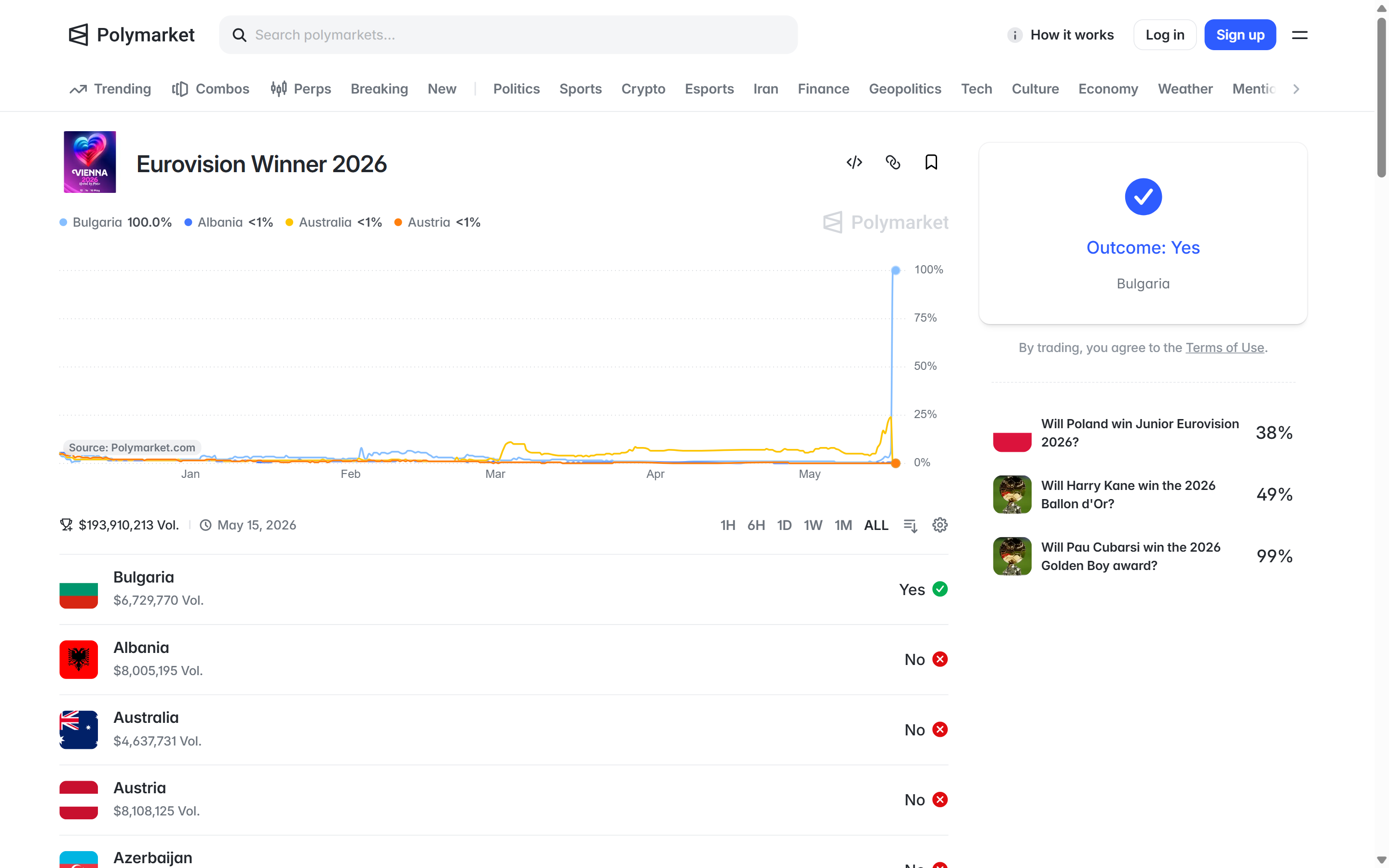
Polymarket’s Eurovision Winner 2026 page groups country outcomes under one event. The completed page displays $193,910,213 in event trading volume and 35 outcomes. Bulgaria is marked Yes; the other country contracts resolved No. A country’s volume is a different measurement from the event total: the Bulgaria contract shows $6,729,770, while Finland’s shows $6,594,936.
These are reported trading-volume figures. They do not measure cash currently available to buy at a quoted price, the number of unique traders, or money paid out to winners. A position can change hands repeatedly. It would therefore be incorrect to describe Finland’s contract volume as dedicated liquidity or to describe the whole event’s turnover as collateral redeemed after the final.
On Kalshi, the event detail page shows $6,986,669, whereas its Eurovision catalog shows $5,452,597 and 35 markets for the 2026 winner event. Both were observed on October 7. The reason for that discrepancy has not been established. We use the explicitly labelled event-page figure in the summary and hero, retain the catalog figure here, and do not call either a reconciled cross-platform total.
Polymarket’s official trading documentation describes a central limit order book with off-chain order matching and on-chain settlement. That matters when interpreting prices: a chart value alone does not tell you the bid–ask spread or how much could actually be traded at that level. Our Polymarket review explains the broader platform context.
2. The pre-final forecast we can substantiate
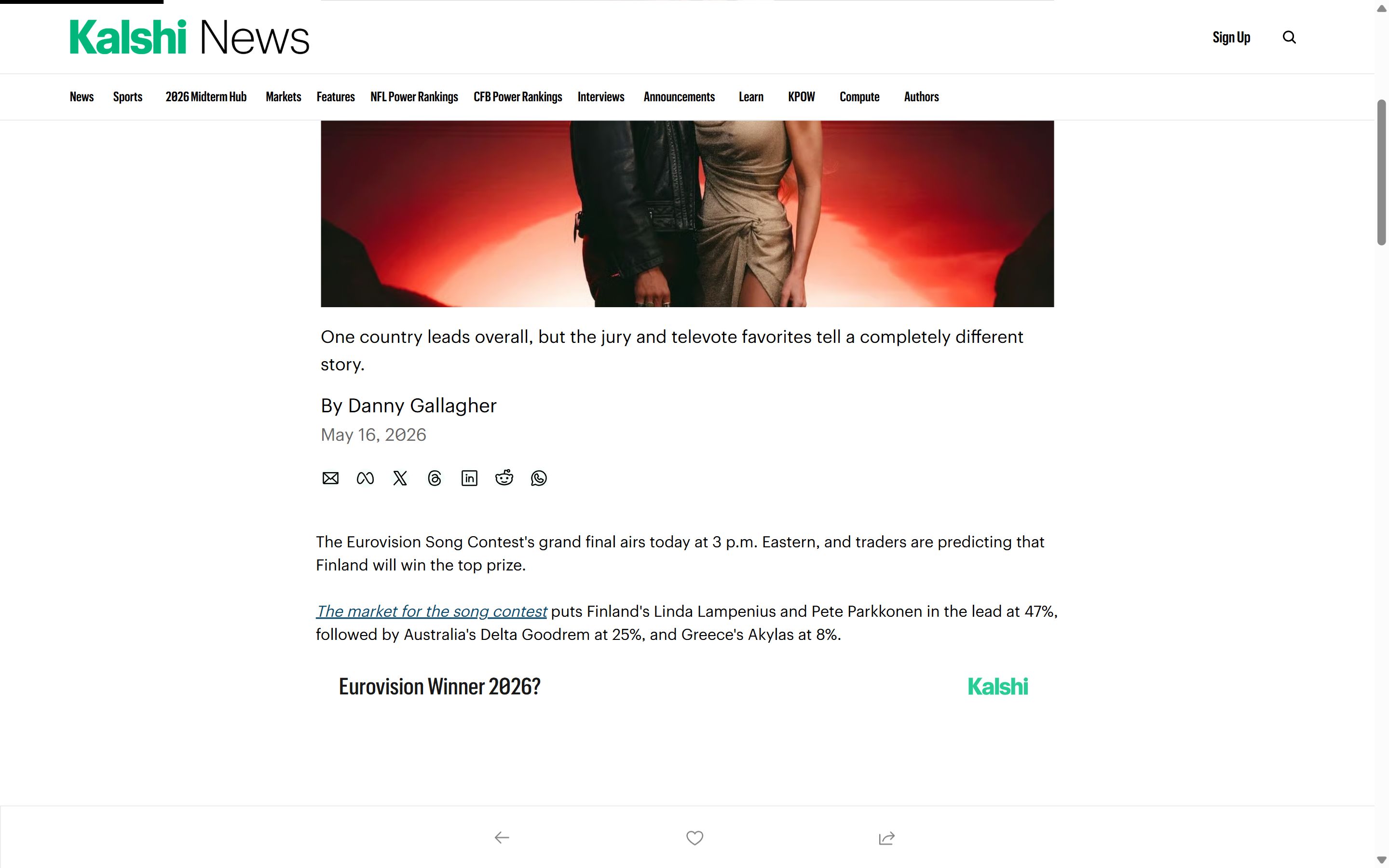
Kalshi News published a dated market summary on May 16, 2026. It put Finland at 47% to win overall, Australia at 25%, and Greece at 8%. In separate contracts, Australia led the jury-winner market at 57% and Israel led the televote-winner market at 54%. Those are snapshots quoted by the exchange’s news publication, not verified intraday highs or prices guaranteed to be executable for a particular trade size.
| Contract | Reported favourite | Snapshot | Actual winner |
|---|---|---|---|
| Overall contest winner | Finland | 47% | Bulgaria |
| Jury-vote winner | Australia | 57% | Bulgaria |
| Public-vote winner | Israel | 54% | Bulgaria |
All three favourites in this snapshot differed from the eventual winner. That is a useful observation about this event, but one outcome cannot establish whether a market is well calibrated across many forecasts. A 47% favourite still has a 53% implied chance of not winning, before considering fees and other reasons that prices may differ from probabilities. “Favourite” never meant “certain.”
The evidence does not establish an exact pre-final Bulgaria price across all three platforms. Accordingly, this analysis makes no claim of an available 0.8¢ entry, a 12,400% realised return, or a verified 0% consensus. Those claims require dated price or trade records beyond a resolved market screenshot.
3. The result: Bulgaria won both votes
The official Eurovision winner report records 204 jury points and 312 public points for Bulgaria, adding to 516. DARA led both sets of votes. Israel was second, 173 points behind; Finland’s 279 points put it sixth, 237 points behind Bulgaria. The table below transcribes selected rows of the official final scoreboard accompanying the report.
| Final rank | Country | Total points |
|---|---|---|
| 1 | Bulgaria | 516 |
| 2 | Israel | 343 |
| 3 | Romania | 296 |
| 4 | Australia | 287 |
| 5 | Italy | 281 |
| 6 | Finland | 279 |
| 11 | France | 158 |
| 20 | Sweden | 51 |
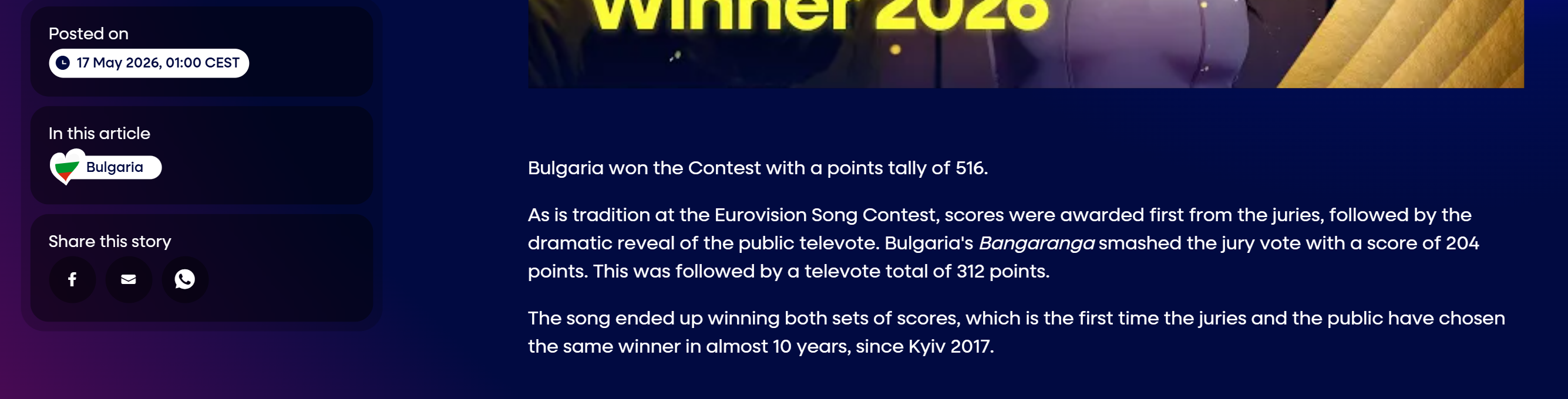
The contrast is between the cited market forecasts and the eventual voting results. It does not demonstrate a jury-versus-public split in the choice of winner. Nor does it identify what caused traders to miss the outcome: attributing the result to specific algorithms, rehearsal signals, demographic models, or coordinated voting would require separate evidence.
For a trader comparing these contracts, the questions are distinct: who wins overall, who wins the jury vote, and who wins the public vote? A lead in one forecast does not automatically make a country the best-priced choice in another contract. Read the exact outcome definition before comparing their probabilities.
4. What the final chart can—and cannot—show
Kalshi’s completed event page displays Bulgaria at 100% and Finland and Israel at 0%, alongside the final Yes/No outcomes. Its ALL chart provides a broad view from January through May. This is useful evidence of the displayed historical trajectory and final state.
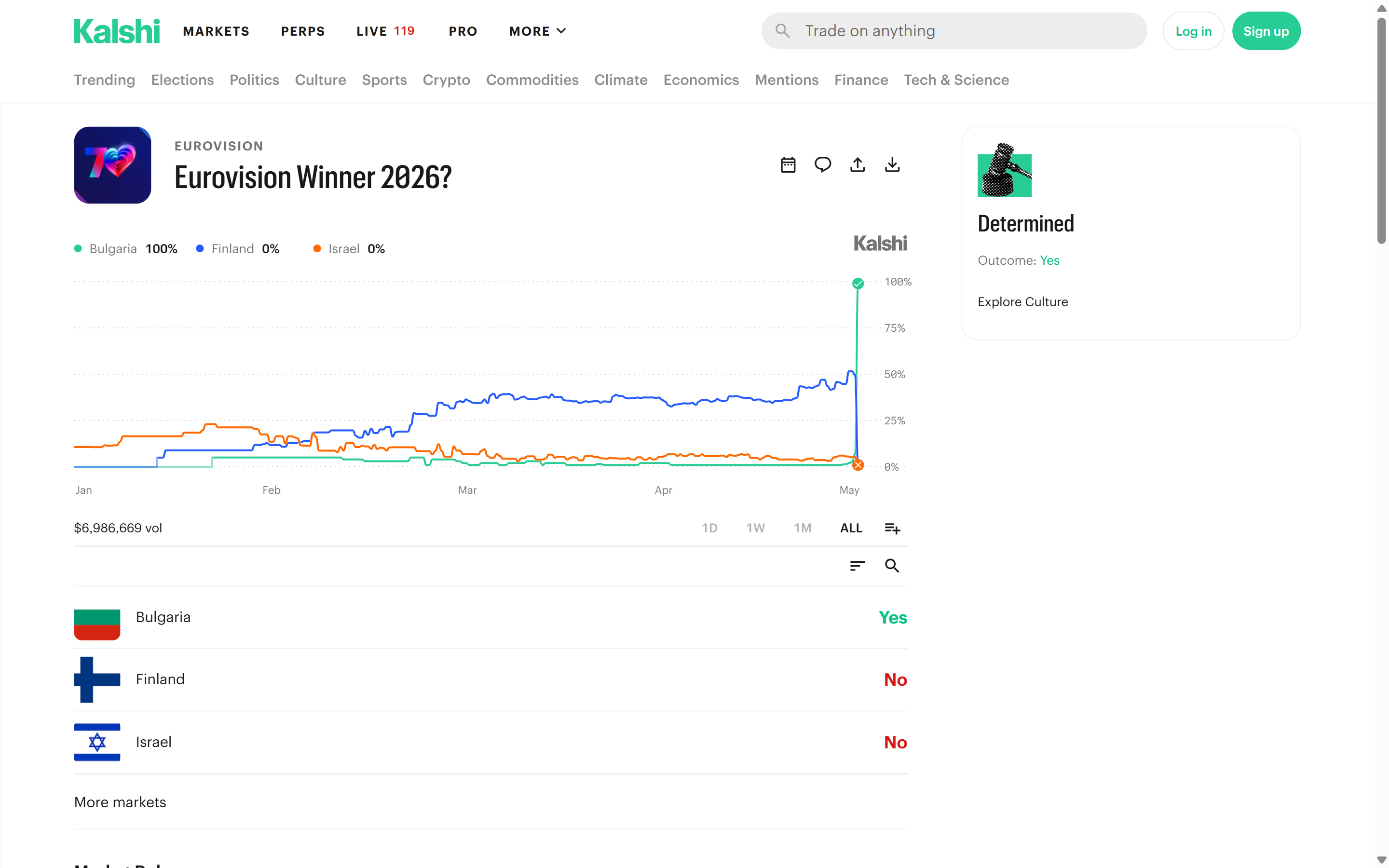
The chart’s scale does not establish a minute-by-minute sequence during the broadcast. It cannot substantiate claims that a price changed at 23:42, that an executable Finland bid fell from 34¢, or that Bulgaria traded at 98¢ seconds later. We have removed the earlier precise in-play timeline because it lacked timestamped supporting records.
Before drawing a trading conclusion from a sharp chart move, retain the timestamp, time zone, selected contract, bid and ask, and available size. An attractive line on a chart is not a fill record. Our guide to reading probability movements provides the surrounding framework.
5. Resolution rules and the evidence of settlement
Polymarket’s event rules specify the winning country, allow an eliminated candidate to resolve No early, and provide an Other outcome if no winner is announced by July 31, 2026 at 11:59 PM ET. They use official Eurovision information, including live footage, while also permitting a consensus of credible reporting. Ties follow Eurovision’s official rules.
The selected Bulgaria contract’s resolution panel visibly records a Yes proposal, “No dispute,” and a final Yes outcome. This supports reporting the platform’s displayed resolution sequence. The resolver address is not a transaction hash, and this screenshot is not an independent blockchain audit or a record of when every holder redeemed.
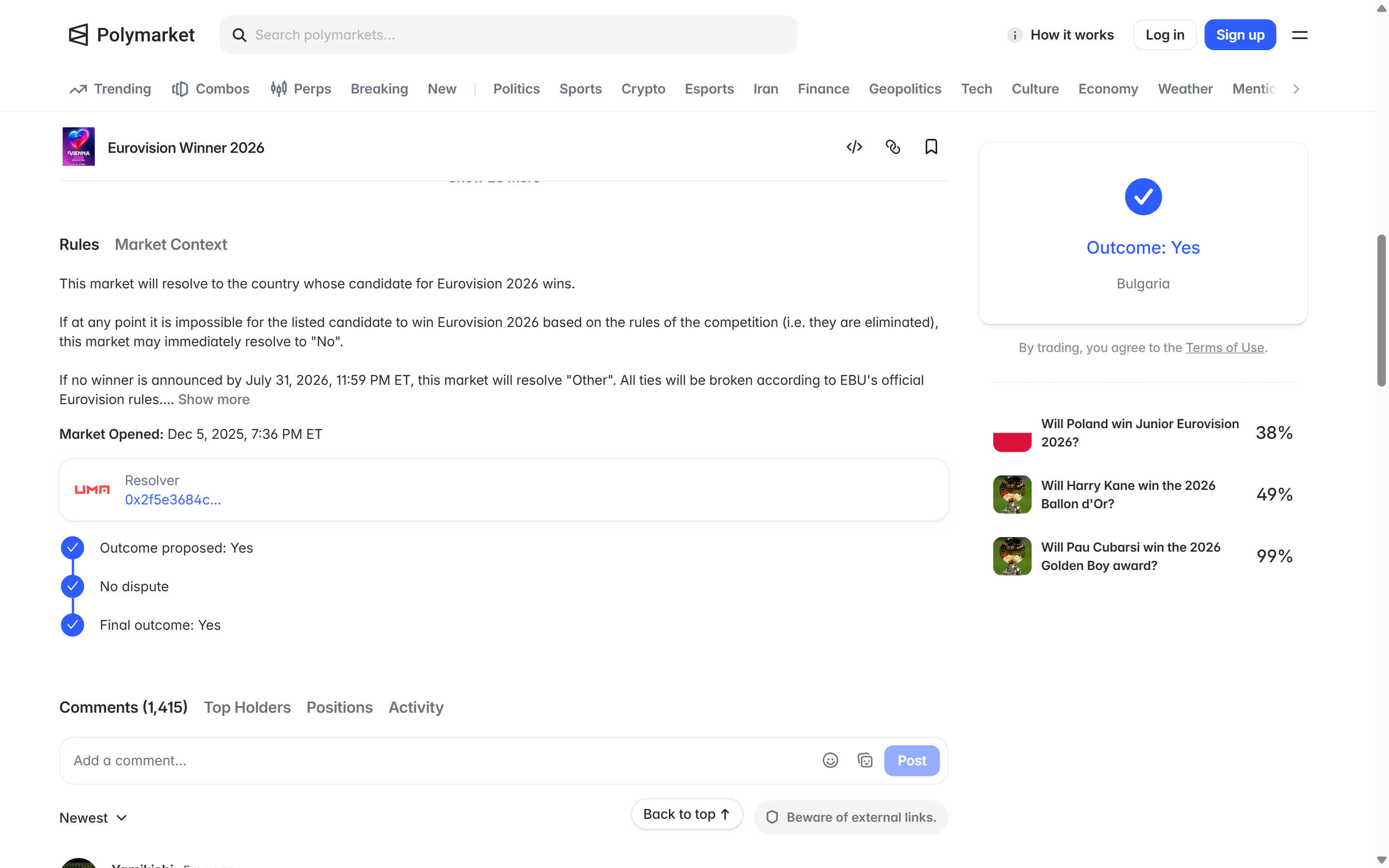
For general context, Polymarket’s resolution documentation describes the UMA optimistic-oracle process and its challenge window. A general process description does not establish the exact proposal, challenge, or redemption times for this event. We do not infer those times from the final Yes badge.
Kalshi’s event page identifies Bulgaria as the outcome and names BBC and The New York Times in its rules summary. The linked full EUROVISION contract terms list the EBU, BBC, SBS Australia, The New York Times and Associated Press as source agencies. The terms use the initially announced winner and specify how later revisions are treated. Describing settlement as dependent solely on an EBU certificate would omit that source framework.
The Kalshi interface displays “30 minutes after closing” under its payout timeline. That is the wording visible on the event page, not evidence of an independently checked clock time for each account credit. The public records reviewed here do not establish the earlier article’s precise compliance and payment timestamps. See our market resolution guide for the distinction between an outcome, a resolution decision and receipt of funds.
6. Manifold and the limits of the “0%” story
The Manifold market now displays Bulgaria as resolved at 100%, with a struck-through 99.7% beside it. This is a play-money community market; its Mana activity should not be presented as dollar turnover or added to cash-market volume.
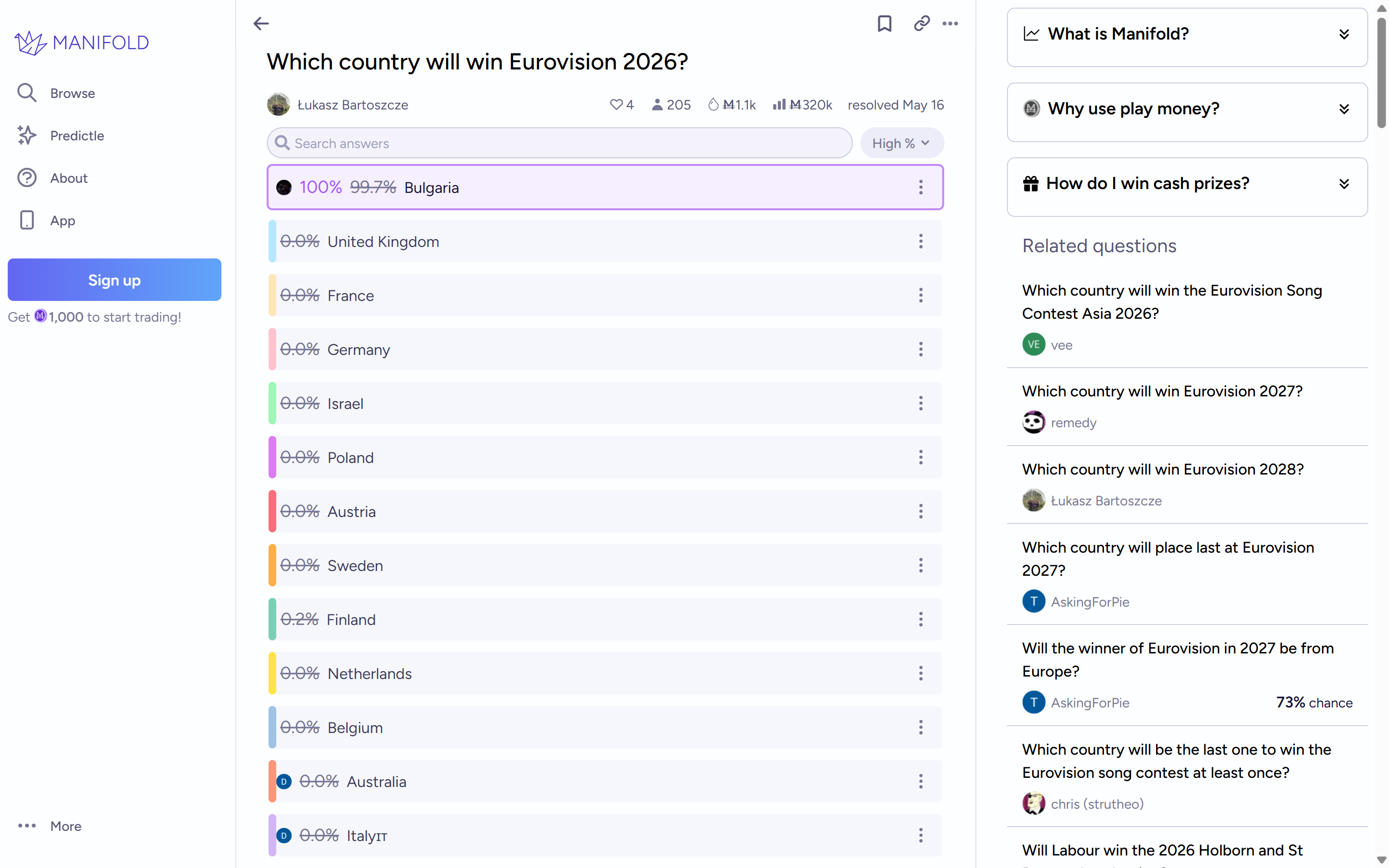
A user comment on the page says Bulgaria had traded at 0% two days earlier. That is evidence of a participant’s retrospective statement, not a verified timestamped probability history. The resolved screenshot above does not show that alleged earlier state. We therefore do not use the comment to support a “0% Black Swan” headline, an exact 48-hour claim, or an explanation about why the platform rounded a probability.
Different counters also describe different things. The page header shows 205 beside a person icon, while a lower tab says 203 Holders and another says 13k Trades. Those labels must be retained if quoted: 205 is not interchangeable with 203 Holders, and a rounded 13k is not an exact trade count. None of these current counters establishes how many people held positions before the final.
7. How to use this case in a trading review
- Save the forecast before the result. Record the source, date, contract and price type. A dated report supports a snapshot; a resolved page supports a final state.
- Compare like-for-like outcomes. Overall winner, jury winner and public-vote winner are separate contracts. Their probabilities should not be treated as the same forecast.
- Keep turnover separate from execution quality. For an entry or exit, inspect the order book and costs. Event volume alone cannot establish the size available at a displayed price.
- Read the resolution terms before committing capital. Check the named sources, deadlines, tie provisions and treatment of revisions. Retain the applicable terms with the trade record.
- Evaluate forecasts across a sample. A surprising winner can reveal a research question. It does not, on its own, prove a systematic market defect or a repeatable profitable strategy.
For this event, the strongest supported comparison is straightforward: the dated Kalshi report favoured Finland overall, Australia for the jury vote and Israel for the public vote; Bulgaria ultimately won all three. A defensible post-mortem starts there and leaves unsupported entry prices, broadcast timestamps and payment claims out.
Frequently asked questions
Was Finland’s 47% an all-time high?
No such conclusion follows from the evidence used here. It is the figure in Kalshi News’s May 16 report. Establishing a maximum requires the full relevant price history and a defined time interval.
Did the public vote overturn the jury winner?
No. Bulgaria led both votes: 204 points from juries and 312 from the public. The earlier version’s explanation of a different jury favourite being overtaken was incorrect.
Can the platform volumes be added together?
Only with compatible units, definitions and observation periods, and with the result labelled as summed reported turnover. Such a sum is not unique capital or unique participants. Mana cannot be added to dollars; the unresolved difference between Kalshi’s catalog and detail page is another reason not to present a single combined total here.
How are ties handled?
The official contest rules give priority first to the higher audience-vote ranking in a combined-score tie. Further tie criteria apply if needed. The number of countries awarding points is not the first test ahead of the audience result. Market settlement must also follow the applicable contract terms.
Do the screenshots prove exact payout times?
No. They establish visible rules and final states. Polymarket’s panel says No dispute for the selected Bulgaria outcome; it does not provide a verified redemption timestamp for all users. Kalshi’s displayed payout interval likewise is not a ledger of individual account credits.
Author: Machiawelli. Evidence review and correction prepared with Codex; final review October 8, 2026. Sources and capture dates are identified beside the relevant evidence. Decorative hero artwork is not a photograph of a trading screen.